
Richmond Tire Fire

[Richmond Tire Fire]
From the long, sleepy corridor of Belvidere,
I look out and see a grey-black basilisk
roiling into the sky, traversing its sooty form
from west to east, an ever-rejuvenating bulk.
The light is shrouded around me.
Few eyes follow the adder’s path.
I pull over, throw on my bag
and grip a bottle of water.
Drivers on Leigh appear not to notice
anything more than their automated maps
broadcasting from phones clasped by claw-like fingers.
They pass in gleaming cars with expressions confused —
as curious about my attention as I am of their lack.
(Are they blind?)
More and more, people trod toward the Leviathan’s origin —
entranced — its mouth affixed to a turquoise building,
tongue flashing so fast it looks like one
continuous mess of flickering, airborne lava.
Men in caps run about its maw
seen only as silhouettes dragging
along a lengthy canvas worm
(their best defense).
We sit on a graffiti-adorned retaining wall.
Highway travelers slow but only one has stopped.
(Some must go. Some must watch.)
We make eye and verbal contact.
We capture the scene with mobile device and mind.
They snake deflates.
The crowd peaceful near the barking
backyard dog who scolds our stupidity.
We are the dumbest creatures on the planet.
We trickle and fade and forget
after a mere moment’s passing.
The hazard lights glow against adjacent buildings
in the distance, a veritable rainbow shown in the cast
of man-directed water to combat the mistakes
made by man-directed madness
of cinderblock and rubber turned to cinder and fume.
Ashes to ashes. Dust to dust. Dusk to dusk.
We pace about at breakneck speeds,
only to sputter, dim, and die again —
taking all the naysayers along with us.
Ad astra per alas porci.
The viper puffs into an hombre cloud.
A single beam of light takes shape in its fog,
roving in sanguine supervision but seeing nothing.
[02/18/2020]

At the Crossroads of Fundamentalism and Humanism:
Recalling Bernie Sanders's Visit to Liberty University
Recalling Bernie Sanders's Visit to Liberty University

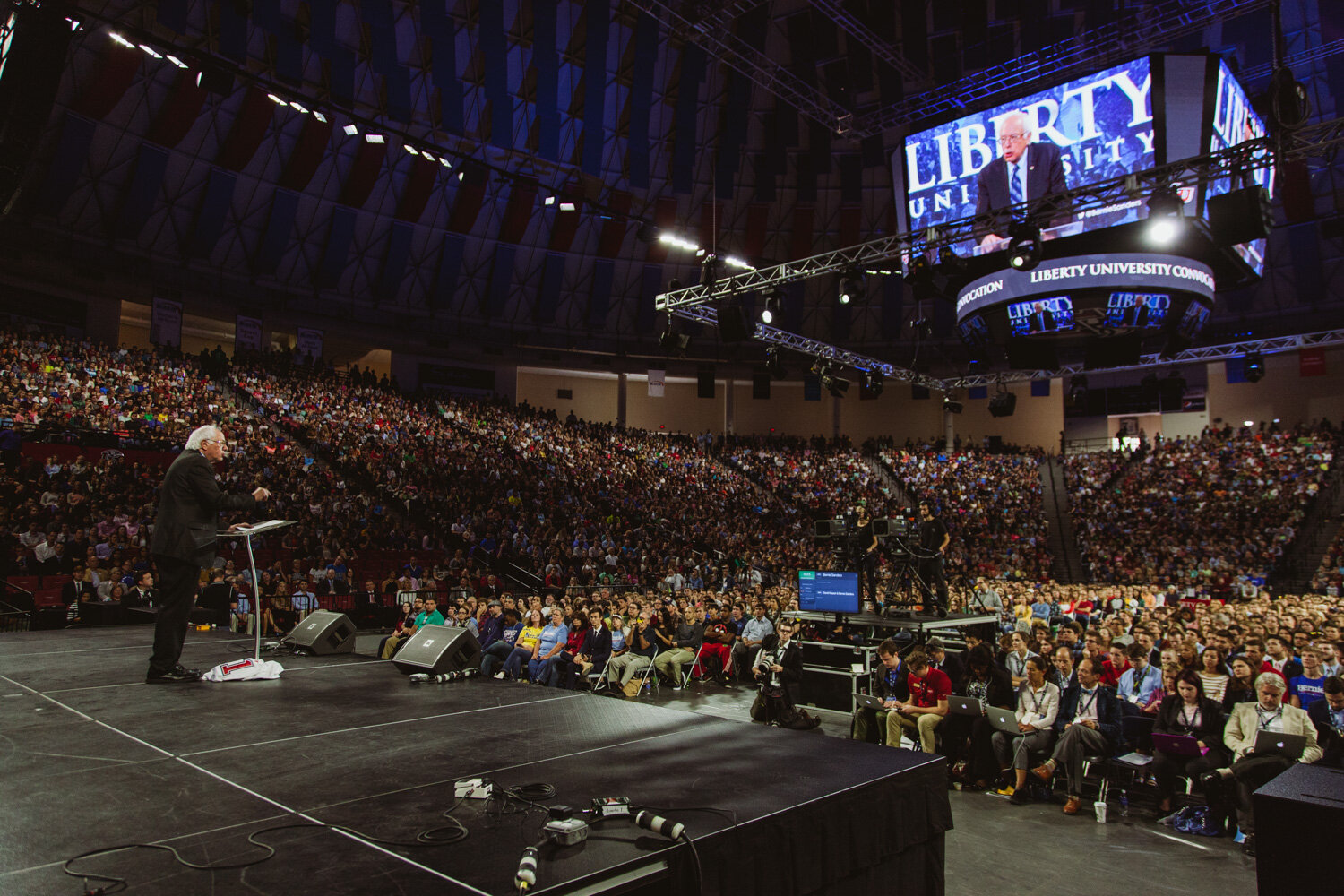
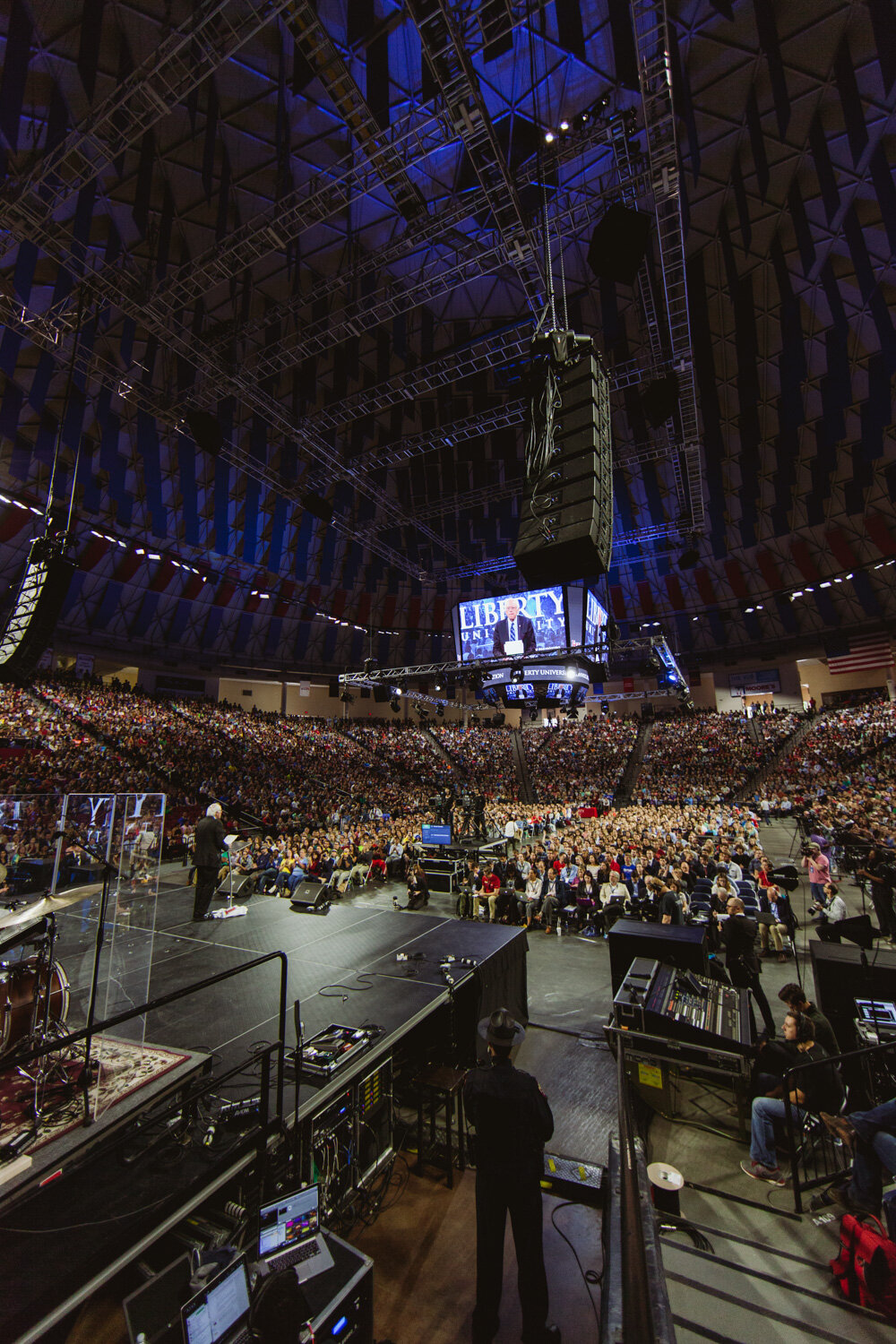
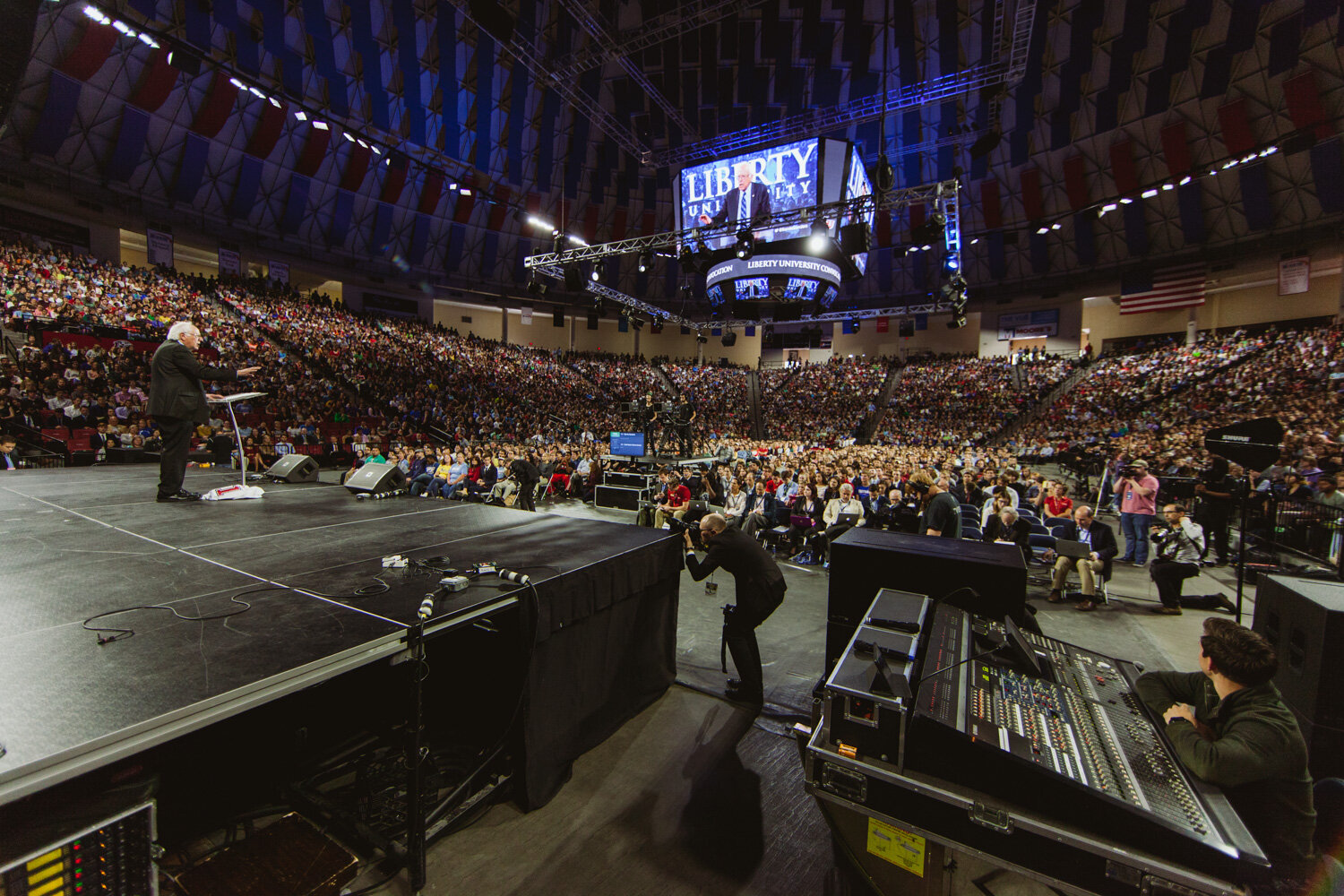
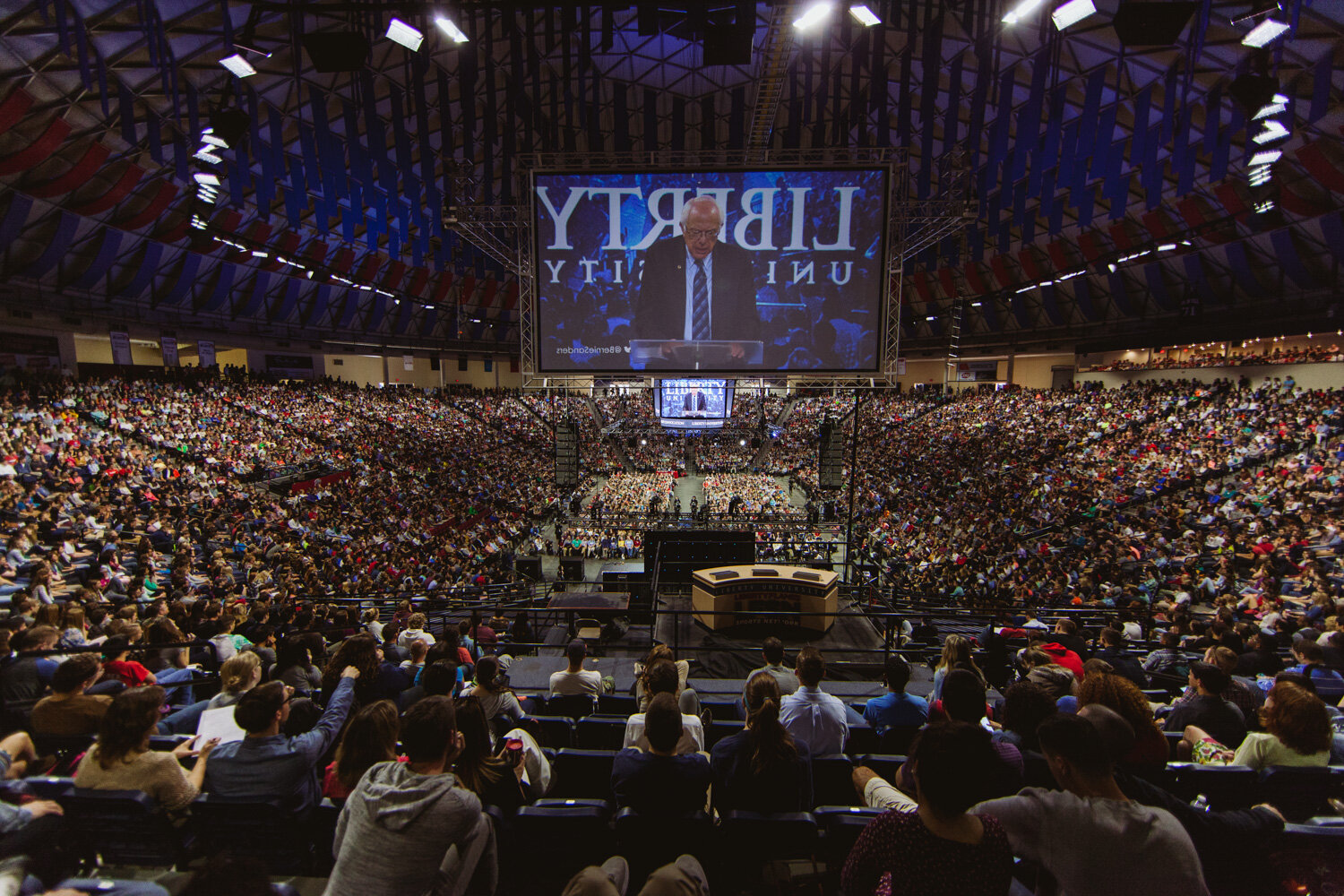
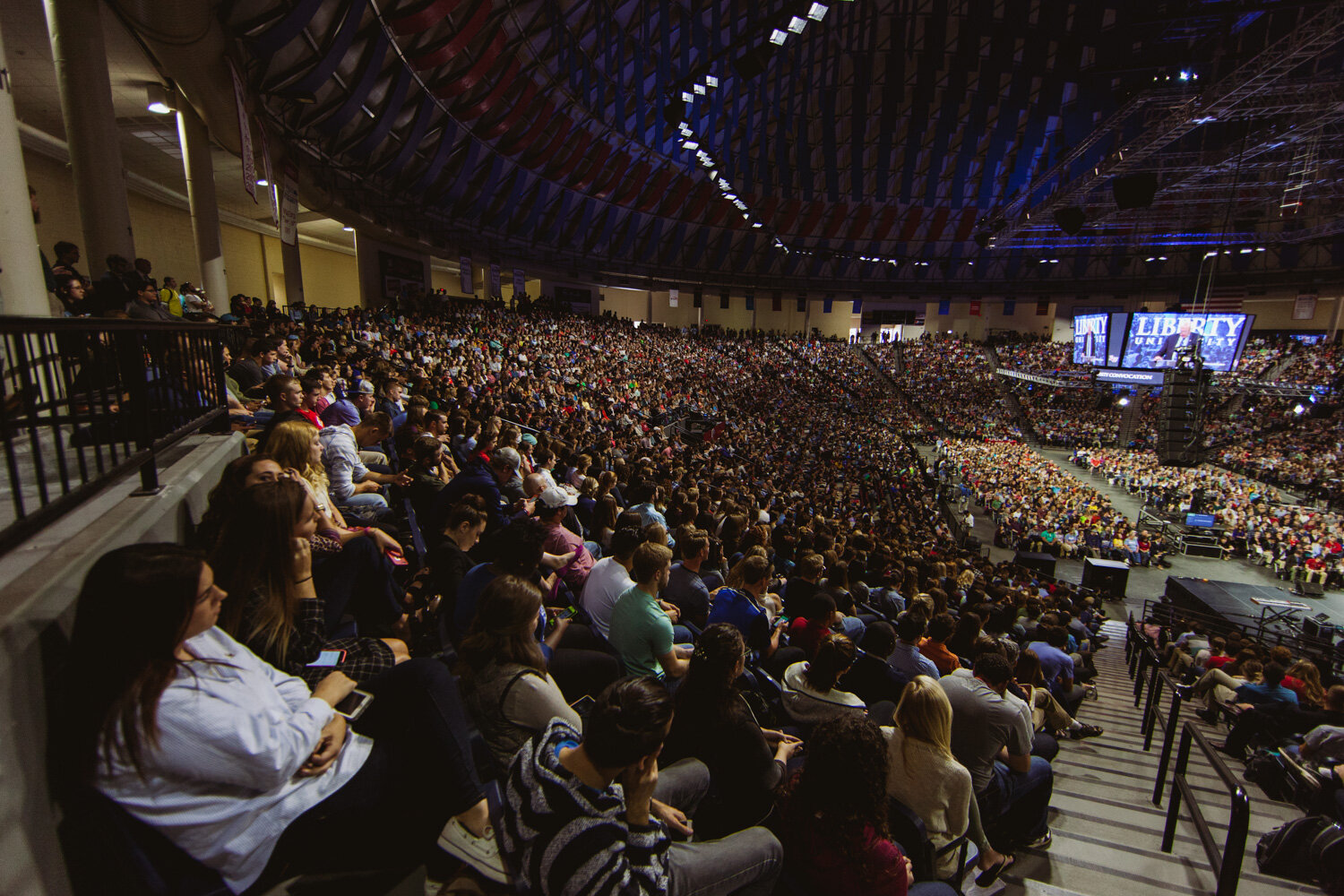
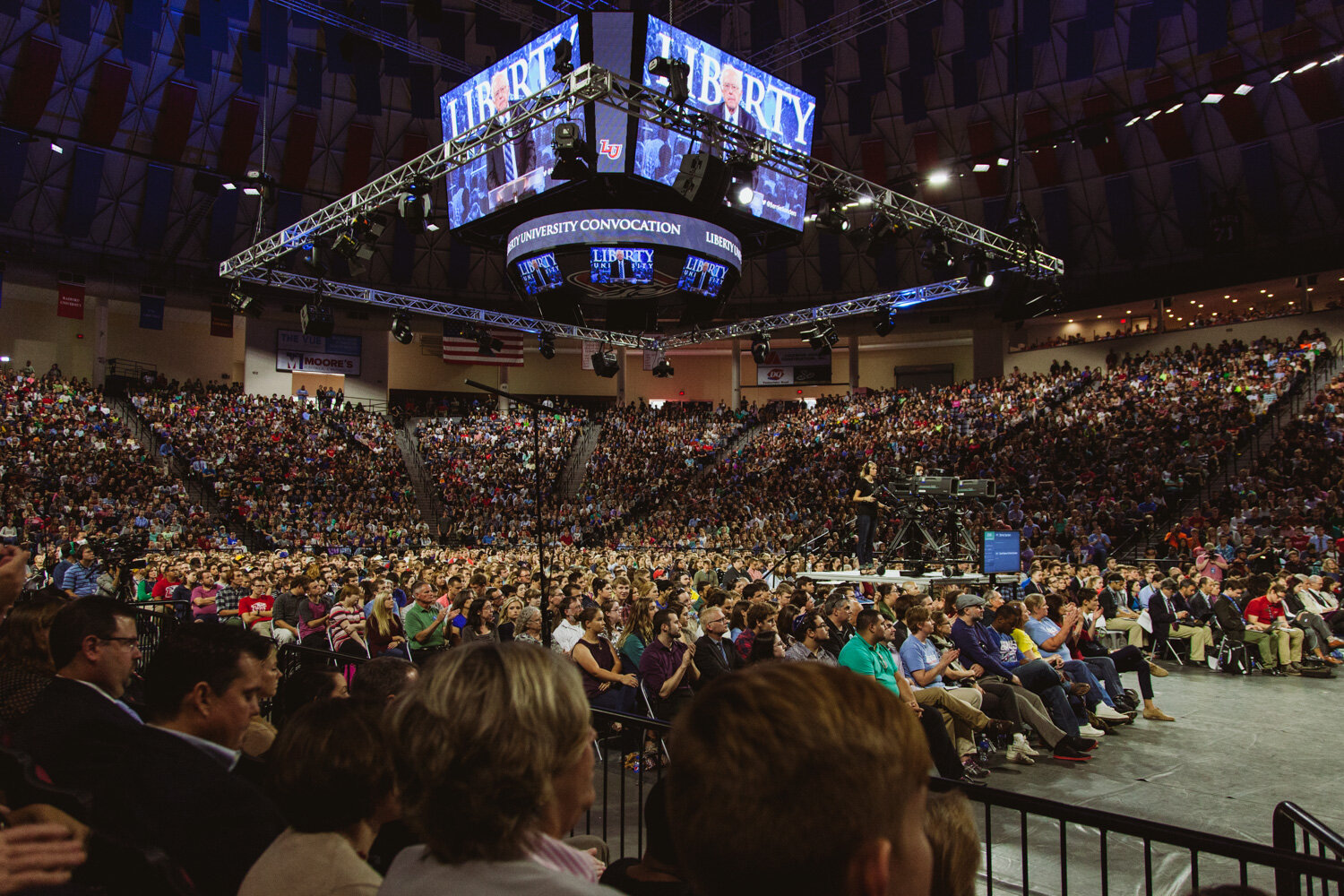
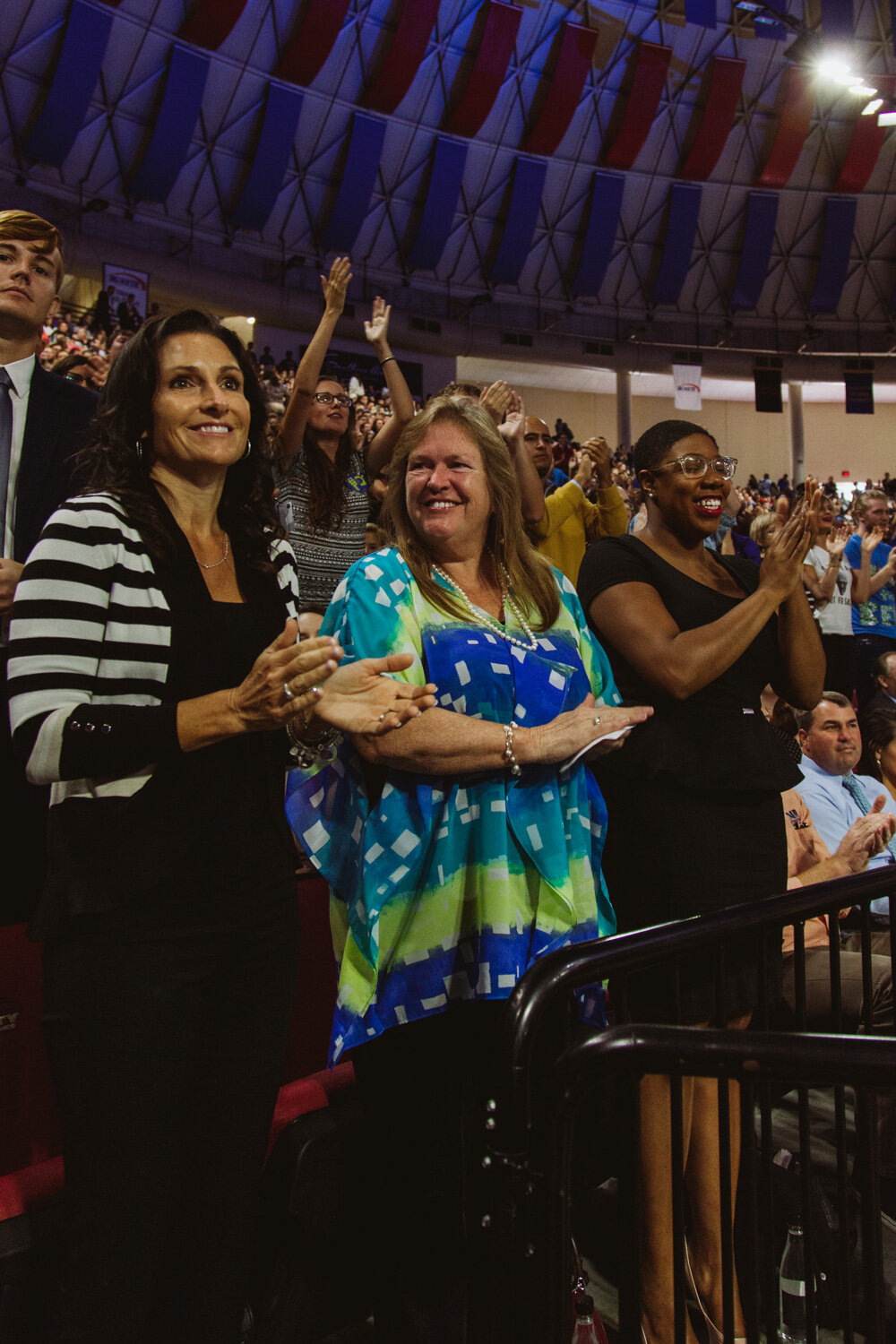
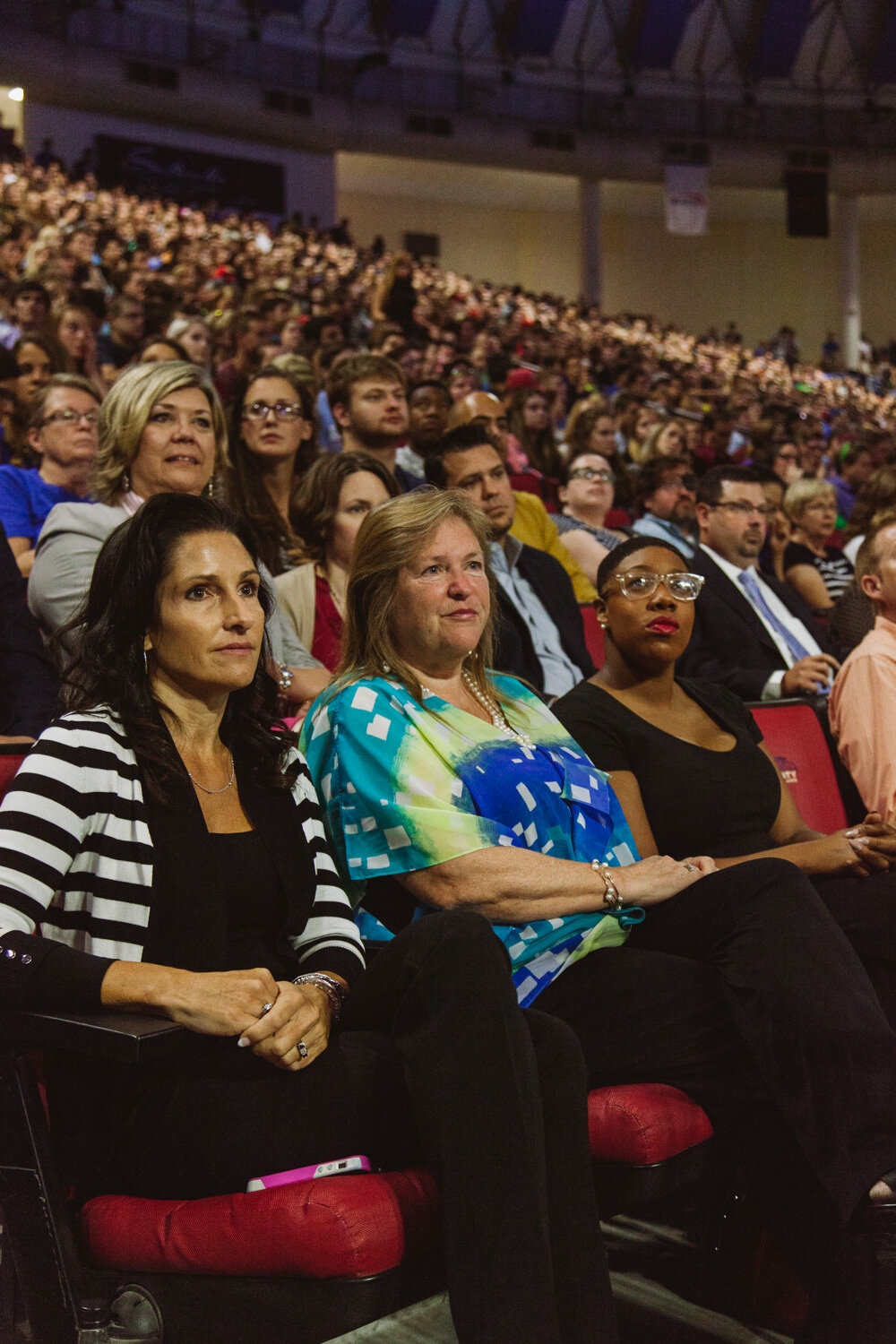
Liberty University students, among others, enter The Vines Center in Lynchburg, Virginia, on September 14, 2015 to hear US Senator Bernie Sanders speak.
“It may be that the human race is not ready for freedom.
The air of Liberty may be too rarefied for us to breathe.”Steven Pressfield, The War of Art

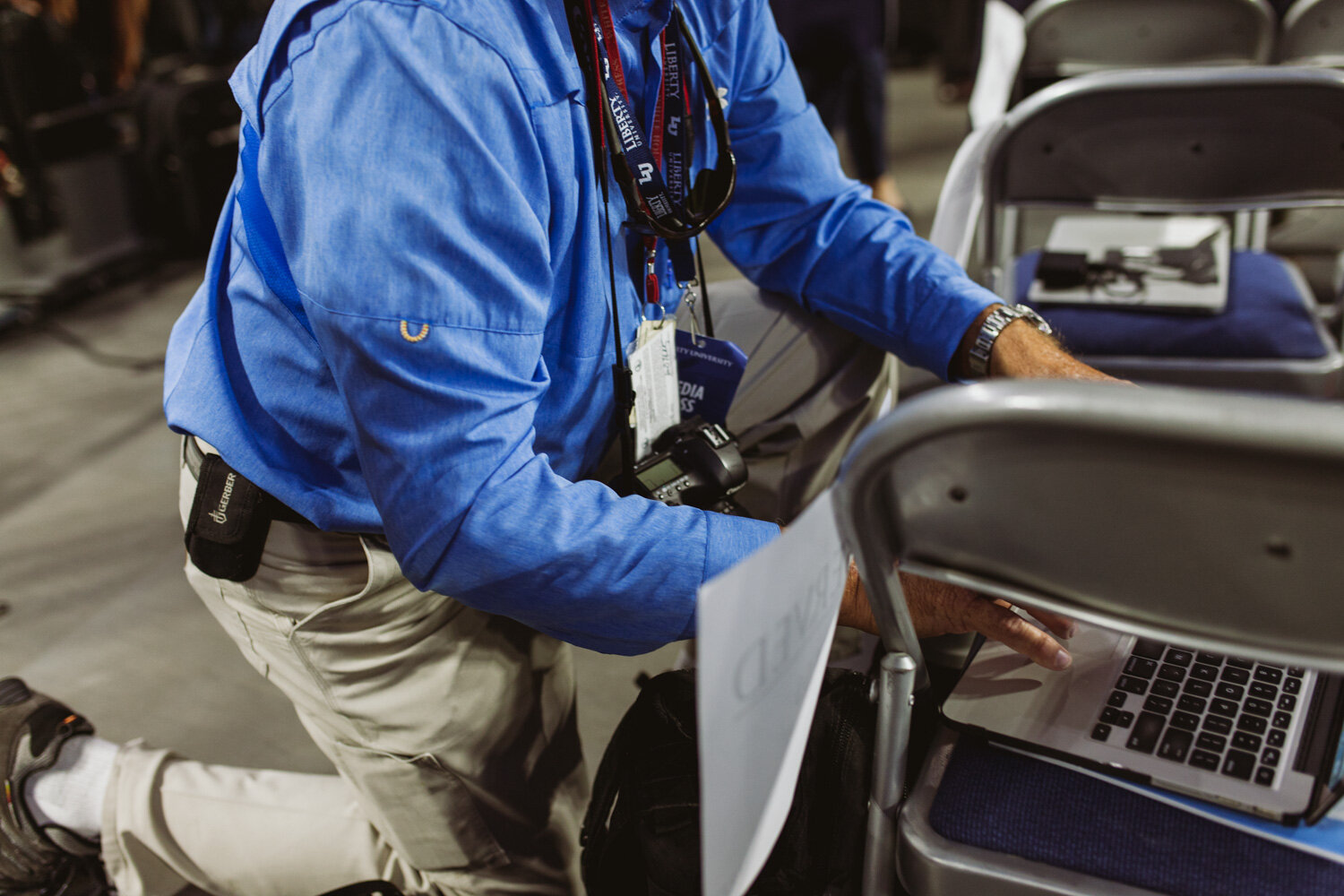
A news reporter gets ready to speak into the camera with the swelling in the background.

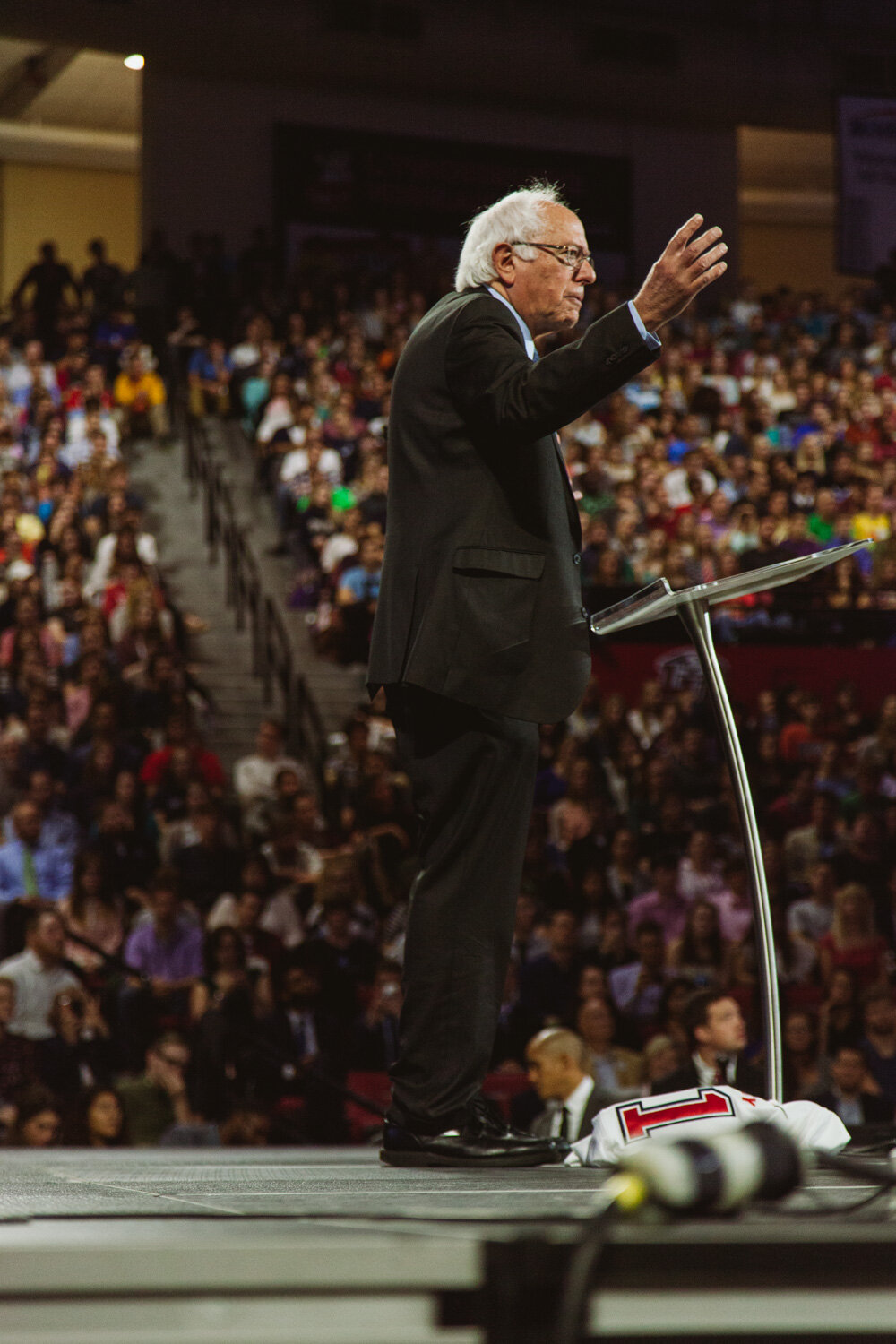
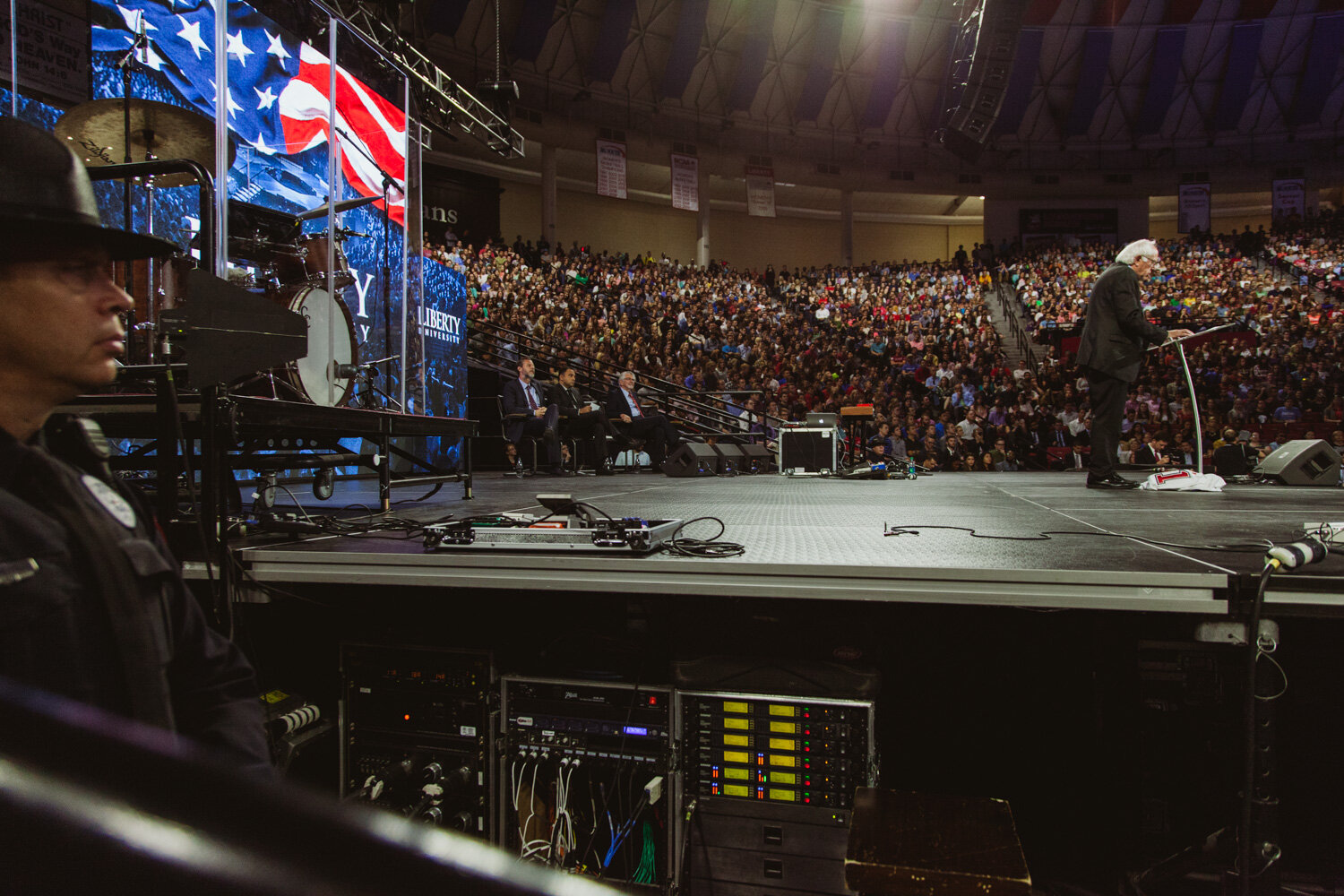
The scene at Liberty University on September 14, 2015, was a familiar one, as was the creeping feeling of overwhelming inauthenticity, likely stemming from the fact that 10 years ago I sat in those same seats three times per week attending what the university ardently claims is not a worship service, listening to people preach and sing about God. Every so often a political speaker would come through, but one could (so to speak) lower the volume on what was being said and not miss a thing. It was always the same.
That same feeling persisted while I worked as a copywriter and editor for the school’s propaganda department in 2010. It only alleviated itself once I finally left the position (and my seat in my graduate English classes 18 months later), and stepped away from 25 years of living within the Evangelical Christian community.
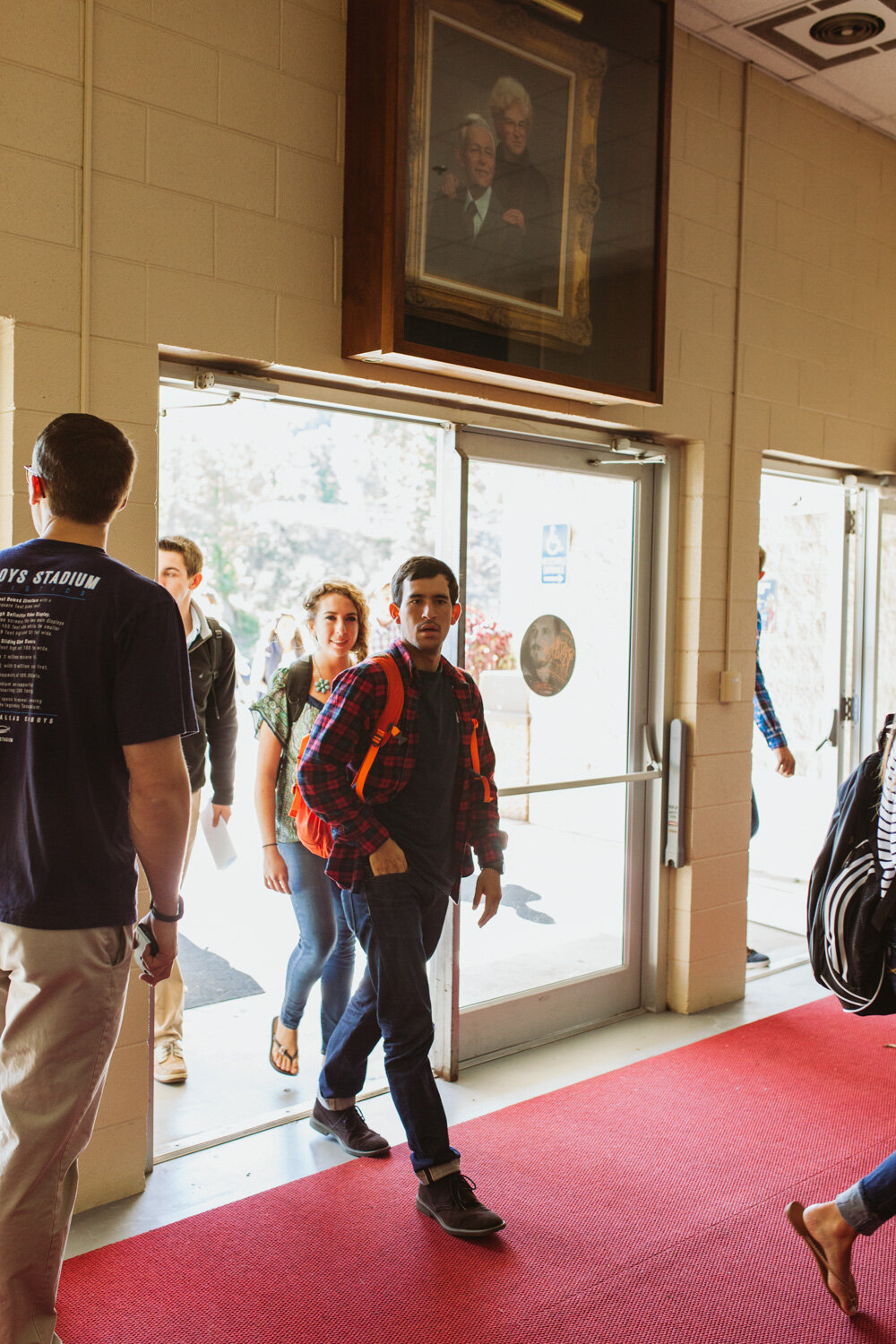
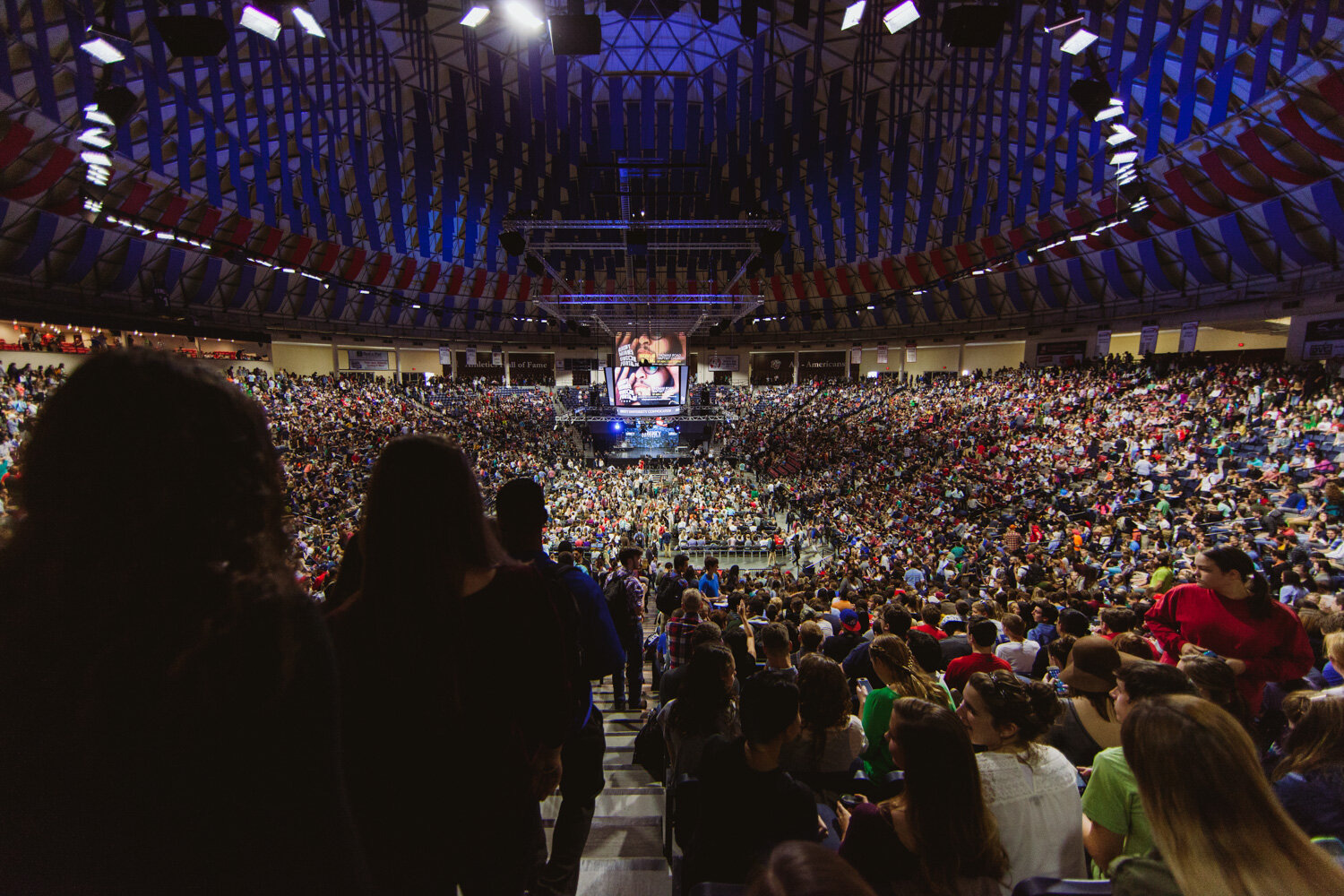
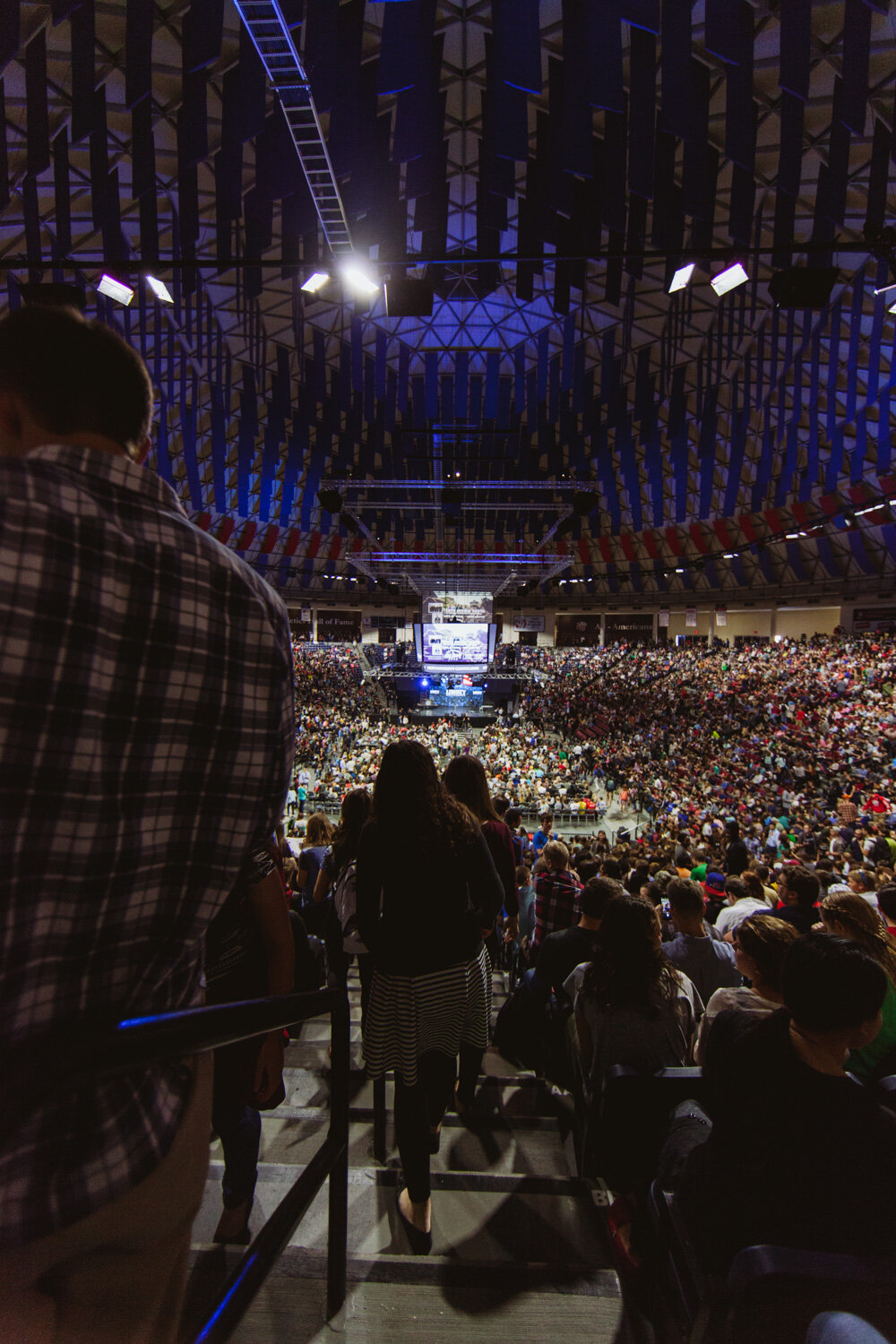
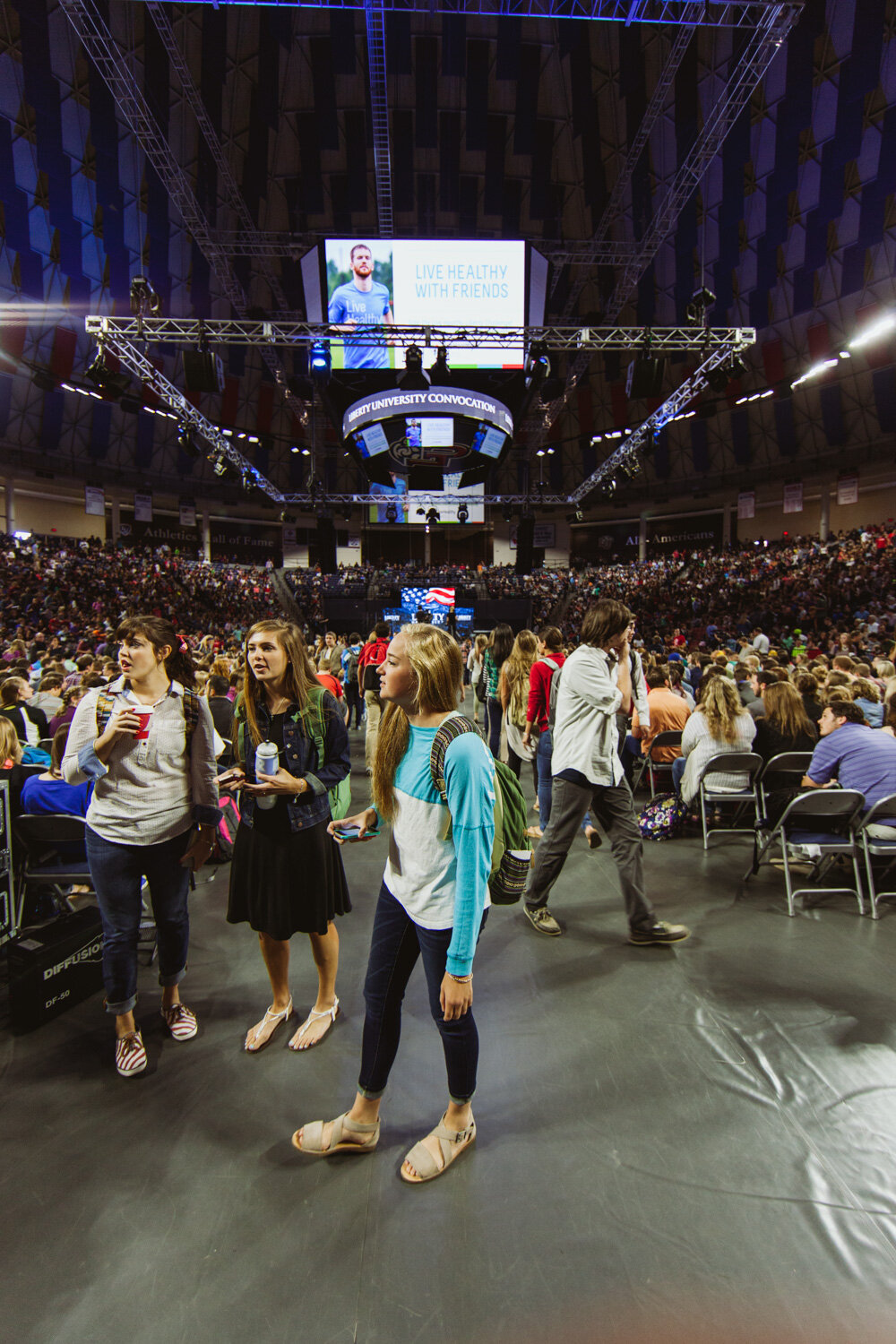
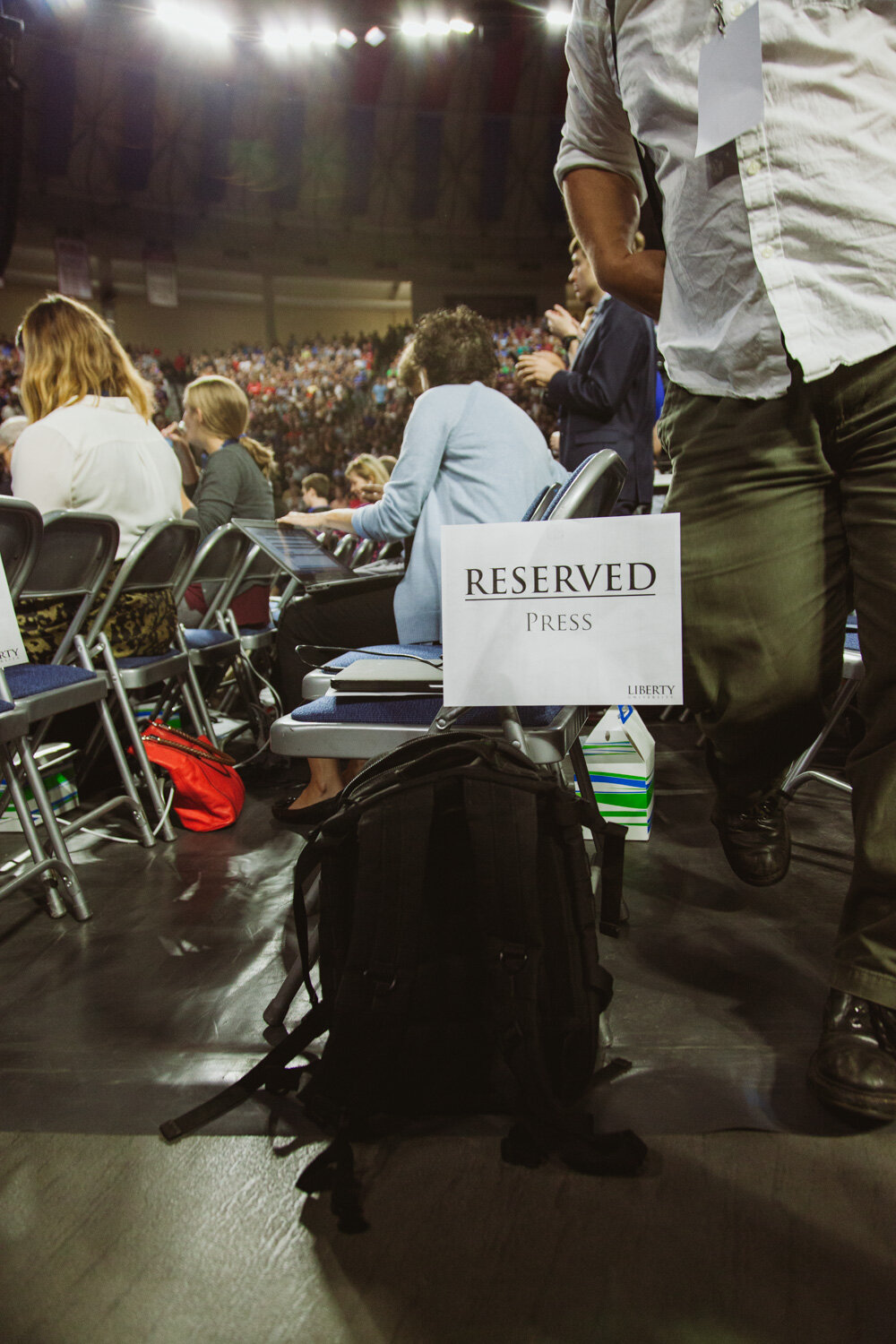
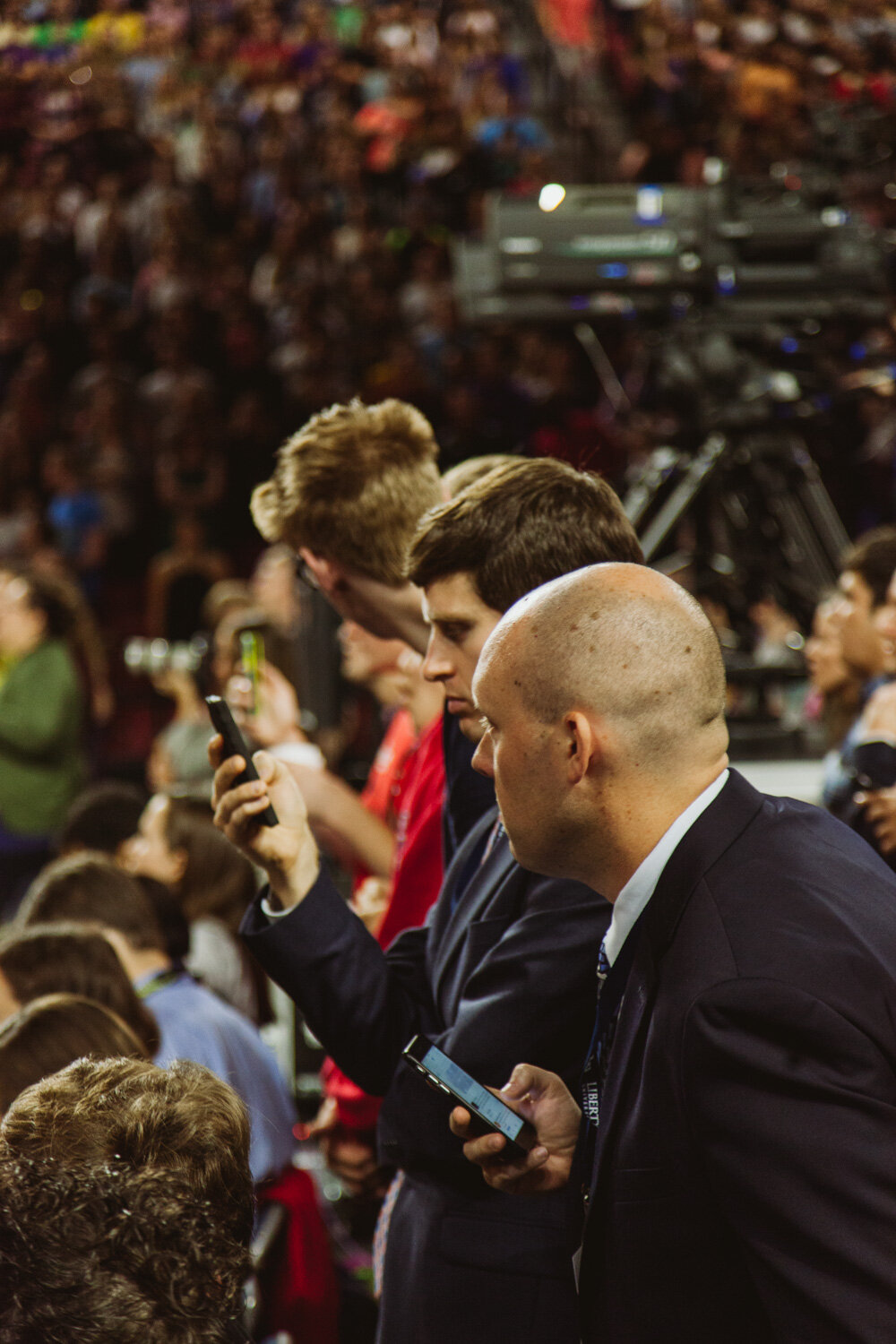
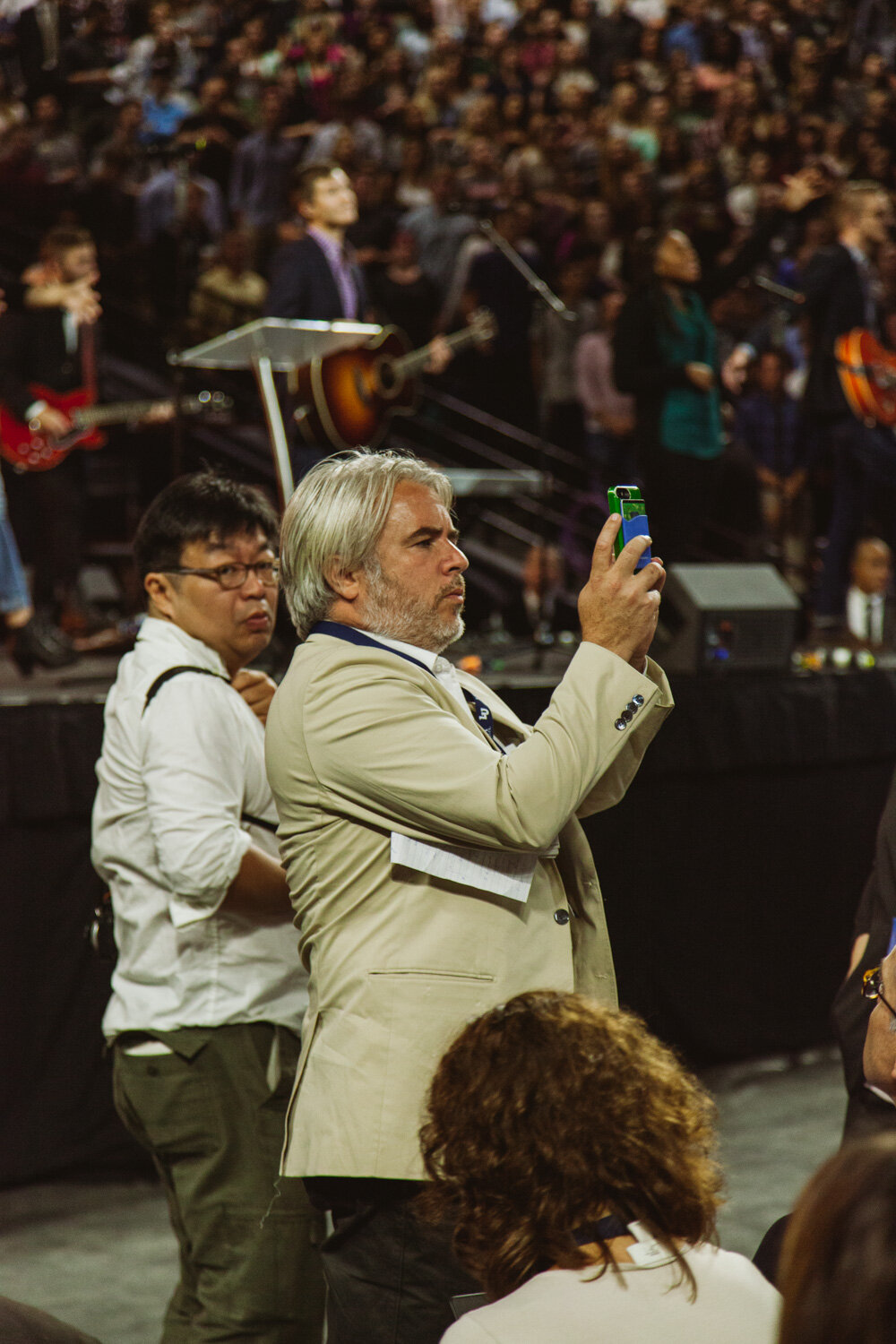
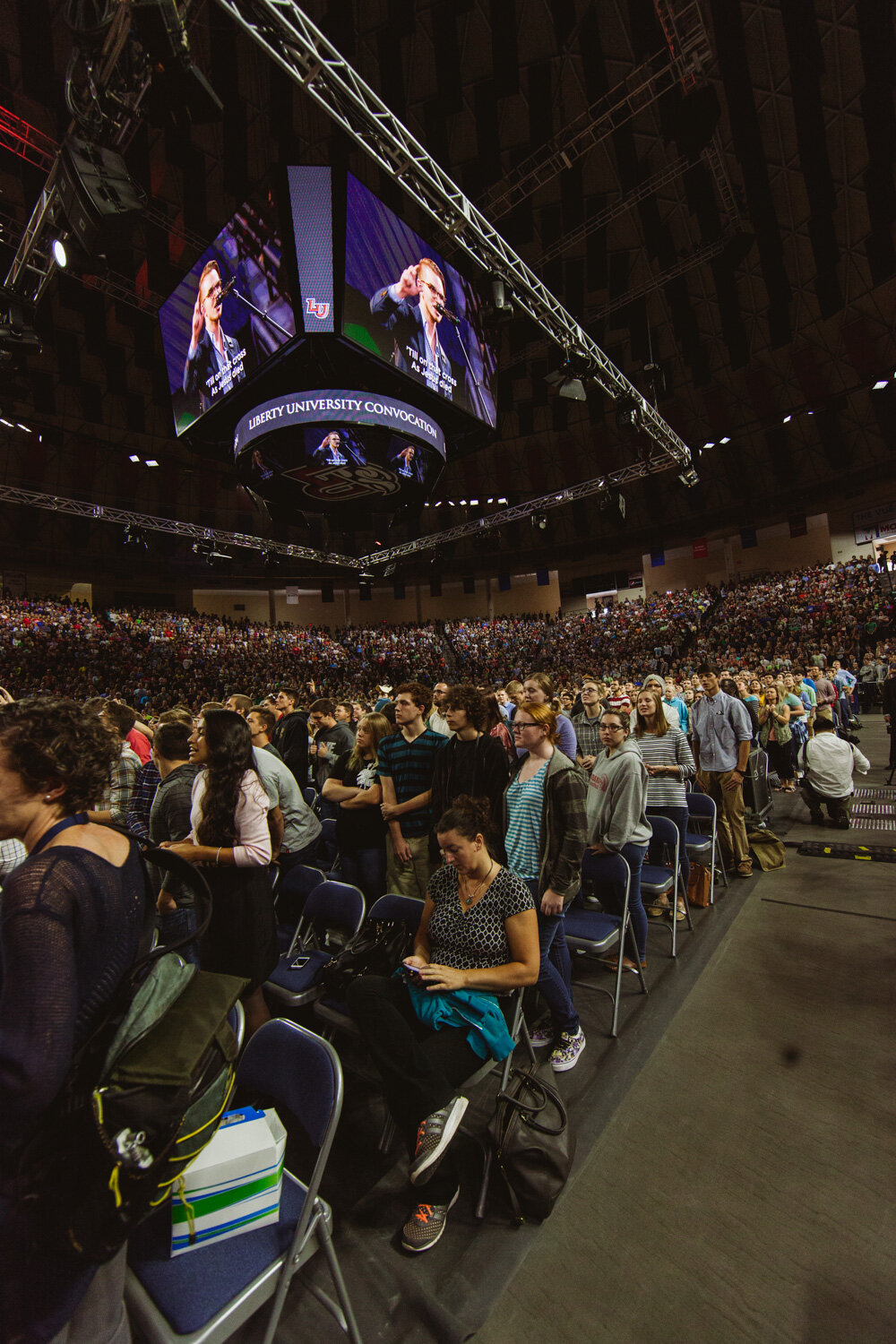
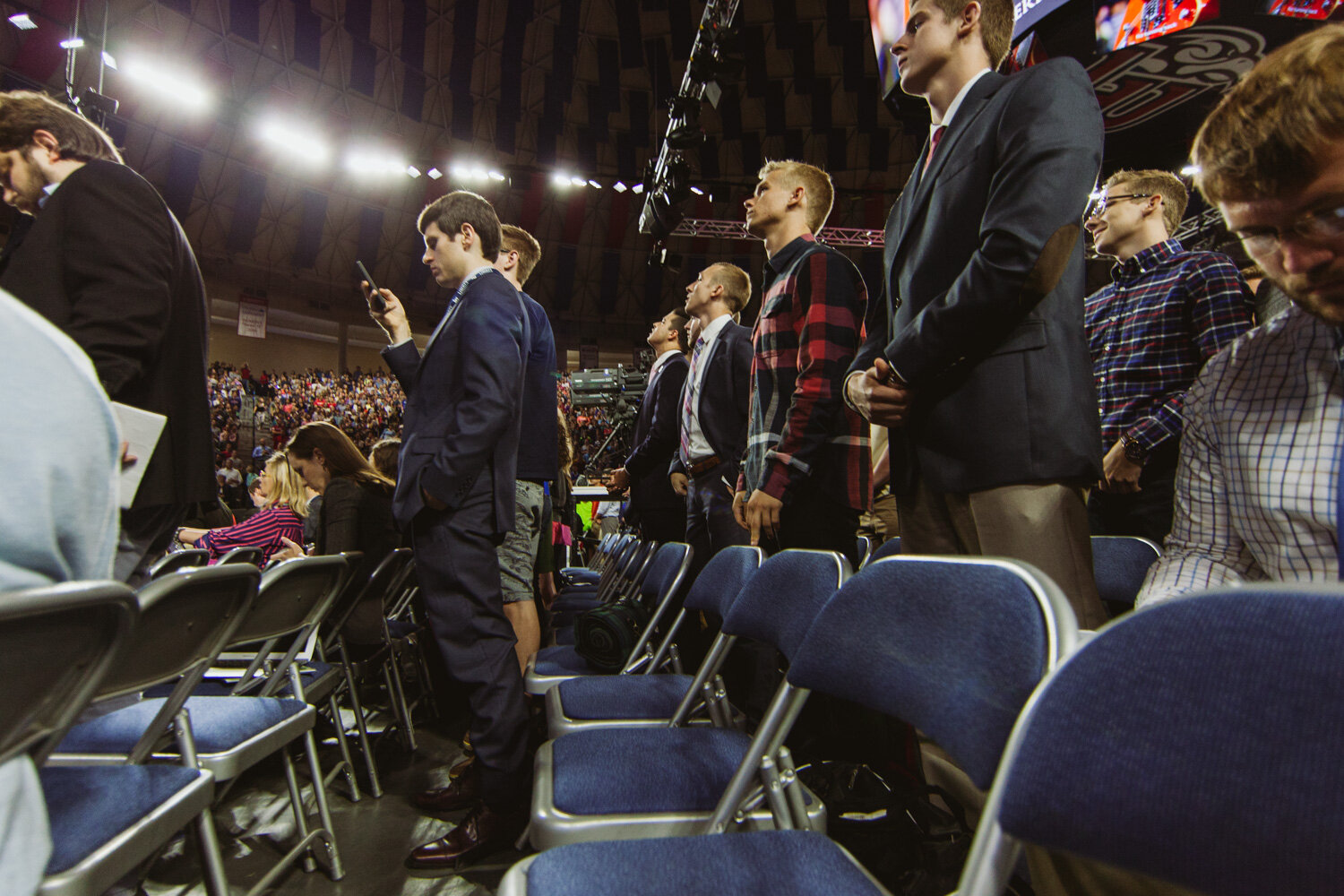
On this particular morning, I let the feeling pass over me while Liberty University Senior Vice President for Spiritual Development David Nasser prayed into the microphone, to be heard by millions:
“I pray that today, Father, that you would teach us, God, that you would use our guest today to help us know not just what to think but how to think.”
Before the guest, Vermont Senator Bernie Sanders, could rise to the podium, Nasser delivered an enthusiastic update on how a student in financial need was given $7,000 in excess of what was required for her to stay in school. She in turn decided to give the surplus to other students in need.
Another report: Students, thousands more than were expected, showed interest in a new outreach campaign to the point that the website kept crashing.
“It is by far the largest single response we’ve had like that as a student body,” Nasser said, “and I think it just goes to show that nobody is a greater servant than a Liberty University student.” It was the first of two wildly hyperbolic sentiments Nasser would utter — well aligned with my overall LU experience.

As if to serve as a reminder to those in attendance and viewing around the world of the particular socio-intellectual climate they were entering into, the praise band performed “This I Believe (The Creed).” Rather than an artful expression of worship of an all-powerful, all-encompassing deity, the song is a listing of the basic tenets of Christianity set to the emotionally saccharine soundscapes usually found during the tender moments of a summer romance flick — built by major and minor chords carefully tied to the heartstrings they're intend to pull.

Liberty University praise band performs “This I Believe (The Creed).”
Following the incantation, Nasser returned to the microphone to introduce Liberty University President Jerry Falwell, son of Liberty’s founder, the late Jerry Falwell Sr. — a man infamous for blending political consciousness with evangelical conservatism (among other controversies).
“Nobody loves you more, Liberty students, than our president,” Nasser said of the extant Falwell. “No one cares about you, wants the best for you and wants to see you be world-class leaders more than our president.”
Nasser said that students reciprocate that love, and as an illustration explained that the guttural bellow of “JE-RRYYYY” the students would initiate upon his approach to the podium, was a sign of a support, rather than a cacophonous jeer.
This cheerleading rigamarole, the endless qualifying and over-stressing of statements is identical to the form and feel that I experienced as a student and employee. It always seemed intended to ensure that the perception of Liberty, its students, and its administrators is not left up to chance.
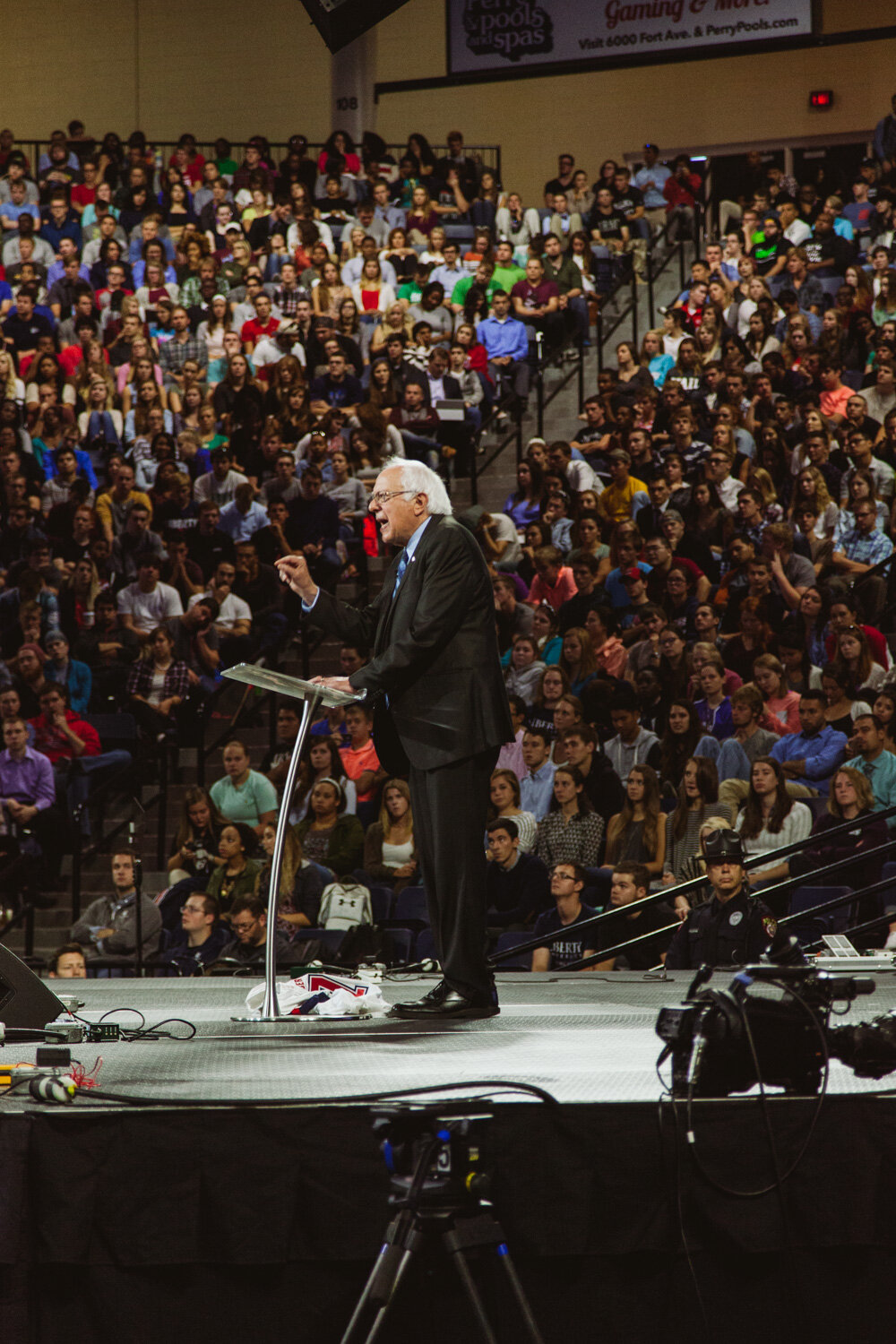
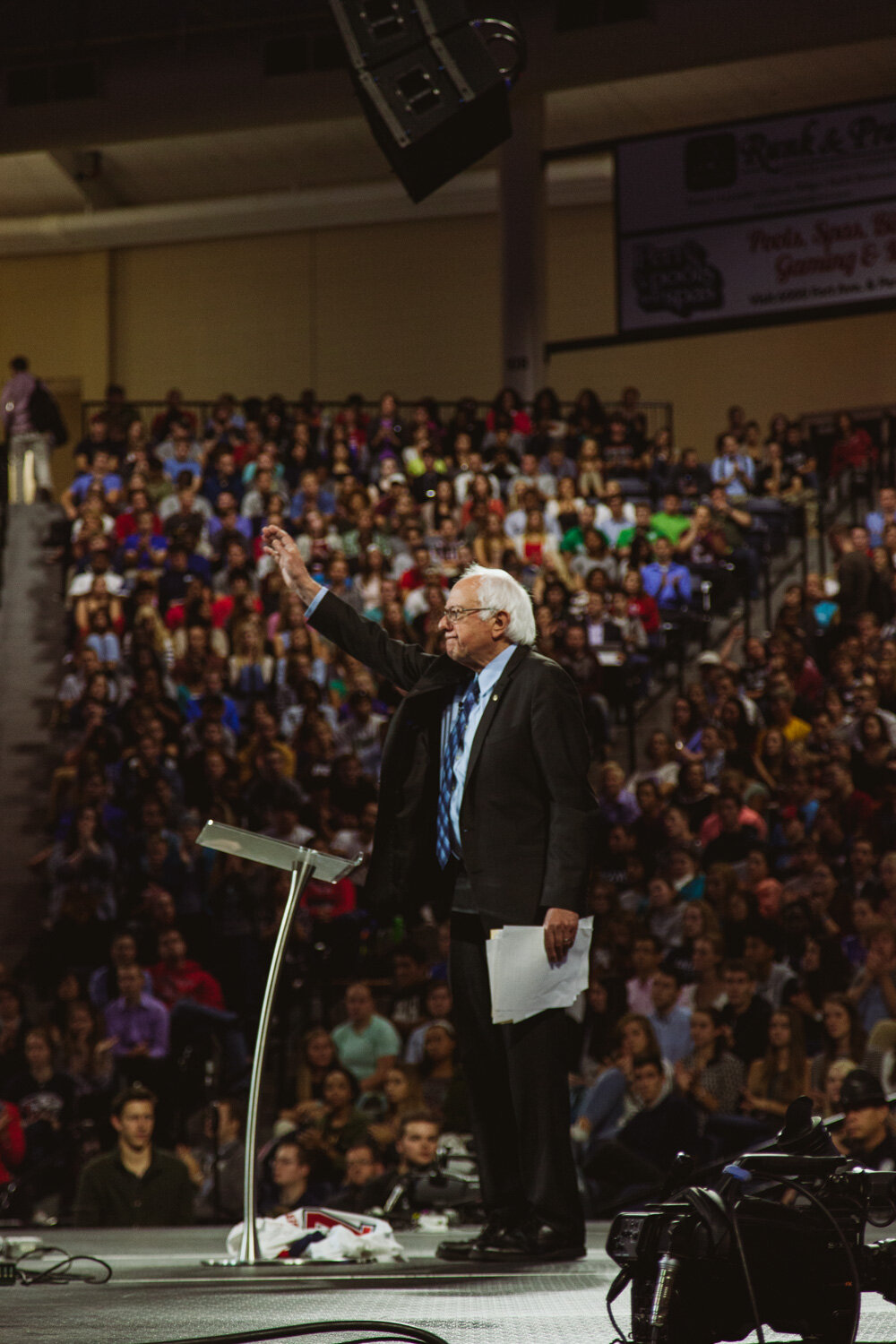
Even Falwell’s gifting of a personalized football jersey to Sanders felt nearly ritualistic; I have witnessed many guest speakers receive memorabilia or honorary degrees over the years and it carried the feeling for me of Liberty trying to “mark” someone for the university’s own edification.
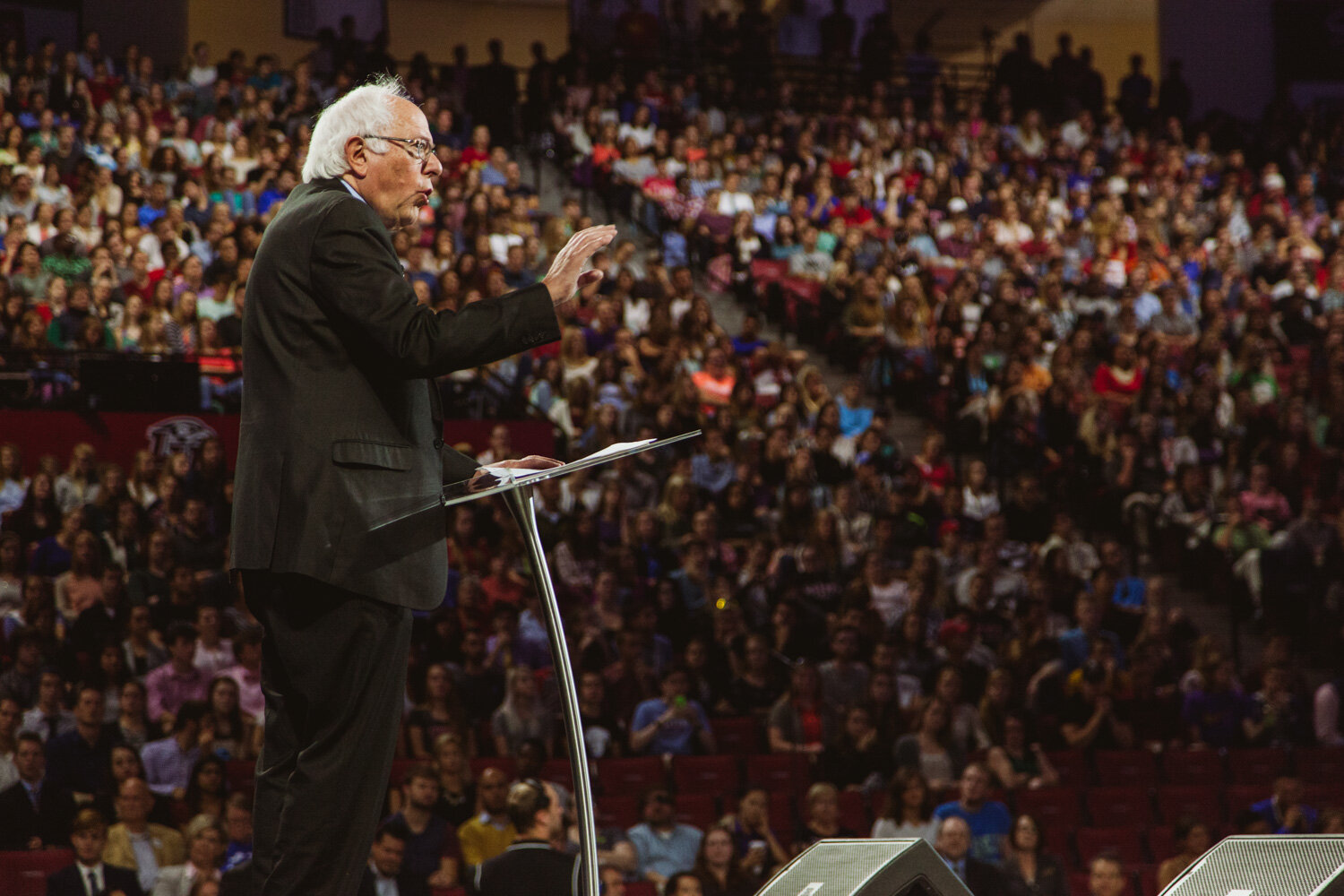
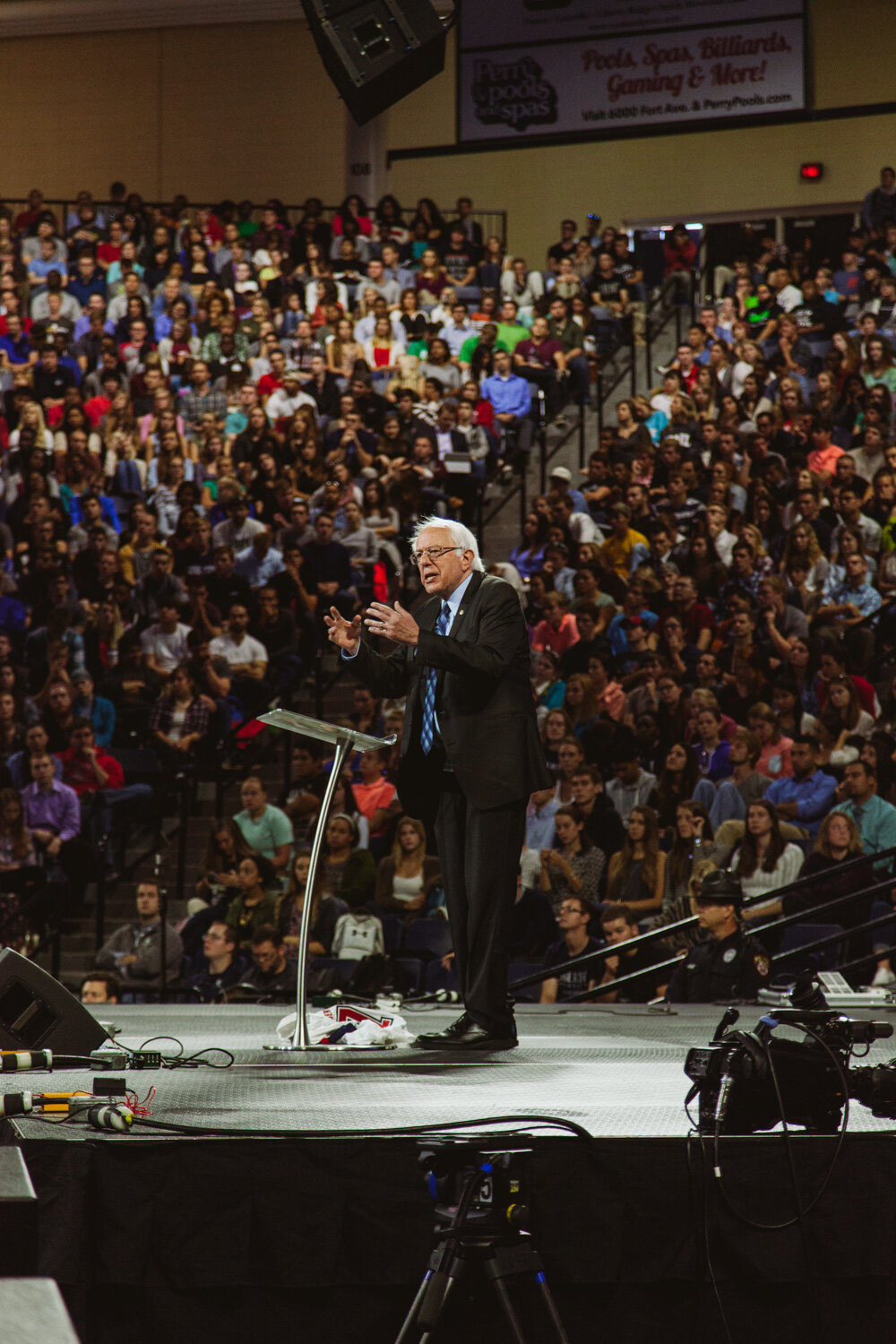
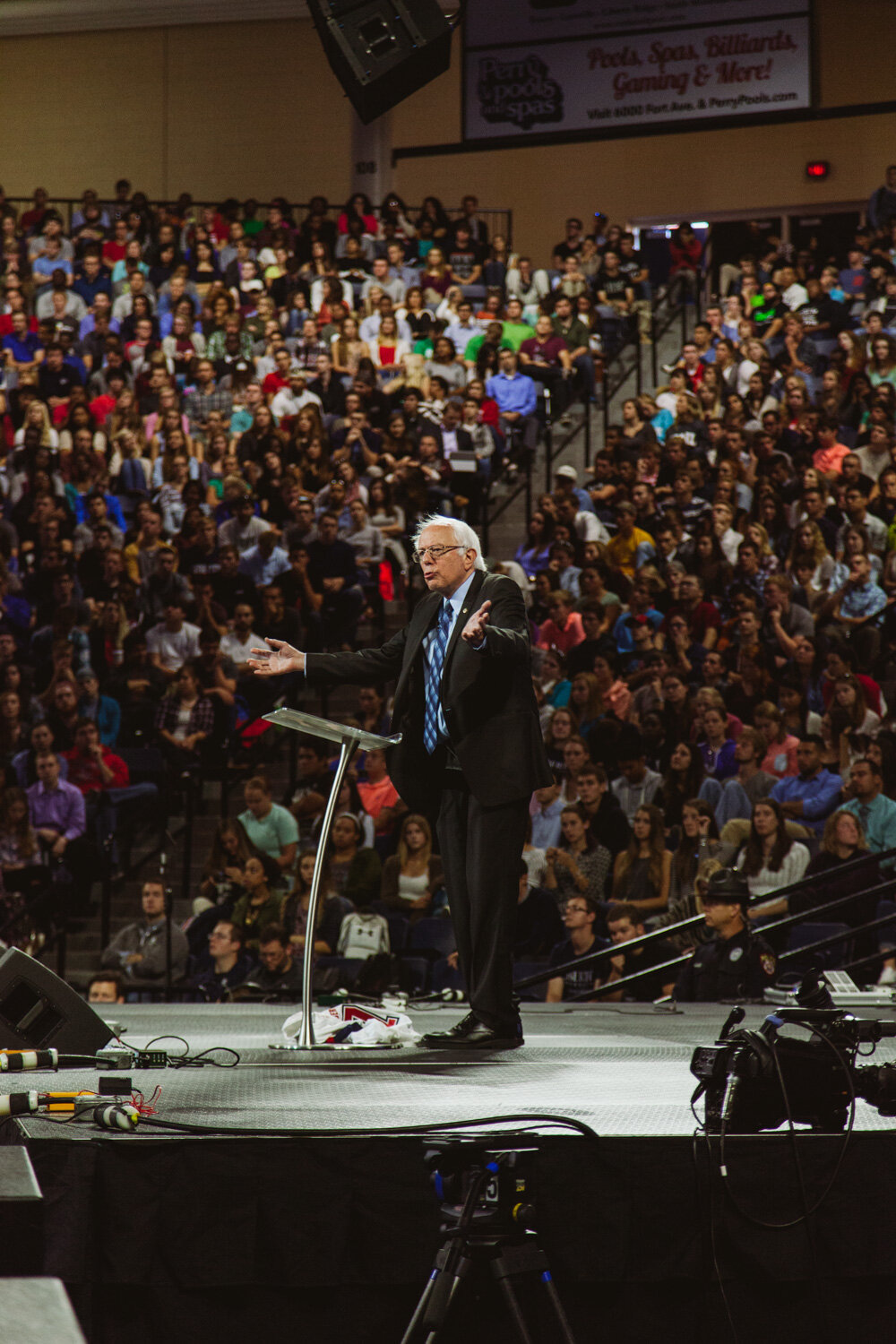
After Liberty had sufficient opportunity to position their cultural niceties and carefully construct their whitewashed house of cards, Sanders began his speech by cutting straight to the quick
“Nobody loves you more, Liberty students, than our president. No one cares about you, wants the best for you and wants to see you be world-class leaders more than our president.”
“[L]et me start off by acknowledging what I think all of you already know. And that is the views that many here at Liberty University have and I [have], on a number of important issues, are very, very different.”
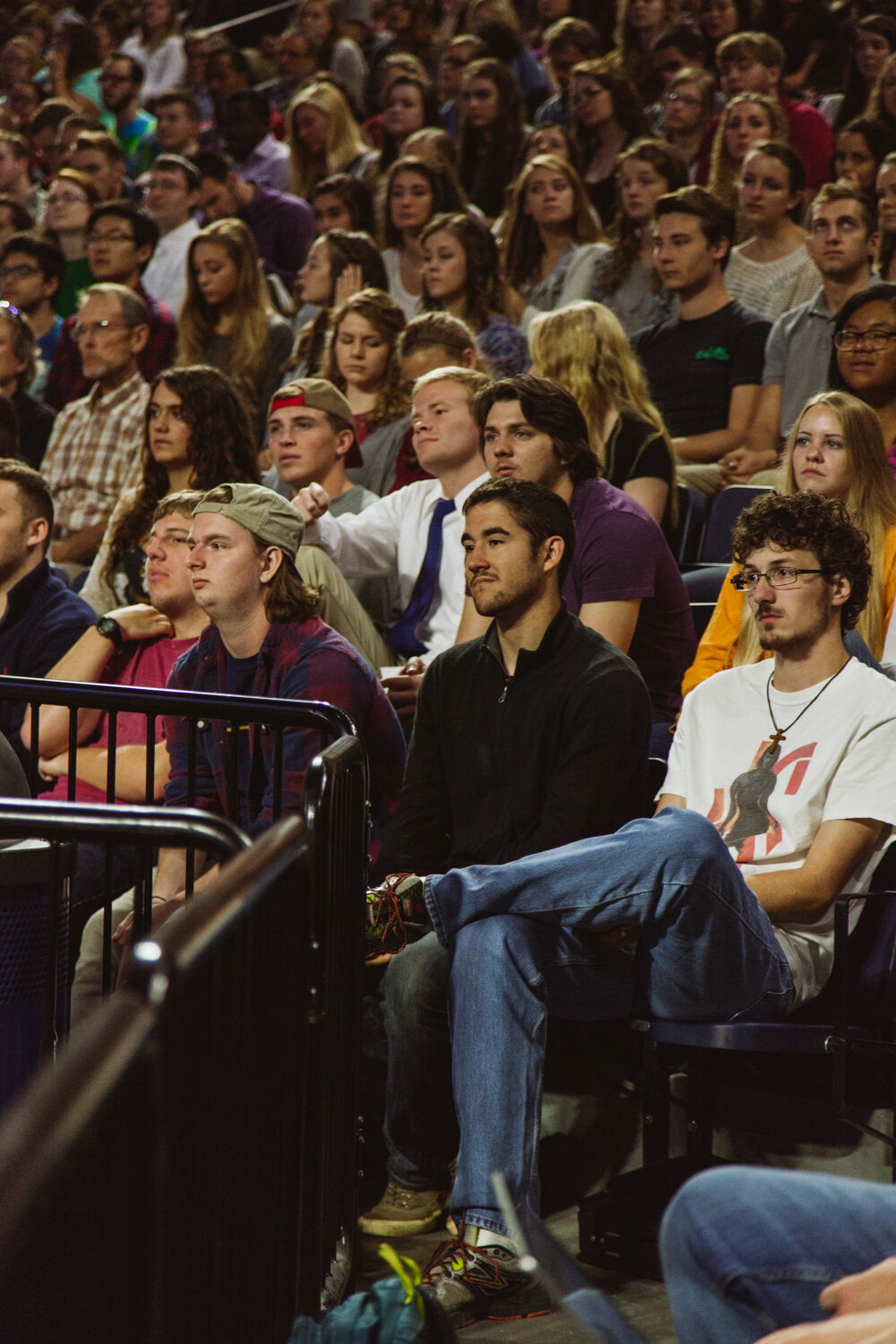
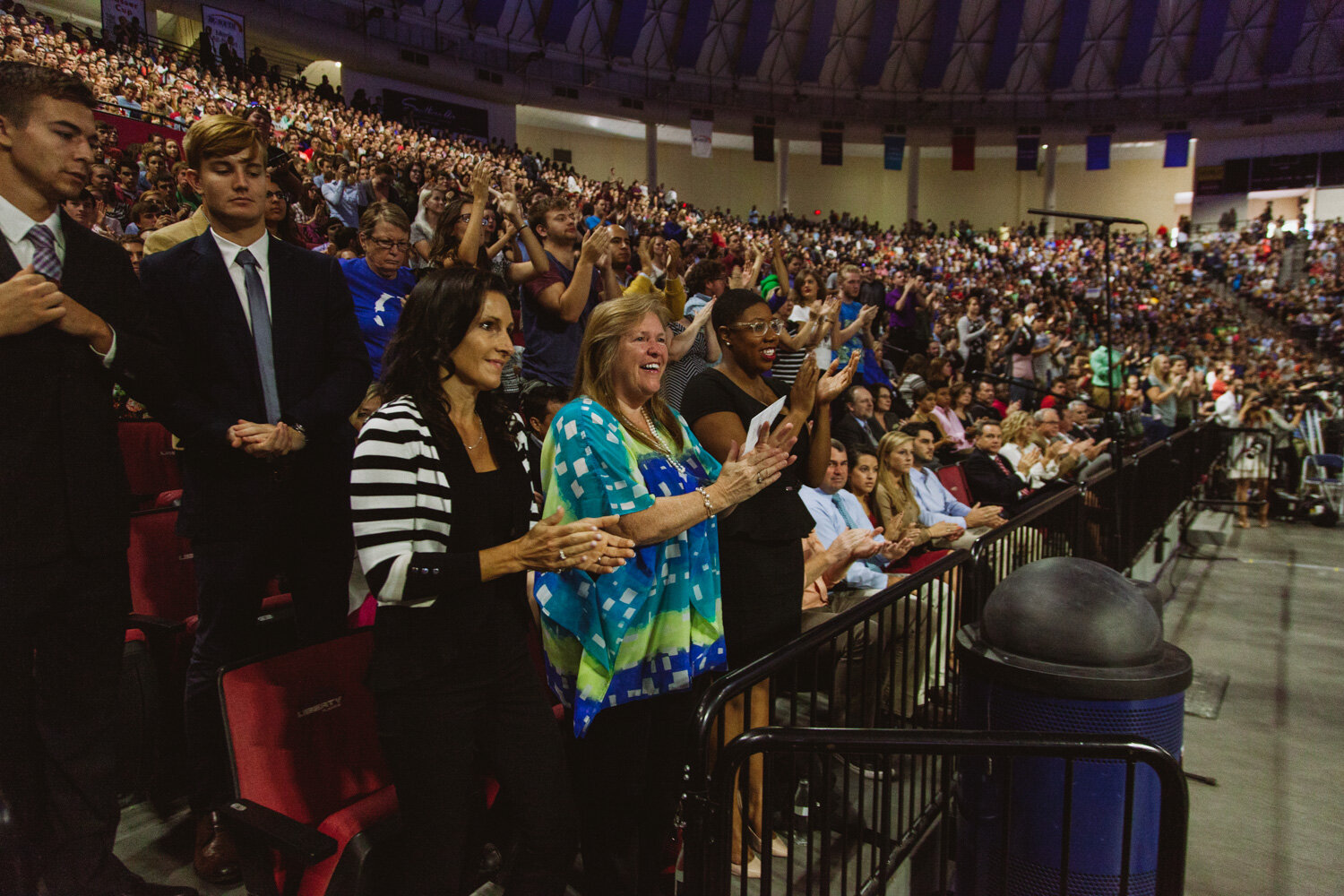
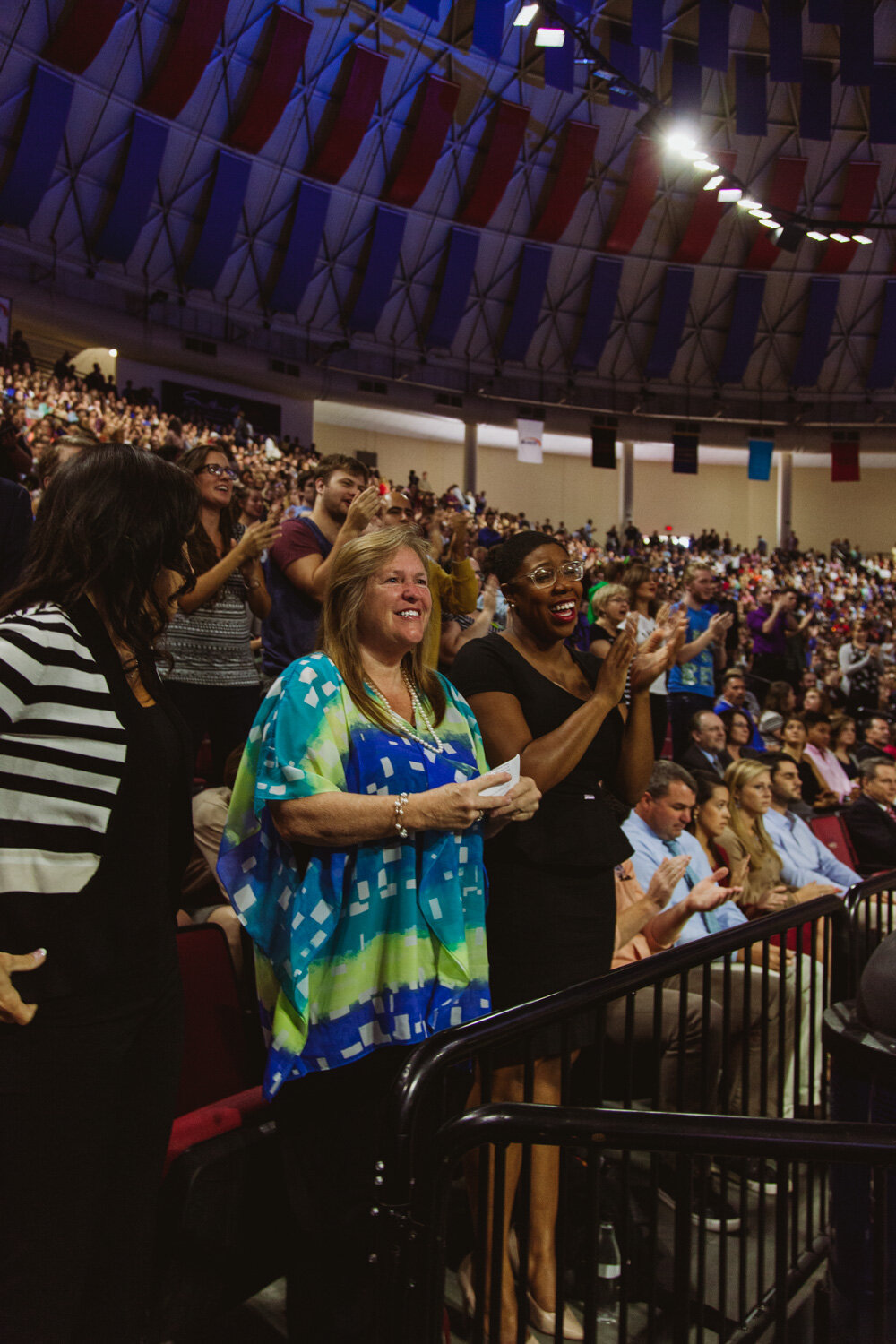
A fair amount cheered in support of those beliefs: gender equality, the right for a woman to control her own body, LGBTQIA+ rights, and gay marriage. Some of the voices belonged to students. As it was during my time as a student, many on campus are not as conservative as the administration’s statements to the press imply.

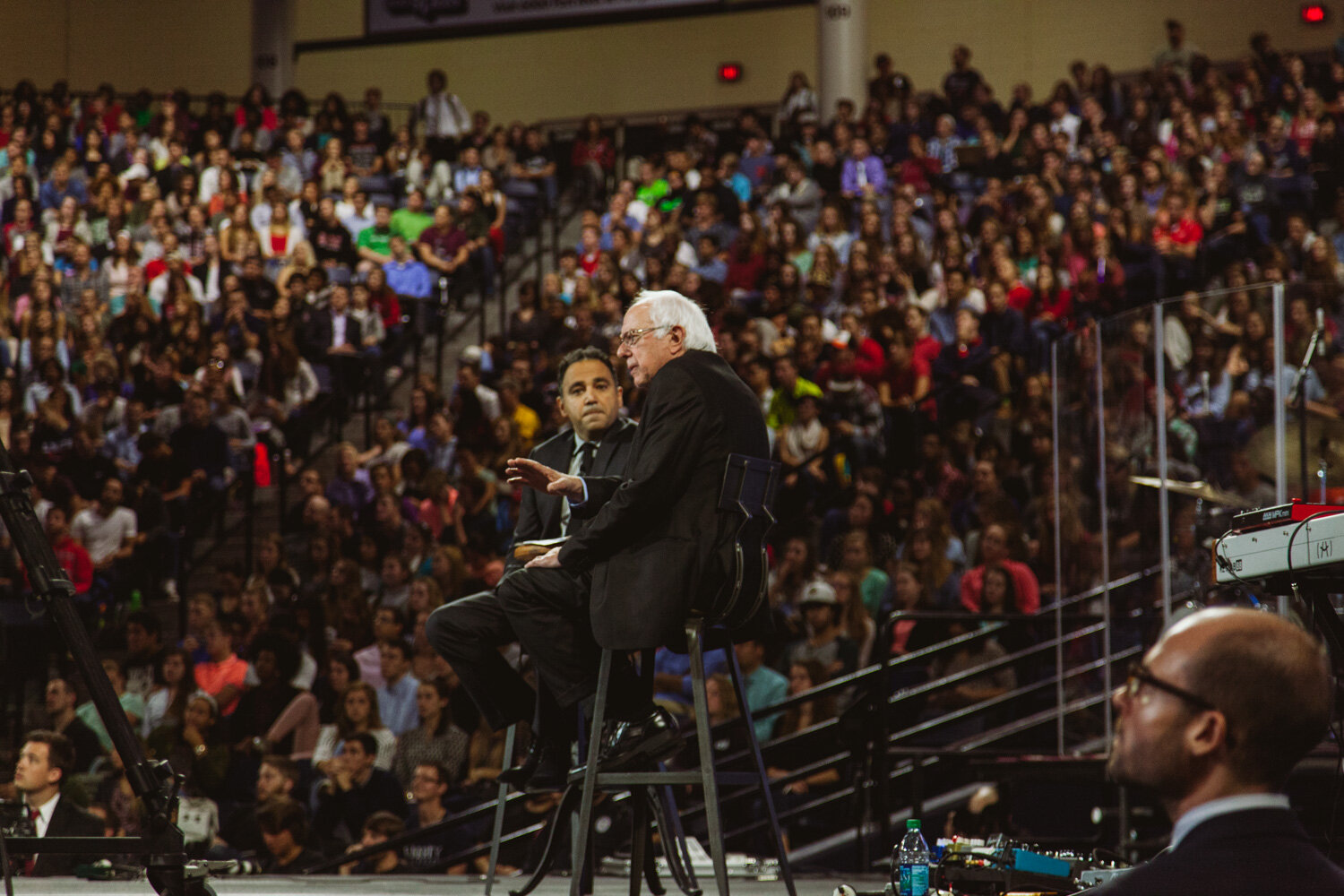
Liberty University Senior Vice President for Spiritual Development David Nasser addresses the audience. Liberty University President Jerry Falwell Jr. and US Senator Bernie Sanders sit in the background.
“But I came here today,” Sanders said, “because I believe from the bottom of my heart that it is vitally important for those of us who hold different views to be able to engage in a civil discourse.”
In case you missed it, you can watch and read that discourse in entirety here. I won’t analyze or recount much of what he said in this piece, as that has been done in dozens of other places in the days since he came to speak.
What’s most interesting to me about this event is the interaction between these two forces: Evangelical conservatism and self-spun socialism. A clean Protestant comb-over and the wily white wisps of an irreligious Jew. My past haunts and my present leanings. The fundamentalist and the humanist.
In the evening after the engagement, my co-parent was at a local bookstore preparing for the next day of her teaching job, and I asked her pick me up a copy of Steven Pressfield’s creative manifesto, The War of Art. One section of the book, called “Resistance and Fundamentalism” does an excellent job comparing these forces.
“The artist and the fundamentalist both confront the same issue,” Pressfield writes, “the mystery of their existence as individuals. Each asks the same questions: Who am I? Why am I here? What is the meaning of life?”
So, there is common ground here. Sanders positions that commonality with a different, yet related, question: “What does it mean to live a moral life?” How does one govern morally?
“The difference is that while one looks forward, hoping to create a better world, the other looks backward, seeking to return to a purer world from which he and all have fallen.”
Steven Pressfield
The War of Art
That common ground falls away, however, at the precise moment each party seeks their reply. The fundamentalist, says Pressfield (an authority on ancient Greek civilization, the author of The Legend of Bagger Vance, and a self-described Christian), attempts to find an answer in sacred texts written thousands of years ago, in the context of a society far removed from our own, and attempts to apply those old responses to today’s complex cultural landscape.
“The difference is that while one looks forward, hoping to create a better world, the other looks backward, seeking to return to a purer world from which he and all have fallen,” Pressfield says.
The artist (or humanist — the author uses the two terms interchangeably in this section) seeks to find that answer in the here and now:
“The humanist believes that humankind, as individuals, is called upon to co-create the world with God. This is why he values human life so highly. In his view, things do progress, life does evolve; each individual has value, at least potentially, in advancing the cause.”
The latter approach, is a far greater challenge, but is more in line with the demands of a global society that faces ever-the-more complicated trials and questions.
Reducing the presidential election to two issues (gay marriage and abortion), then, as Christian fundamentalists have stereotypically done, is far more understandable given Pressfield’s distinctions. It’s just so much easier. It requires less thinking and deliberating. There's effort and uncertainty involved.
The fundamentalist doesn’t have to weigh the pros and cons of carrying a fetus to full term when it’s diagnosed with skeletal dysplasia. The fundamentalist doesn’t have to dive into the alleged moral ambiguity of a person who has felt like a stranger in their own body, only to feel whole through modern science’s ability to allow her to affirm the gender she (or he or they) has identified with all along. To the fundamentalist, the answer is clear. The baby will be born (and, in some cases, summarily die). A man is a man and a woman is a woman. Thinking anything outside of that makes you wrong: a murderer, a freak, a pervert, a sinner — lost.
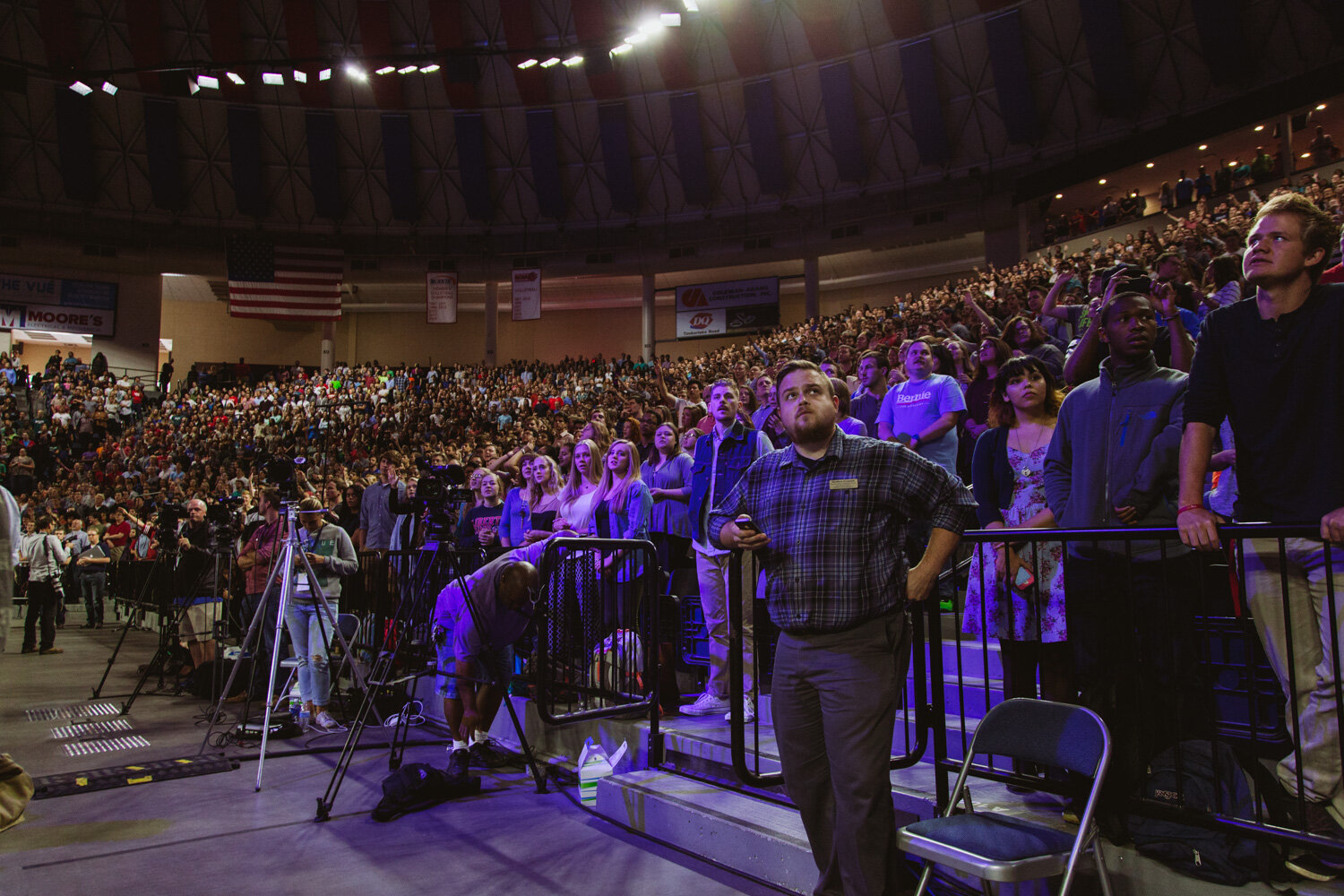
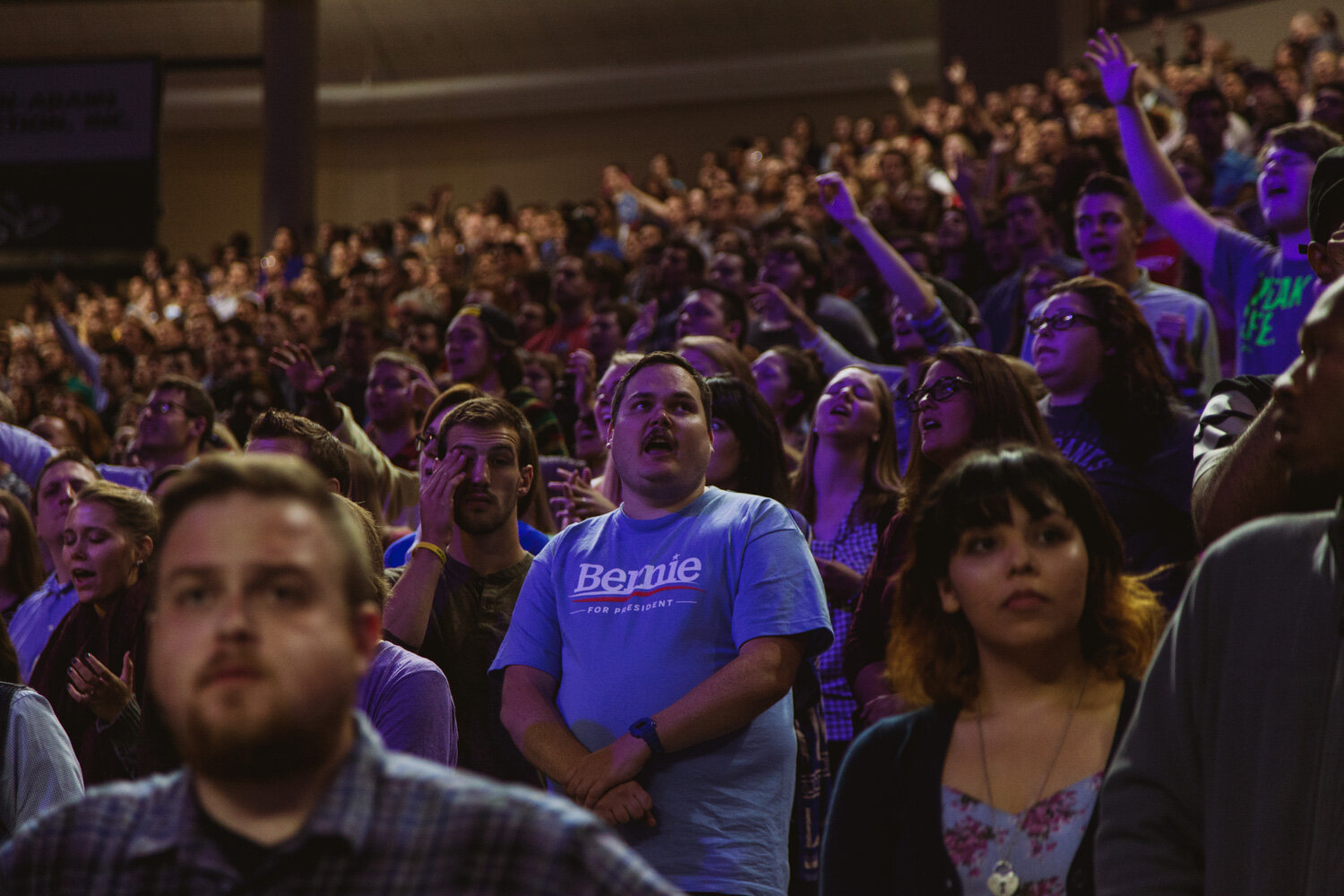
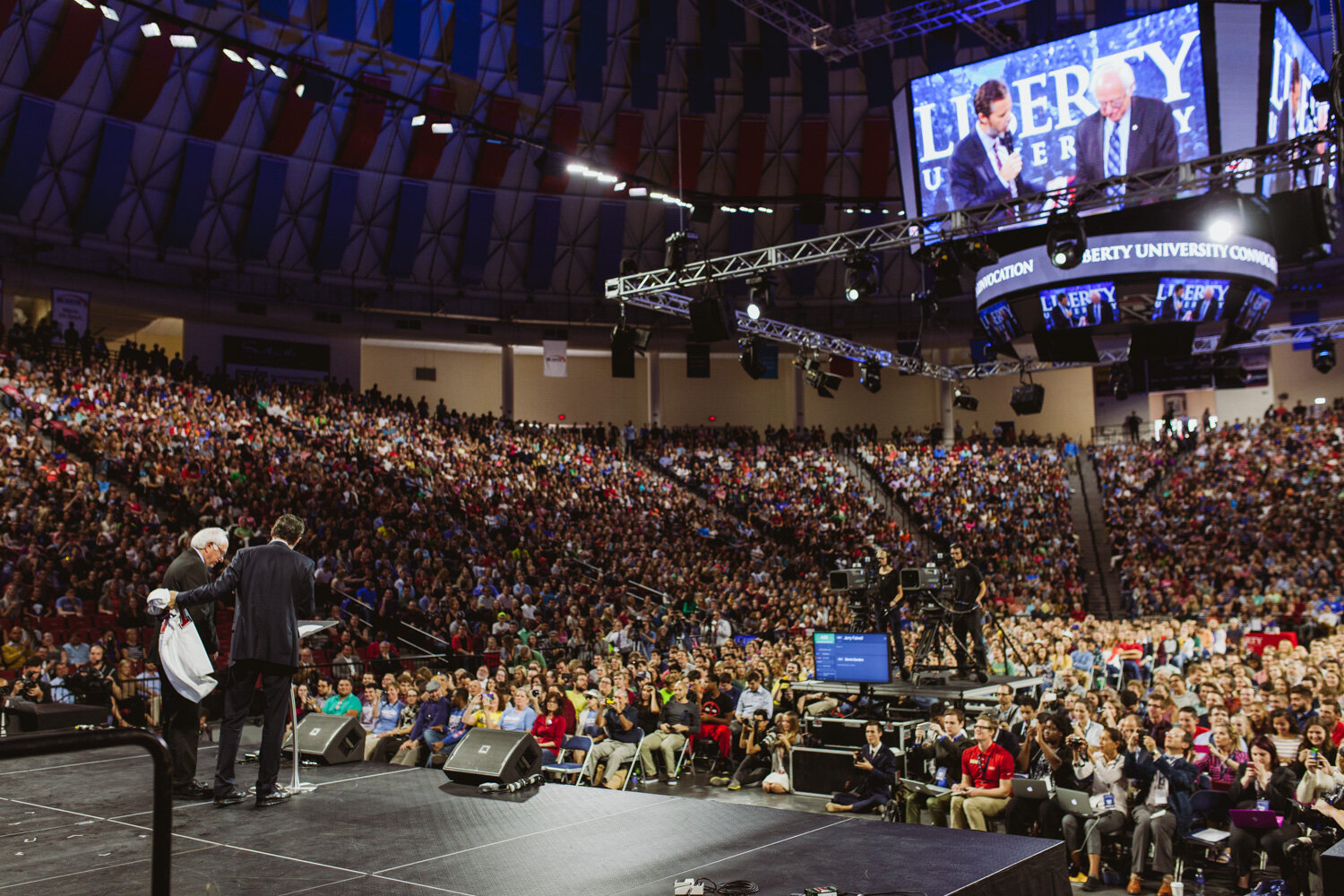
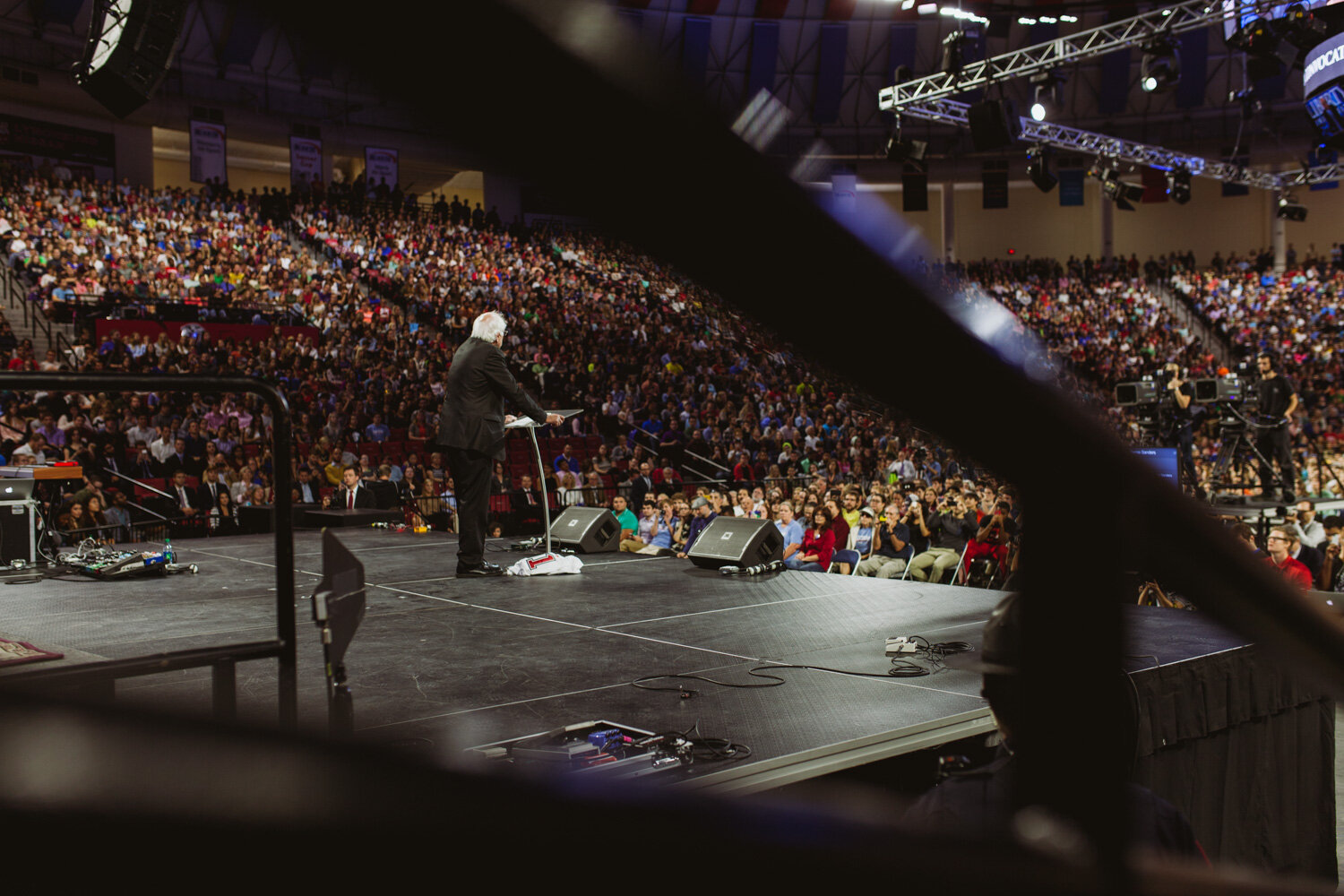
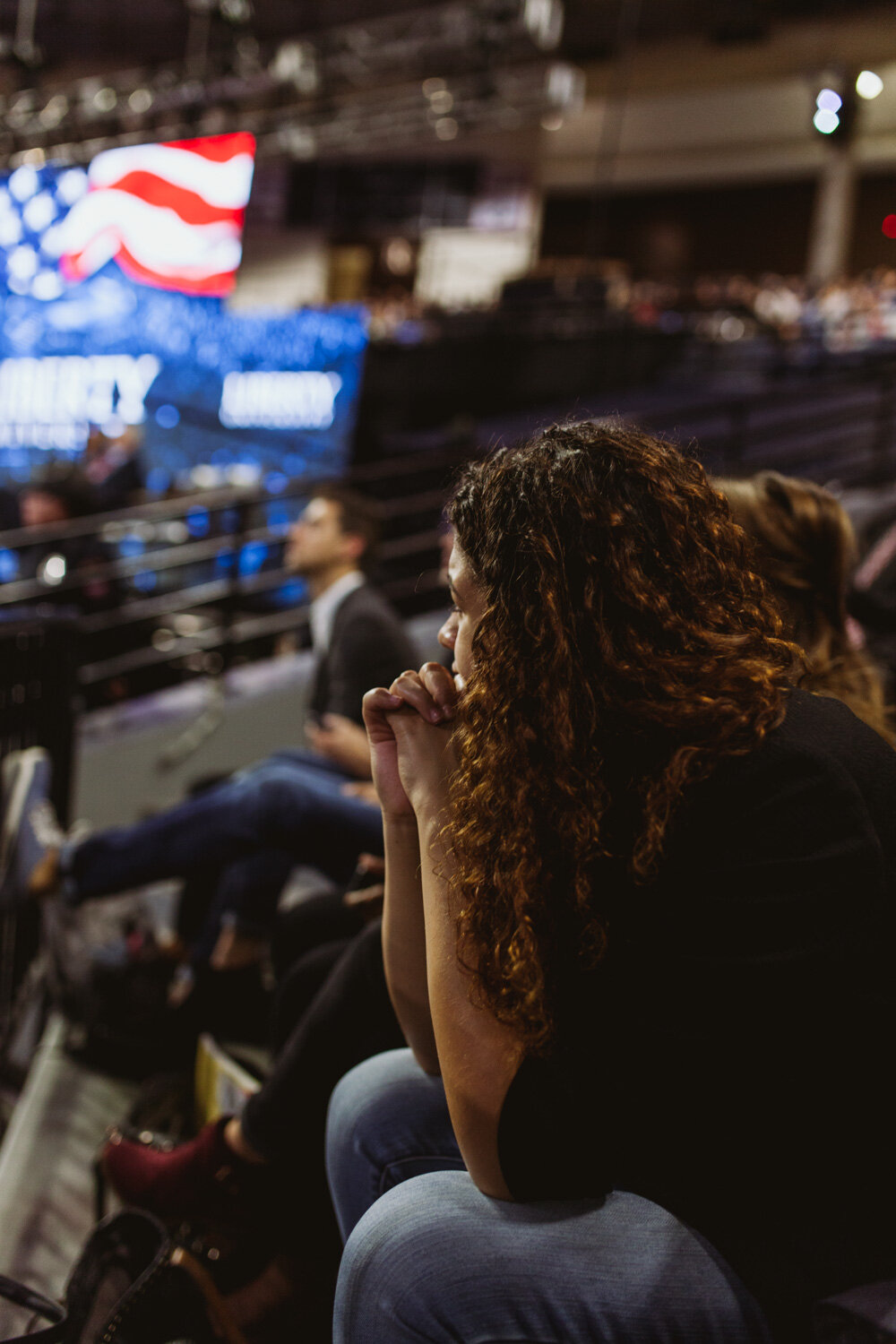
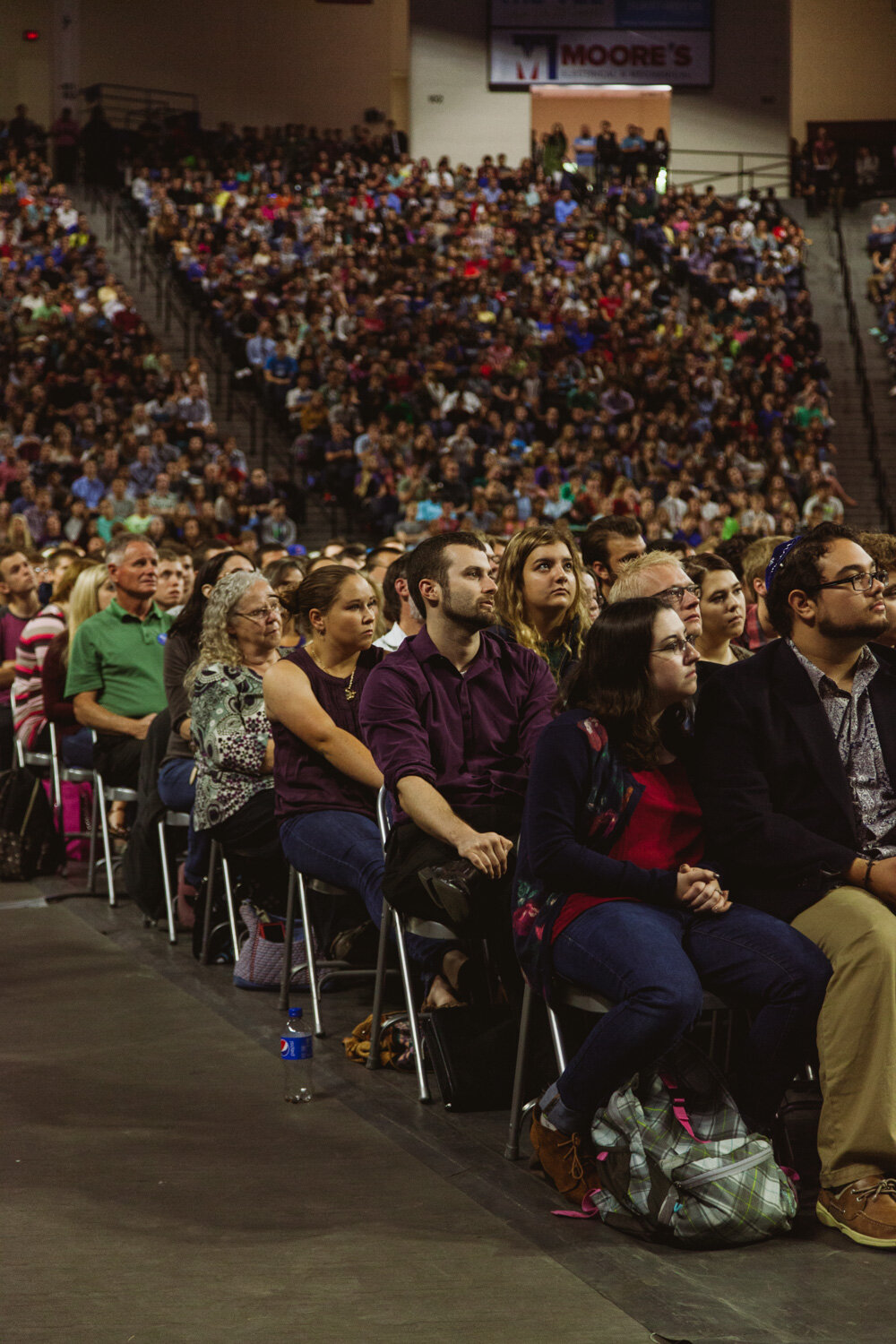
The fundamentalists can sit quietly in their seats, letting their thoughts drift to a homework assignment or their eyes to smartphone screens during the speech and Q&A, while Sanders postures that the United States is not a just nation. But those same individuals can jump into raucous applause when the campus spiritual leader offers a cute rebuttal about inequality: “It’s not a skin issue, but a sin issue.” (Note: A clever turn-of-phrase does not an absolute truth make.)
But there is hope. I spoke with a Liberty University resident assistant who said she cheered for the right for a woman to have control over her own body (although a guy from behind offered her a consequential “fuck you”).
I spoke with a few others who said that you no longer get reprimanded, fined and expelled for being gay at LU, as you would have in the past. And for further sense being made, I encourage you to hear the words of an evangelical pastor (and fellow alumnus) who equated Sander’s plea at Liberty to John the Baptist decrying the Pharisees.
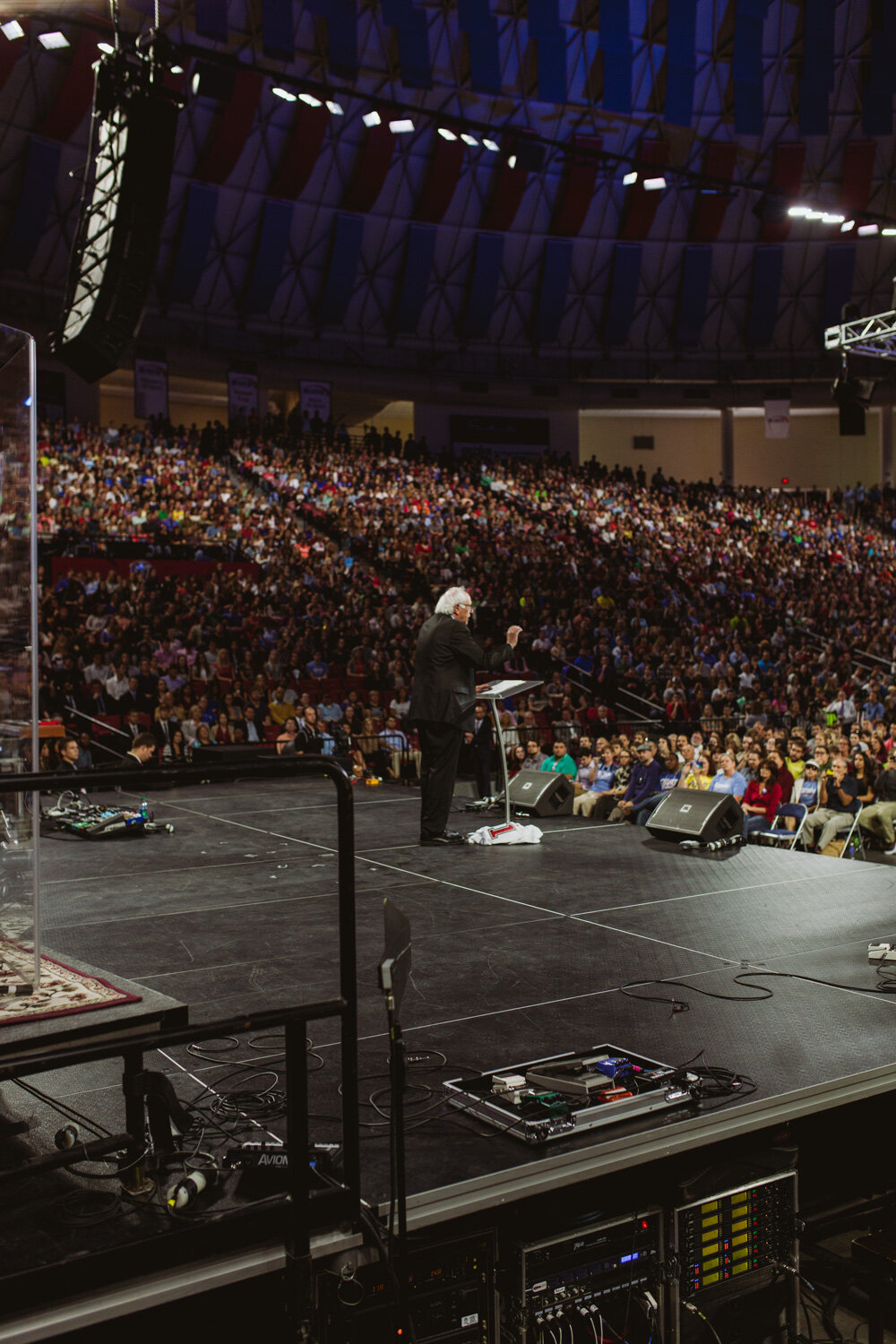
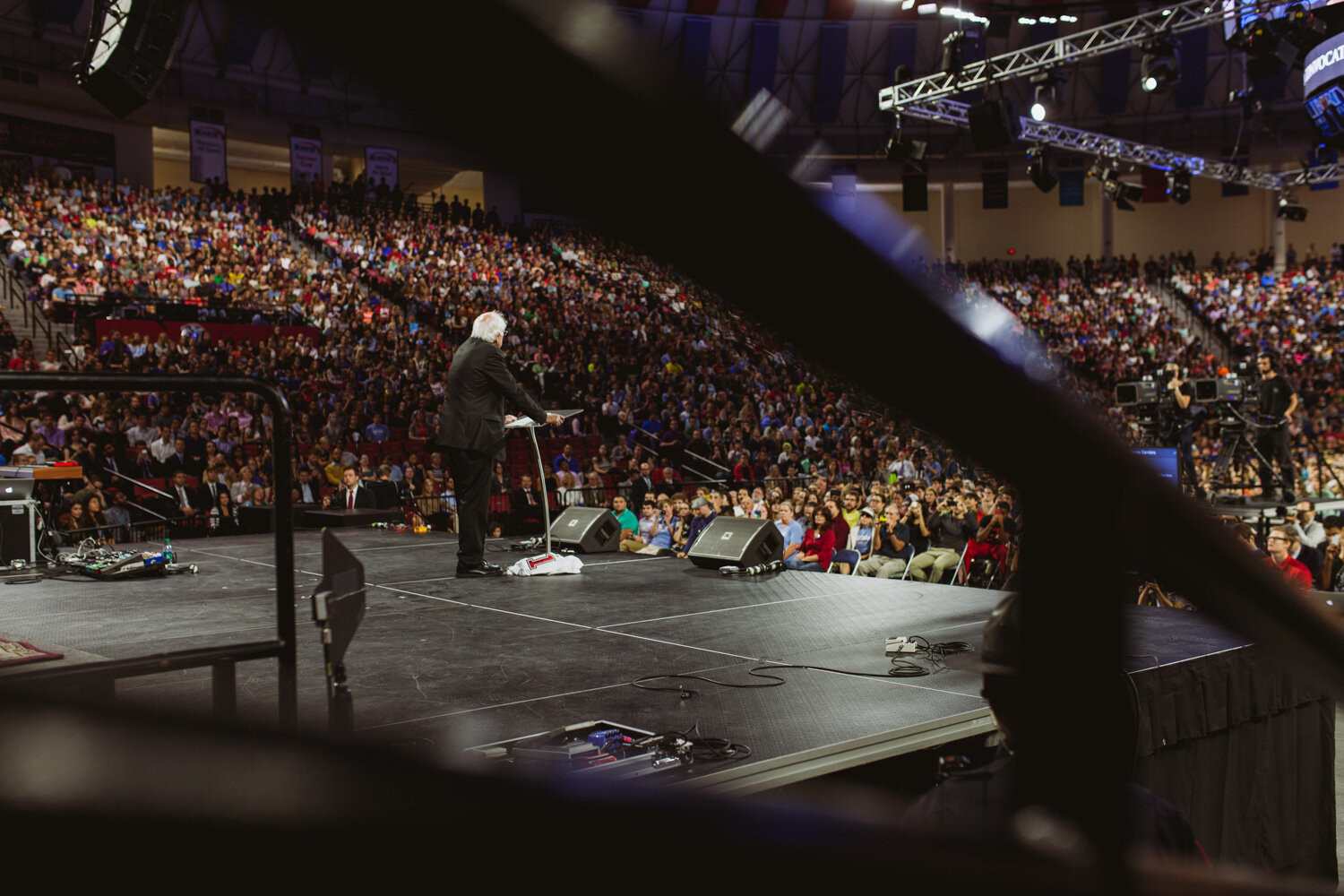
What I’m getting at is that hope is out there, however rarefied. And I think it’s the duty of those who see it to keep that candle burning, if not tip it to the person sitting next to you to light another, and another, letting the wax spill over your hands and Levi’s.
Even though I may seem somewhat positioned against Liberty and its administrative body (arguably with good reason), my frustration really comes from a place where I know people can be better or, rather, must be better if we are going to keep this beautiful thing called human life spinning for another few thousand years or so.
My preference is to not be ashamed of the fact that my undergraduate degree is from Liberty University, a place not exactly synonymous with intellectual integrity and compassion for those who are different.
My preference, as it was on that day, is for positive change to take me by surprise.
At Liberty, the cultural climate seems to have improved from the time my supervisors tasked me with editing less-than-favorable information from the school’s Wikipedia page (I declined), but there’s a long way yet to go. I hope to be able, as I was on that day, to take an electric blue and pink polka dot bicycle ride across town (like a one-person queer pride parade) to witness it happening.
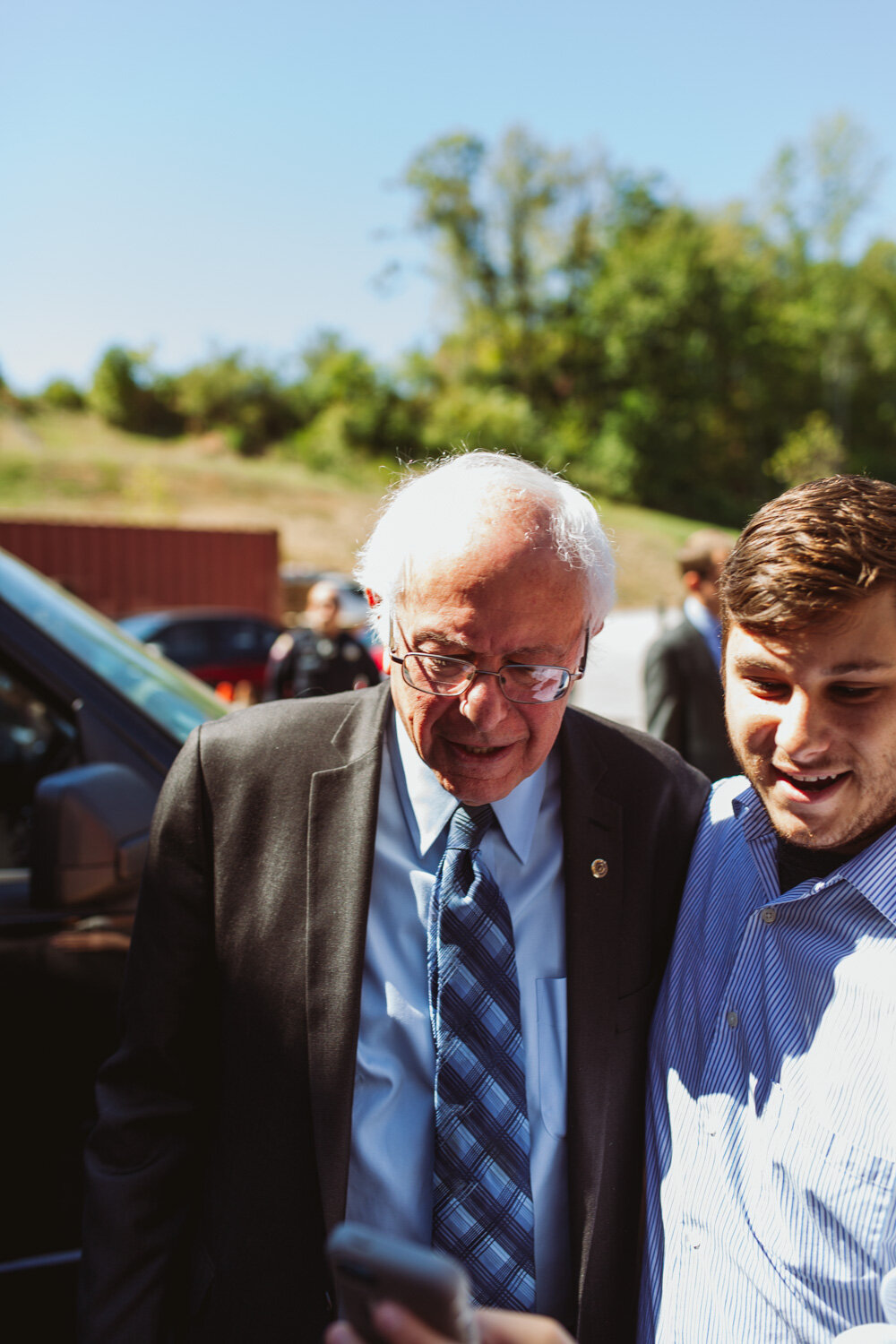
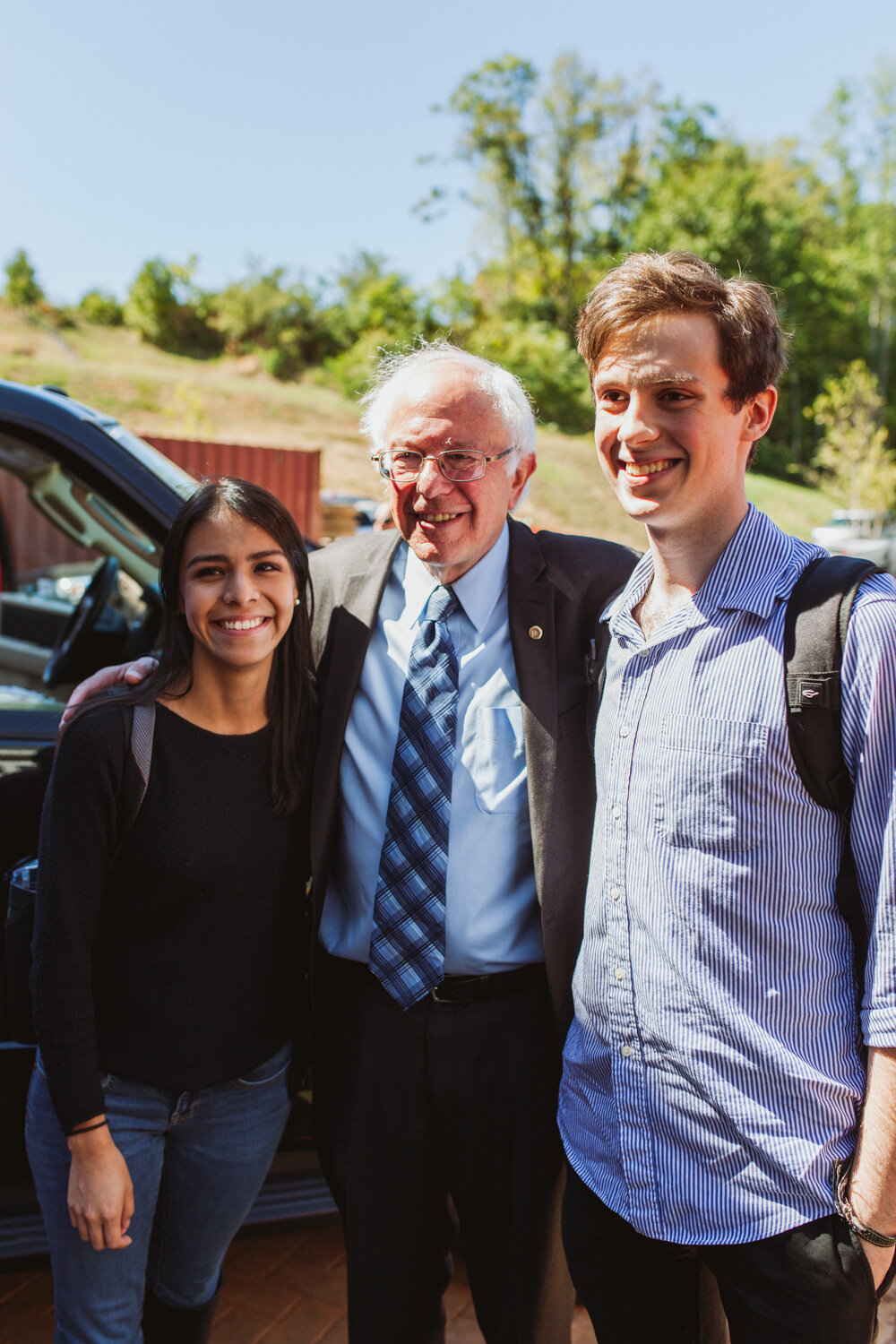
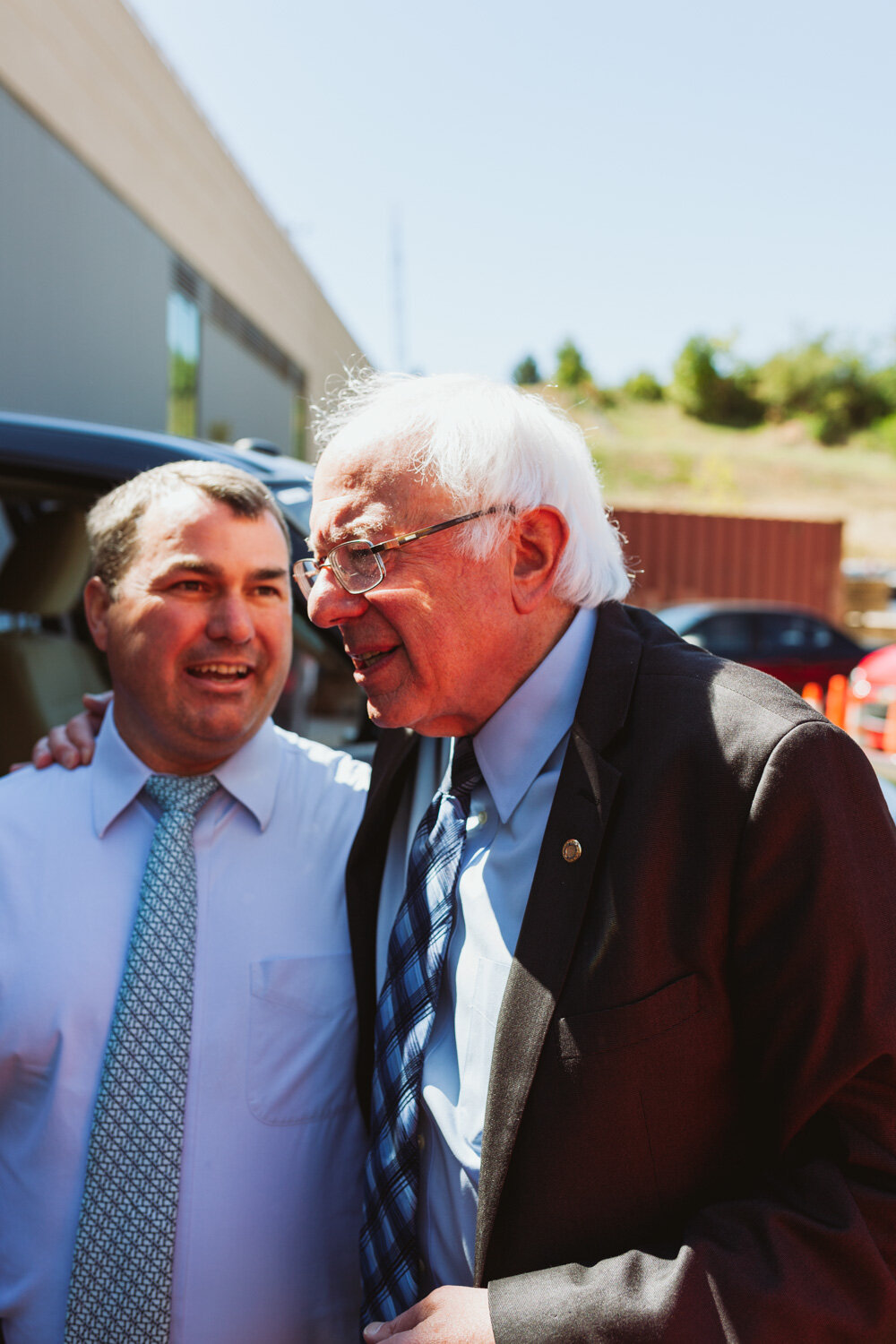
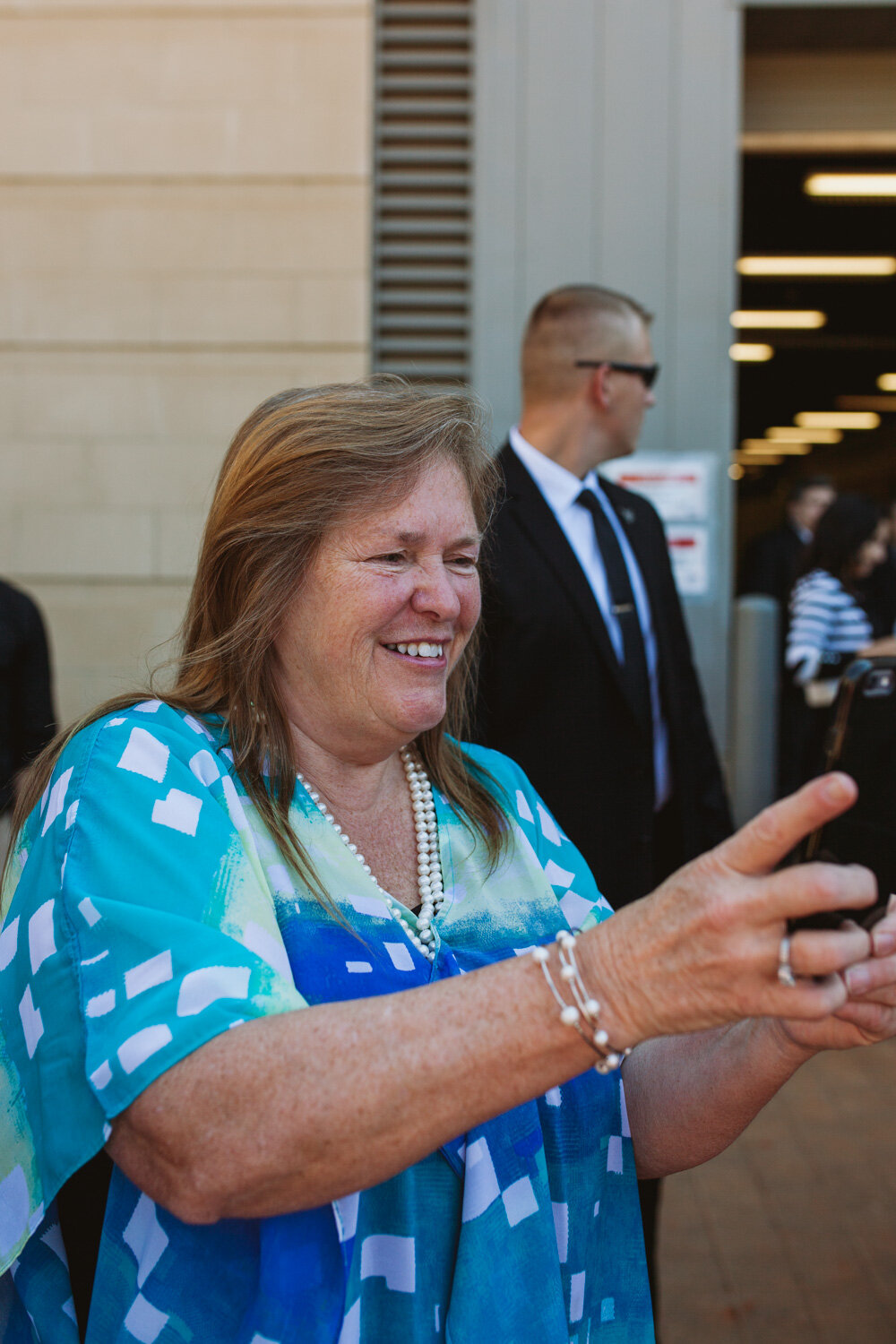
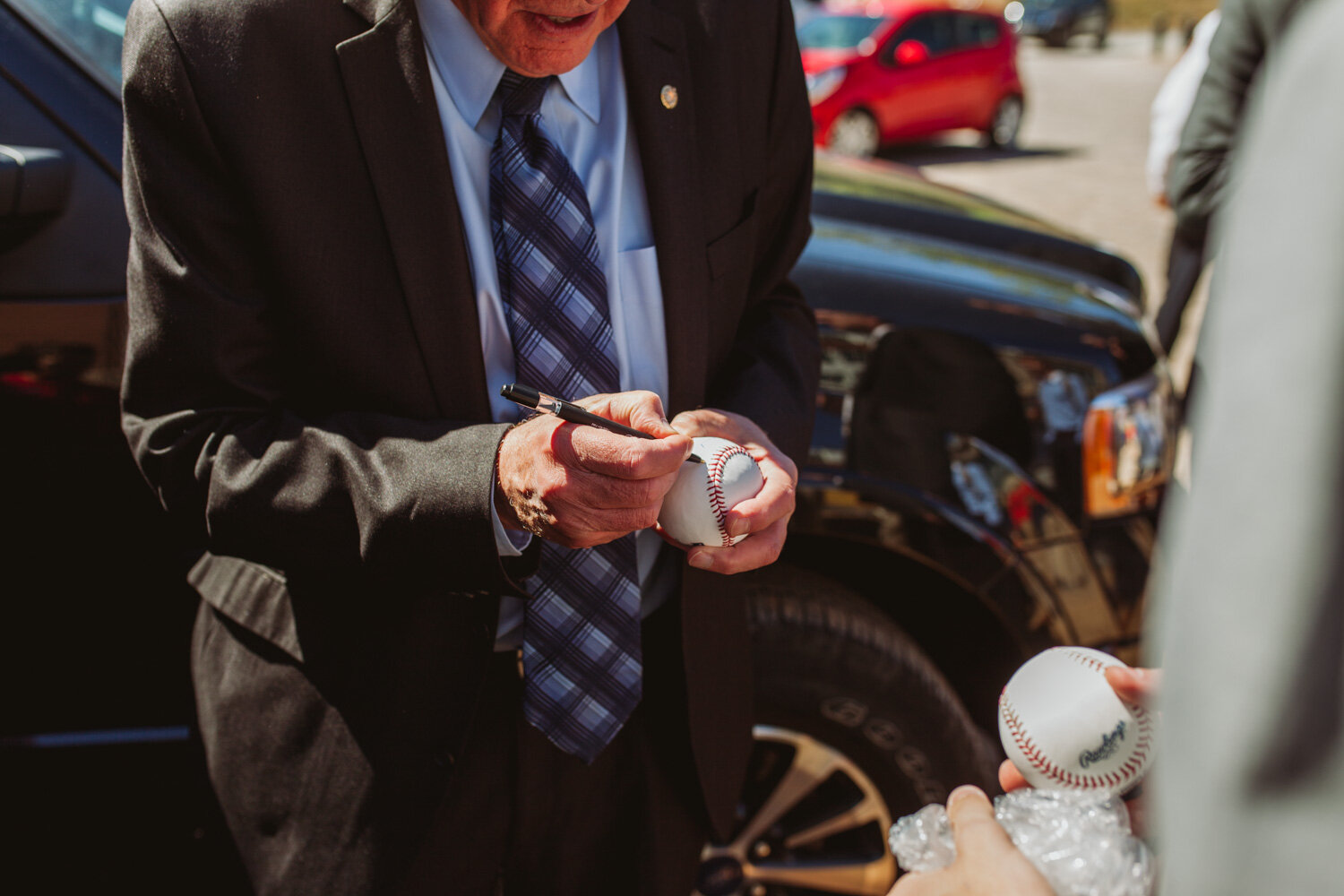
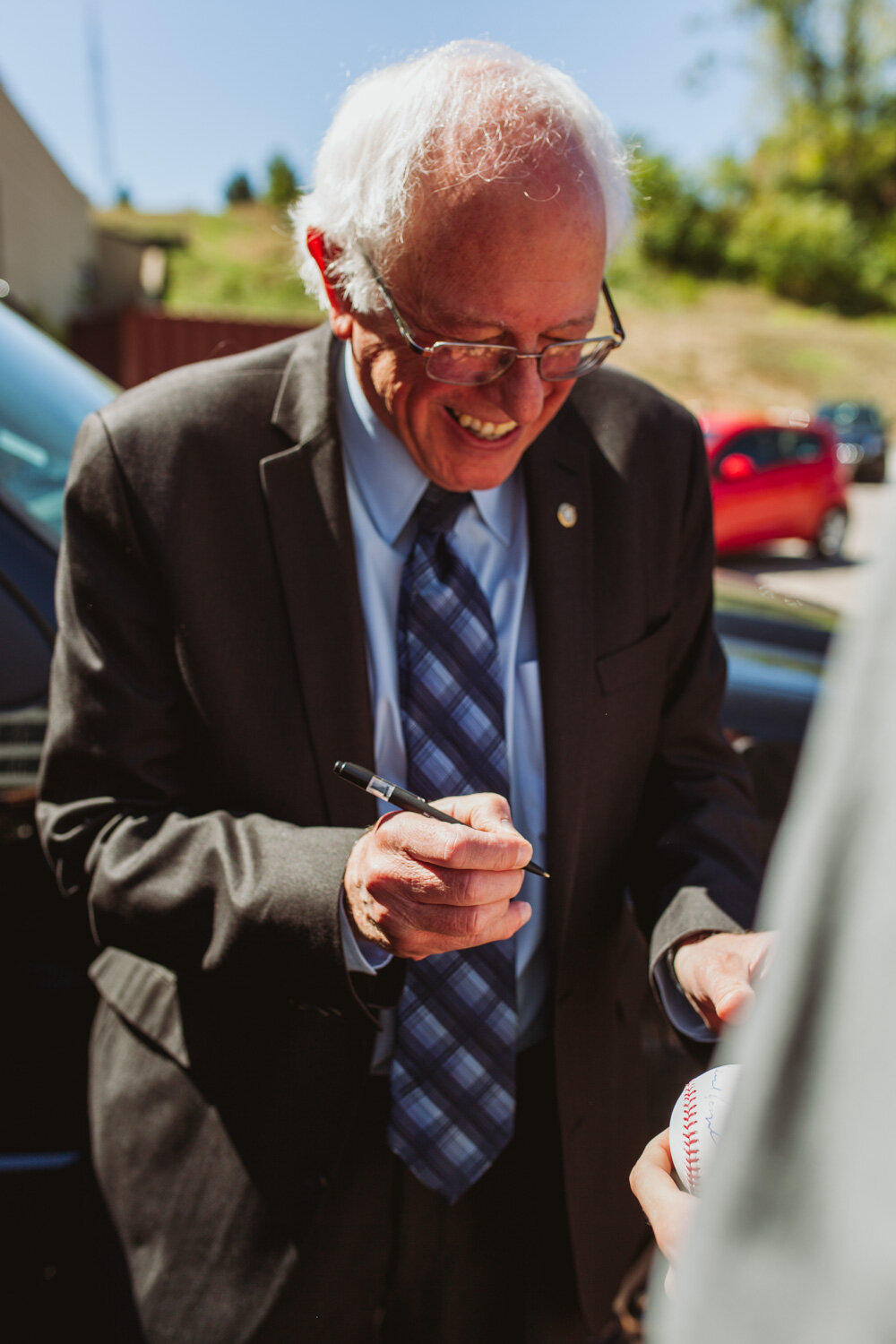
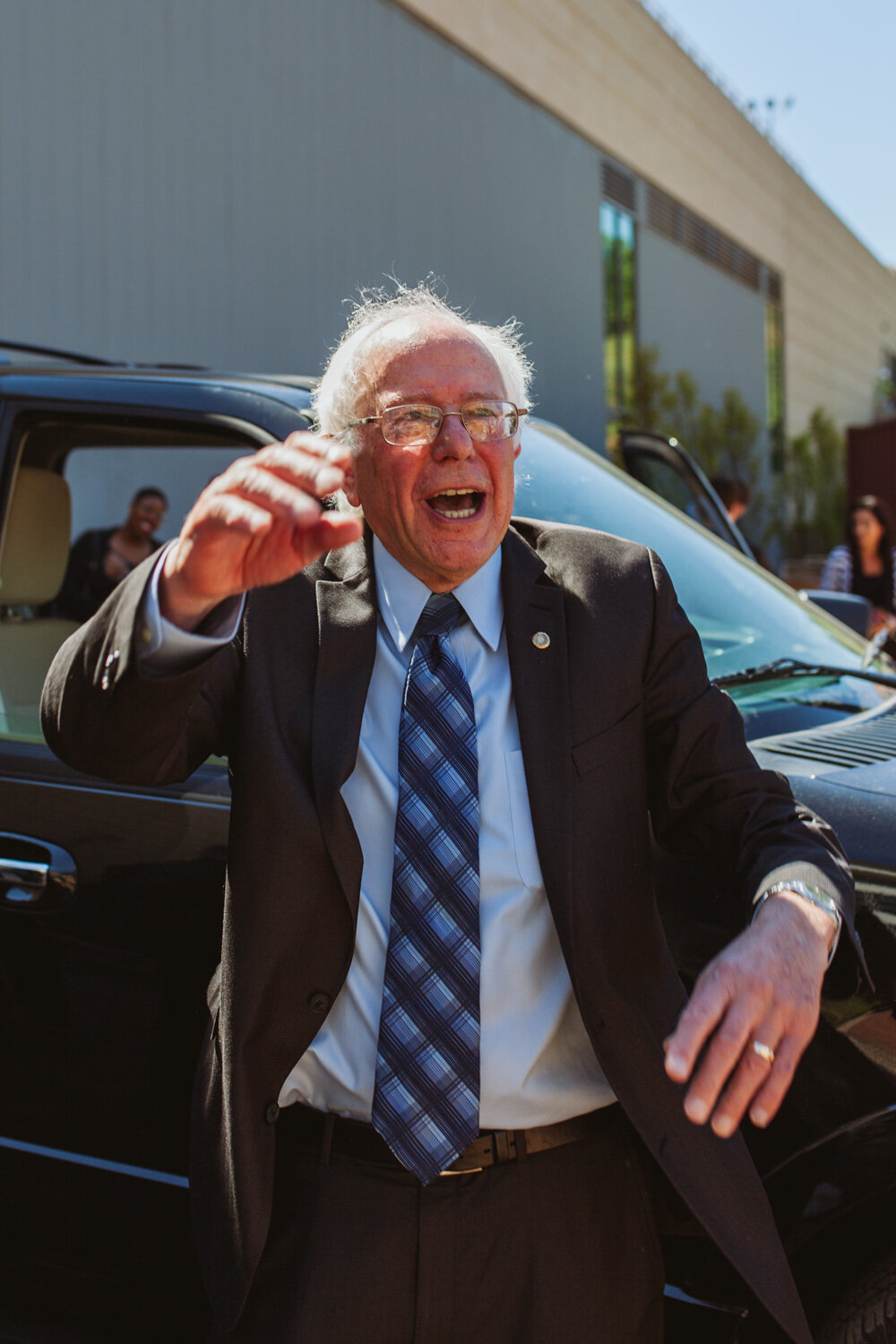
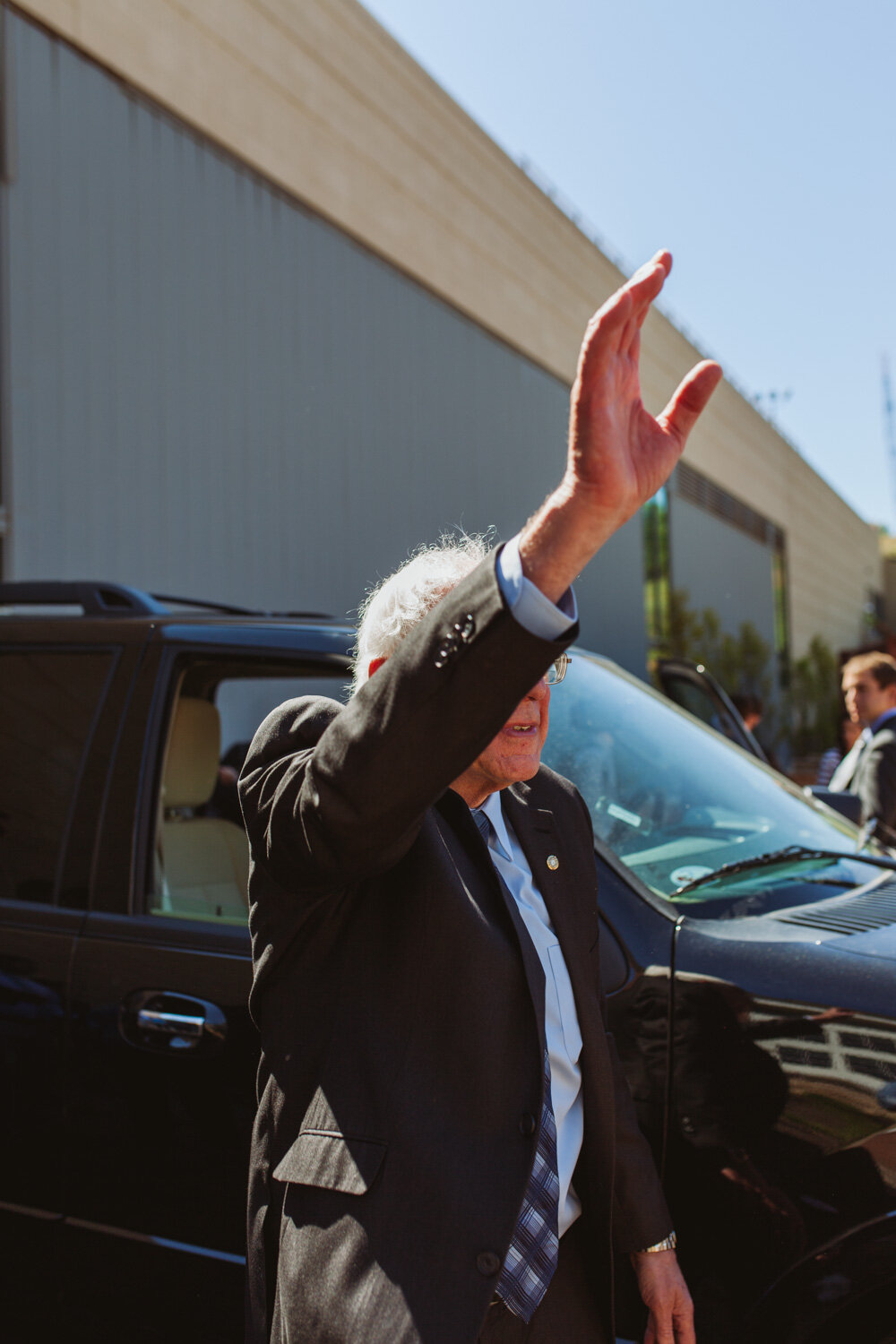

Once the service was over, I ran into a couple of friends who are currently enrolled. Their energy at hearing Sanders speak was electric, encouraged and invigorated. They told me to follow them around back of the building so we could possibly meet him.
And so I did.
He graciously exited the SUV when he saw us, and said he had enough time to take a few photos. When it came my turn to say hi, I handed my DSLR to a friend and told him how to shoot (but neglected to give instructions on the focus, as you can see below).
I had never met a U.S. senator before, much less a presidential hopeful, and so I was grateful for the opportunity and wanted to say something meaningful. What I wanted to tell him was that in my 12 years of voter eligibility, I’d always cast my ballot in favor for who seemed like the lesser of the two evils. This election could be different. There’s a candidate who I believe actually represents me and the America I was raised to believe could be possible.

OOPS: Forgot to tell my friend how to focus my DSLR for this shot of US Senator Bernie Sanders and myself.
But I couldn’t get any of that out. Instead, I shook his hand, smiled for the camera and said, “Thanks for not being full of shit.”
He laughed, and looked into the camera. I’m pretty sure he knew what I meant.
Thoughts? Questions? Frustrations? Let’s talk about it (below).

Florida Findings
Florida Findings
I smell the sand.
I see the sand.
But I do not taste
its brine. It exists mixed
in with the ash and dirt,
leaves and twigs. On the forefront
of this surface is the pockmarks
of rain pellets that fell as we
chuckled and wept and slept.
The rustling I hear
undulates. Its crescendoes
punctuated by aviary chatter and evidenced
by the workings of swaying shadows.
In the shade we discover
the wetness and the cold. Beneath
the sunlight is revealed the crystalline
dimensions of it all. Sparkle and fade.
Even some of the disconnected leaves
are green
although trampled. Even the chill can exist
in the light.
I can furrow my face
at these perceived chaotic churnings
or I can delight. There’s always choice,
although I often refuse to give
myself the space to make the more useful one.
I wonder if these disinterred
roots still grow. Yellowish, mottled, and broken,
do they flail their fractal hairs
to amble toward somewhere more
secure in order to try again for fruit?
Above it all, when viewed without
distraction, is peacefulness,
is lush lingering
limbs that protect or provide
portent.
_____________________
February 7, 2020
Florida Earthskills Gathering
The Power of Poetry (workshop)
w/ Eric Lewis & Olivia Verhoye

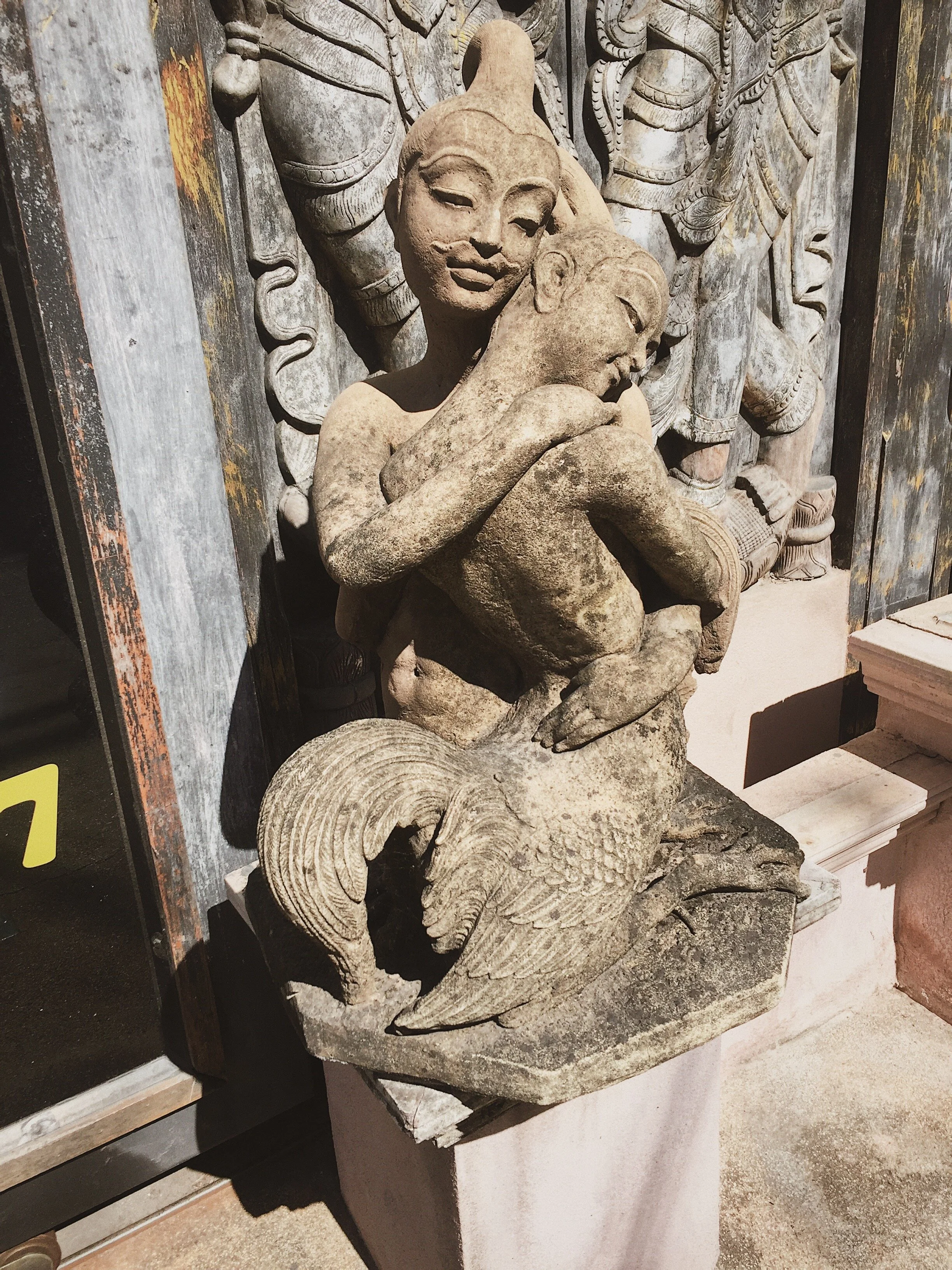
Spontaneous Prose (7 minutes)
Spontaneous Prose (7 minutes)
I’m favoring the sounds
of “F” this morning,
because FUCK this.
Feverous in my fecund mind,
my heart following the form.
Were it different — I wish —
I suppose what I grieve would not
be lost. But it is, for now.
Maybe it must.
I scour the insides of my skull
with a hot spoon, culling the meat
from the bone, searching for favor
but finding none — internally regarding
my externalities as pretentious
and sanctimonious.
But maybe it’s me?
Does god know? Does the some-
or everything we call “god”
even have some faculty of knowing
that in any way resembles what we endure?
Or does god simply exist and experience and change?
Octavia Butler says that “God is Change.”
Is my raucous resistance to this relational revolution
an indication of separation from my own
true divinity, that which i displace
with my thoughts and run-amok emotions?
We’ll see.
—————
February 7, 2020
Florida Earthskills Gathering
The Power of Poetry workshop
w/ Eric Lewis & Olivia Verhoye


Feel'd Notes: A Fitting Diagnosis
I’ve had a strained relationship with mental health for as far back as I can remember. It wasn’t until after my 30th birthday, however, that I encountered a fitting diagnosis — ADHD. Before my clinician laid it out for me at the time, my belief was that I had bipolar II. I’d previously met with a psychiatrist in 2010 at the encouragement of a friend who went to the same guy and received Adderall. I tried one of her pills and it made me feel productive and “normal,” so I went in seeing if I would get my own.
I later learned that mental health diagnosis is more effective when ones symptoms are being taken into account from a period not as heavily influenced by alcohol as mine had been. My propensity for late nights, barely sleeping, impulsivity, intermittent hyperfocus, distractibility, and mood swings were all attributed to the wiring of my brain, rather than the substance used to douse its natural faculties. The psychiatrist gave me a medication initially developed for epilepsy, one said to be effective for bipolar but required the user to wean on off the recommended dosage. Pretty sure death was one of the potential symptoms of taking (or discarding) a “effective” amount right away.
As you could imagine, I didn’t feel comfortable consuming that drug for a variety of reasons, and stopped dosing before I even hit the second tier up the potency scale. It was during this time that I began writing songs again after a near 4-year hiatus wherein I dealt with a guitar-related growth in my wrist. My drinking (and mood swings) continued for three more years, until I traded in my addiction to alcohol for filmmaking and yoga.
It wasn’t until another 2 and a half years that I found my way into another clinician’s office — the one who identified me as having the “classic,” indrawn sort of ADHD that is not as easy to spot as the outwardly hyperactive variety. While I had accepted the bipolar labeling with a grim badge of cool, learning about ADHD from my counselor (and an amazing book he recommended called Driven to Distraction) led to a flood of self-identification and … relief.
Reading strangers’ accounts that sounded like they were grafted from my own experience and into the book provided both pain and hope. Ahhhh, so THIS is that thing that I’ve always known but could not speak to, draw lines about, and know how to address. That invisible force, identical to my frame and mirroring my movements, finally had a shape, a name, and a host of effective remedies. I’d stumbled my way into typical self-medication techniques, but the confirmation of the more lasting treatments I’d already discovered on my own combined with a litany of other methods provided a greater plan toward self-mastery … or even just for surviving.
The funny thing about ADHD treatments, though, is they are often synonymous with activities one would do when living with greater diligence. Daily exercise. Keeping a schedule. Early nights and mornings. Meditation. Develop a skill. Sometimes my mind is so untethered that implementing the activities that harness it is a daunting prospect. I often fail. I beat myself up for it. I get worked up and stressed out until I reach a point where I have no other avenue but to write or sit in nature or stretch as many muscles in my body as I can find.
In the wake of such experiences, I feel rejuvenated and rested — even if I just broke a sweat. I reflect on those trails and wish I could have remembered that the stress never helps, and its never as bleak as my panic and depression lead me to believe by clouding my experience. I’m so grateful for those moments (or seasons), and am learning to be patient with myself when my mind grows dissonant. Because I know that I’ve not always felt this way and won’t always feel this way — that no matter how hard it gets, it always gets better.
Shoutout to my partner @veganastronaut, our counselor, and anyone else who rides these waves with me.
###

Feel'd Notes: Self-Doubt
Thank you so much for taking your time to send so many kind responses. The feedback shouldn’t be what galvanizes me entirely, but it certainly helps fuel my diligence in this endeavor of frequent expression. To add clarity to my recent barrage of transparency, I want to address some of the comments the previous posts have garnered.
A few people have asked me if I have a book coming out, or why I’ve not been published. Those same questions have plagued me for some 12 years now. Not trying to pull a Muhammad Ali here by declaring myself as “the greatest,” but if I’m being honest, I do have a sneaking suspicion that I do have within me (or at least through me) access to a certain level of creative ability that COULD amount to more than just admiration for my literary (and musical) heroes, but more so a strange kinship.
In other words, I’m scared shitless at the prospect that I MIGHT BE ONE OF THEM.
What if I fuck it up? What if I’m deluding myself? To borrow a phrase from Frank Herbert’s Dune chronicles, I do feel a sense of “terrible purpose” regarding my nature as an expressive human. Not so much that I feel like I have any sort heightened ability, but rather that I’ve grown to recognize that we ALL are uniquely gifted in tremendous ways that are acutely needed during the time of our individual lifespans. We need only to permit ourselves to submit to that purpose, effectively making ourselves a conduit for what transcends the individual self and benefits the ALL.
And so to circle back to the question: Why am I not published? Well, I am. A poem here. A personal essay there. A short story in a college literary magazine (ages ago). I’ve been paid as a freelance journalists for some local publications in the past. Sometimes I’m contracted to write web content for a variety of purposes. I’ve written and co-written screenplays. Not nearly as much as I’d like, mind you, but it’s happened.
I think the spirit of the inquiry, more specifically, is: Why am I not self-sustaining as a creative writer? Why have I not published any BOOKS? Well, honestly, it’s because I’m terrified that I’m not good enough. I’m terrified that what I have to say is banal or (worse yet) self-indulgent. I wonder if anyone will care or connect with what I have to say and share. Ultimately, I’m worried that everyone will reject ME.
Oh, the wily ways of self-doubt.
As much as I can project those fears on to you, dear reader, the truth is that I am rejecting myself. I’ve been running away from my true self for 12 years. I sometimes meter who I am because I think it won’t be accepted, perhaps because I tend to view myself as unacceptable. I could blame my conservative Baptist upbringing, but at some point this is all an effort in self-repression, a reticence to open my heart and lungs and mouth and just BREATHE.
I no longer wish to run and hide. I want to unfurl. Because if I go through much more of this existence without speaking the thoughts and experiences I’ve accumulated, then it feels like I will have lived a “near life experience” (as my friend @gull_face would call it), which would be a tragedy. Not just for me, but a tragedy should anyone not live and live fully, to not step into the space to be the unique embodiment of consciousness that we each are.
In February I published a confessional called “Sleeping at the Wheel of My Life’s Purpose.” In many ways, it has continued to be a daily battle to plant my hands at 10 and 2, instead of allowing myself to take a cruise-controlled careen into the abyss of unconscious patterns.
Some things inside me have shaken loose of late, and I really hope these habits persist. So, again, thank you for the encouragement and feedback. It means a lot. Like @devendrabanhart said in a live session called “live @ quiet please!” — some people are strong enough to make a go of this life’s journey on their own, but me, I need help.
Thanks for being there. Thanks for listening. And if there’s something you feel like you need to share or say or be that you’ve been avoiding, I encourage you to let it out. No amount of inner turmoil is worth constipating your soul.
###

Feel'd Notes: Opening Up
When I met this being, it was only a mere few weeks after I realized that continuing to hold space for my marriage to come back together (despite how many times my co-parent implored me to move on and realize that it’s over) was actually an effort of not listening. Ultimately, it was unkind to continue to hold that hope, if that makes sense.
When I finally began to rest into a place of acceptance, I was driving back from witnessing two of my friends get married in Richmond (I was living in Lynchburg at the time). @420chocolatejuice was part of the wedding band, and rode back with me in my 1993 Volvo wagon. He and I became close during some of the most trying points of the separation, and it was easy to open up to such a willing and compassionate ear. He asked how I was doing, and I said I was doing well, and simply acquiescing to the reality that as a non-Christian, non-drinker that lives in Lynchburg, the chances of me finding a partner on a similar wavelength were essentially nil.
Judah wasn’t so certain. He encouraged me to be open to possibilities in unconventional places. Then he gasped. “Oh my gosh. You HAVE to meet my friend @veganastronaut. I think she’s dating someone who lives states away, but if nothing else I think you’d make great friends.”
Friends I was good with. After being with someone for 12 years, someone I was (and in many ways am) still in love with, dating was by no means of any interest to me. Just a week before that conversation, on what would have been our 10-year wedding anniversary, I was at a @sufjan5000 concert. A friend of ours we met in Argentina gave me two free tickets for the show. Sufjan is one of the few artists my co-parent and I ever mutually enjoyed. After not finding someone to join me for the show, I went alone, and wound up finding someone at the gate who could use my extra ticket. I wore an outfit that was much more representational of how I was feeling as a person. I stood out, I know, but I felt like me.
Out of curiosity (and for the first time in my life), I downloaded Tinder and Bumble. I swiped through, made a couple matches, and immediately deleted my accounts.
Even though I didn’t so much as talk to anyone on those apps, it still felt good to accept the fact that July 22 is now just any other day and that I am an autonomous being with the ability to connect with others in whatever capacity I desired. At that point I really just wanted to connect with myself.
I went home after dropping Judah off and looked up the person he mentioned I’d get along with. The strange thing is that I knew this person, but didn’t know her. I’d seen her at a music festival my friends put on two years prior. She was climbing up a tree that I was sitting beneath with my co-parent and our three kids. I remember noticing this free-spirited person and admiring how much fun they were having.
While it was somewhat synchronistic that the person Judah recommended I meet was this same creature I saw that day two years ago, it was surreal to discover that she was the same person I had seen at the same festival the next year. And the same person I saw the year after that at the same concerts and gallery showings I attended. It was weird because in each of those instances, she looked like an entirely different person. I didn’t know her, but I knew her, somehow. Like she was this beacon of energy that called to me, yet I felt too timid to meet. To discover that these seemingly three different individuals that I had noticed over the course of two years were actually all one person, however undergoing progressive transformations, struck me in a bewildering way.
That next weekend, I went to see Judah play bass in one of my favorite musical projects to date, alongside bandmates @jlloydharmon and @silentbetti. I had just moved into a new place with my kids, and wanted to celebrate the milestone by experiencing some local culture. I went to the venue — a vape shop — fully intending to leave if people were blowing plumes of the grotesque nicotine substance into the air my children were breathing. Not only was that not the case, but instead the lady in question was there smudging sage and dancing around. Her bright, gregarious nature intimidated me. I knew I could not keep up that speed. I kept my distance but I noticed her smiling at my kids at one point, which made me happy. Again, I wasn’t in a dating mindset at the time (and really I never am … I make close friends and sometimes those close friends become lovers or partners), but figured if there were to be some interest, any person I might see romantically would have to accept the entirety of me — minions and all.
I left that night without speaking to her, but not being able to help but be aware of her every movement. My kids said they were having fun (my oldest was being far more outgoing than me and made friends with people who later became MY friends), but it was time to get them to sleep. I drove off blasting the music from a somewhat obscure music project that included Radiohead’s Jonny Greenwood called Junun, wondering if she would hear it and turn her head.
Later that week, my friend Jeremiah (who fronted the aforementioned band) posted about discovering that very project. I commented on his post, saying I’d been listening to it since that February. Oddly enough, she posted on it to, and had been enjoying it for a year. I mentioned that there was a documentary out on it, and that I was dying to know what the songs meant in English. She said she had the CD insert and would loan it to me. We all made plans to get together a few days later to watch the documentary.
In the meantime, Judah invited both she and I to his place for a vegan lunch that took place hours before the documentary screening. I arrived a few minutes past the agreed time, knowing that there’s no way I’d be able to match her energy. I was just coming out of a place of crisis. Just then allowing myself to enjoy social settings again.
When she arrived, it was clear she had just been crying. Or WAS crying. I felt a sudden sense of relief and concern. She and her partner of several years were breaking up right then and there. She recited poetry to help calm her nerves, and read a Frida Kahlo letter about being single. I was enraptured by her eloquence and literary recall. She mentioned that she’d spent 15 percent of her life with this person, and was reeling. I replied, “Try nearly 50 percent.” She must have understood what I meant, and gave me a big hug. She was leaving for work. She pulled back from the hug, held me by my shoulders. Looked straight into my eyes and said, “I don’t know you, but I know you, and then left.
We reconnected later that night at the documentary viewing, where we didn’t speak much but I was still so aware of her motions and posture. I drank (and shared) yerba mate to ground myself. After the viewing, I invited her outside to loan her a collection of Ralph Waldo Emerson essays, encouraging her to read “Self Reliance,” as it helped me so much during my own period of grief. I also gave her a typewriter, and said the kinesthetic, noisy, imperfect nature of it was cathartic to say the least. We spoke outside under a street lamp for an hour. I felt seen in ways I had never felt seen before. She said she felt the same way. We left that night with no expectations, just relief at knowing that after so many years on this planet, that truly there was another soul like me out there.
We shared our first kiss the following night, after accidentally meeting as guests of guests to a bonfire at @foraged.obscurities’s house. We spoke until nearly 4 a.m. At 8 a.m., I was to begin my first day on the job as an English teacher at a new high school. The kiss came without notice, but felt like something from long ago. Like we’d known one another for eons but only just then reconnected. We were (I thought) simply hugging to say goodbye and part ways, but she held on tighter and longer, then whispered, “You are so charming” in my ear. We pulled back and looked at one another.
Our bodies separate, but I could feel her entirely as if we were one entity. She asked, “Who are you, perfect human?”
I replied, “I’m pretty sure I am you.”
Before kissing, I wanted to let her know some things about me. About how my last relationship ended similarly to hers. I had an affair in 2010. It only lasted a few weeks, but the effects of it continually reverberate in my life and the lives of those around me. (More on that later.) I had held in the secret for 5.5 years. The day I cam clean was the day my marriage was over. I tried to keep things together by holding in something so significant, but it only built a greater and more impenetrable wall between my co-parent and I. The guilt was part of why I used to drink so much. I figured I could bear it forever. That it would be too cruel to let her know this thing had happened that I would never do again. On top of how wrong and cruel it was, it also fucked ME up. And I needed to be honest with this new friend and not go too far down into the affectionate wormhole of a new connection without letting her know who I had been, and would understand if that would be a dealbreaker.
She said it was remarkable how far I had come from the person I described myself to once be, and that she was glad to meet me “now” instead of then. Even a day earlier, and who knows if we would have allowed ourselves to connect so profoundly. Before that first kiss, we discussed how we wanted a partnership to look like: true companionship, total transparency, and mutual augmentation or BUST. We made out for what felt like an eternity, and stated tentative plans to meet up when we could, in a day or two.
We’ve now been together for three years. I’ve never experienced a closer friend, a more synchronous lover, and a more viable intellectual contemporary. We discussed being in an open (ethically non-monogamous/ polyamorous/whatever-you-want-to-call-it) relationship within the first couple weeks. At the time I thought the right answer to that was “oh HELL no,” but later, after much reading, was surprised by how much I resonated with that relationship structure: one built on avid, clear communication and trust, a understanding that we will likely feel connections/attractions to others at times (especially given that we are both queer), and a deeply affectionate bond that felt like any intimacy shared in addition to what we experienced together was more of an overflow of what we had rather than a detraction from the partnership.
We’ve had various trials and errors along the way, and often one or neither of us feels all that mentally well. Not because of our relationship or whatever shape it takes in a given period, but because we BOTH experience depression and anxiety in our own ways. We BOTH experience existential dread. We BOTH feel that this mess of a society is so backwards and doesn’t really have a place for compassionate people who would rather live in harmony with the environment than exploit it for momentary personal gain and pleasure. It’s a tough fight at times, but we are here for it, and eager to accept and overcome whatever new challenge with compassion (and grace for those moments of intense fear).
Ultimately, however, I know that this smiling face in the picture here is my partner, my lover, my friend, my companion, my contemporary. Regardless of how hard shit gets or how dissonant we can sometimes feel, we know that just beneath the membrane of illusory separation, that one thing is irrefutable: “I am you.”
###

Spontaneous Prose
SPONTANEOUS PROSE
Blue-lit morning. Golden eyes sparkle — never fading — even in the brightness of dawn. Silken and dewey, you writhe.
We knock heads. Face of my face. Understandings between embraces — the entire contiguous organism open, receptive, transmitting electromagnetic connectivity and transmuting pain into presence and joy. Undertow of emotions, sweeping the anxiety out and out until it washes into a billion diamond smiles.
Breaker of breakers. United and untied. Fancifully verbose yet precise — not a word wasted in this stillsuit of eternity.
Breath of my breath. I inhale your exhales — perfect in time, imperfect situation made pure. Whole. Unanimous pleasure. Guidance of intertwined fingers. Goddess of all that I am and will grow to be.
Regal.
With the morning’s digital clangor, I arise — rinse the night’s perspiration from my skin only to to fall back again. 400 threads. 4 million years. My soul, you are divine, infinite, correspondant even in formology. Your brilliance beyond measure, beyond expectation.
In you I find ever-present rest and equanimity.
Te adoro.
August 8, 2016


Creative Confessional: Sleeping at the Wheel of My Life's Purpose
7/18/18
I want to start this off by telling you that I am sorry.
Sorry might not even cut it, though, but I don’t know what else to say about it other than to plainly say: I am sorry. Like really fucking sorry.
I am sorry because I have not been holding up my part of the bargain, not really been sharing the load as diligently as I can. I’ve been sleeping on the job of my life’s purpose, but no one can fire me, so I’m left with two choices:
Wallow in the missed opportunities and squandered moments wherein I could have been practicing. There are tangible consequences to my truancy. Those fallouts are ever-present in my waking reality.
Recognize the path I’m on isn’t going to lead me where I must go, and change courses entirely.
There are certain patterns of living that I have found my way out of (let’s not just yet get into other patterns I’ve slipped into, though) that through expressing my experience even on a small scale has had a broad impact on a few people in my general community in ways that have surprised me.
For some, this had led to distinct changes, others just an ongoing awareness that they bring up to me whenever we happen to be in physical proximity. Then there are those in between. People have reached out to me digitally or in person to let me know that a piece of writing or a show I played had some sort of impact on them. Some people have even thanked me. Some people have been low-key pissed that I’ve not been sharing all along. It’s not a common occurrence (mainly because of how infrequently I’ve shared my writing or music of late), but it hits me deeply and truly when it does.
Far more common in my life has been praise for photographs I have taken. That feels good too, but it’s not the same, and (sorry to those I collaborate with on camera projects) I have a lingering suspicion that while I have learned a great deal about myself and have had some irreplaceable experiences through its practice, that it’s really serving me as a placeholder creative outlet, one with more immediate gratification, and ultimately a deviation from the practices that matter more to me.
From another vantage point, though, I believe that my photography and video work will be much more lighthearted and creative again once I am not neglecting my more pressing creative practice of writing — fiction, essays, poetry, journalism, scripts, and music.
It’s a perverted form of selfishness, really. Much like the selfishness of smoking the better part of a quarter of weed by myself in less than a couple days (edit: I’m mainly abstaining these days). I have an abundance of strange magic in me that has been kept under a seal of repression for as long as I can recall. I cannot truly blame that repression on anyone else but me, in the end, but the years of religious and socially conservative indoctrination, peer ridicule, and being a queer who’s not-exactly-white/not-exactly-POC did not help.
But fuck blame, the nature of it and its affects are far more relevant to this diatribe. Repression, in my experience, is not living the life you are here to live, your life’s purpose.
I’ve repressed myself in so many ways over the years — my spirituality, my sexuality, my gender identity, my cultural heritage, more fully engaging with my romantic partner. I have also repressed myself by not engaging with the things that matter to me most, the things that are true about me regardless of other people or my stage in life. Reading. Writing. Being in my body and not just my mind. Plying guitar. Singing. Being in the water (Cancer sun/Pisces moon, here). Spending time alone. Engaging with people. Letting people know how amazing I think they are (and the freedom NOT to engage with them sexually). Sitting in stillness. Being out in nature. Camping. Exploring the infinite, basically.
Much of the last few years has been hijinks and navel gazing. Not that there is anything wrong with doing those things, just as long as they are illuminating in some way. But even then, illumination when kept to yourself is somehow darker than blindness.
A good friend of mine once told me that a writer who does not write flirts with insanity. That may be true — although I am no flirt. I usually prefer others to make the first move. But in this scenario I’ve been throwing some major shapes, and so me and my own personal brand of insanity have been seeing one another for a good while now. I presume that we always will (even if from a faraway vantage point), but goddamnit if I could just get some balance going I suspect I could do things. New things. Meaningful things. And perhaps (PERHAPS!) it will run concurrently with me not feeling so financially jeopardized that the vegan ice cream goes on the credit card.
At the yoga studio where I practice, a group of regular attendees and some of the teachers went down to Tulum, Mexico, for a retreat. I heard them talking about it after class for weeks and weeks before it happened. The usual response of those hearing about the trip for the first time (and it’s >$3,000 + travel price tag) was more casual than me deciding if I can afford to grab a meal at a restaurant after class.
The unfazed nature with which they regarded such an expenditure of time and funds alarmed me, not in any negative way, more so just realizing how wide a gap there is between my economic reality and theirs (I can’t really afford the monthly membership to the studio, but can far less afford further mental unravelling), putting me in a state of nonplussed bewilderment about how I could be so far behind those who are essentially my peers.
Instantly, I remembered what one of the teachers there said during a late night open studio session, that his view of finances changed when he recognized money as simply a tangible placeholder for an authentic energy exchange. You put your energy out there and those that receive it will reciprocate appropriately.
It struck me that the reason why my finances are so screwy and my clientele has been so inconsistent isn’t really something I can entirely blame on an advertising industry that seems to mainly have budgets for projects that promote businesses or products that harm people and/or the planet. Really, it comes down to my own miserly output. I’m not doing my fucking thing, and I suspect that I will never be in a place of pecuniary stasis until I am (#everydamnday). And I’ll not be able to do that until I make the decision to not repress myself, to not deny who I am by not loving and practicing who I am without compromise.
Aside from self-doubt, then, what’s my excuse? I only recently realized that my means of motivation has been out of focus. What I’m told is that I should seek to write for money and personal glory. Neither of those things are all that appealing unto themselves. Much more recently, I’ve found that what motivates me most about writing is healing, love, discovery, truth, and beauty. To me, those are far more galvanizing (and reciprocating) than invented coin and the pursuit of public praise.
So, again, I am really sorry for not doing my part. We are all crucial, inextricable elements of this Greater Thing together, and like Ralph Waldo Emerson opined in “Self Reliance,” if I’m not actively doing the “work” of what it is to be me, then no one else is either. And to repress who and what I am is to depress who and what I am.
In order for this grand puzzle to work, we must all do our unique part, like the salmon that sims upstream, like the bear that eats part of the salmon and tosses it into the brush. Like the fungi that bore through the salmon and absorb its nutrients. Like the tree whose roots exchange sugar with the fungi for the nutrients from the salmon, grow tall as a result, and breathe oxygen into our lungs so that we may live out our life’s purpose.
We are the one’s driving out own flesh vehicles, and if we are stuck daydreaming and distracted to no avail, we are sleeping at the wheel. There is no autopilot. There is no cruise control — only active exploration or careening into a co-created void.
###
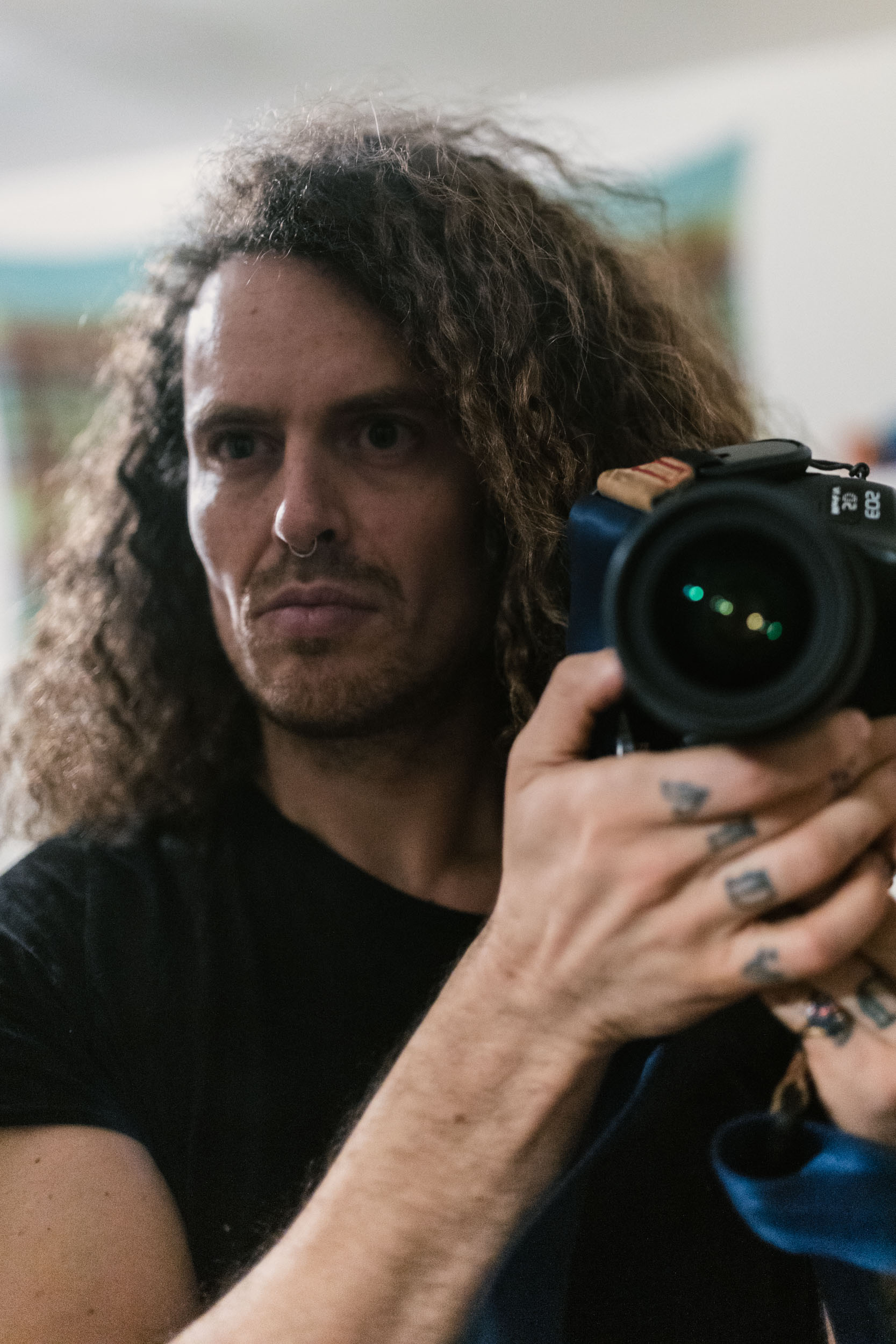
I AM YOU.
I AM (the human that will find) YOU.
I am carving the words you spoke
On the carcass of my mind.
They’re the seeds from which
Will spring forth a new one
A new divine. In between
Those words and moments past
Have crept in the soliloquies
Of my disengagement, my sorrow,
My self-made sadness
Stitched around me like
A cacophonous sarcophagus
Carved by my own fears.
In this I see the pain is the way.
The path through which I will encompass
All Understanding. No longer resisting
Or pretending otherwise. Not through masks
Or basks in my own lakes of misery.
I grow this new one because the old
Is discarded. It was never me anyway,
Just a tool by which I perceive
From time to time — to calculate and groove.
I am its author, not I it.
The junctions are branded at the joints
Of my body: my spirit — my eyes, my mouth, my throat.
Sometimes I crack misshapen
I regrow. Golden ore adhering the pieces
Stronger, brighter, sparkling.
And in all of this, the lesson is to TRUST.
To trust love, the knowing, the all-knower:
The conscious all-watching mind that is not a mind
But encompasses all minds.
Not “God," but I and You and Her and THEY.
Frequent flowerings such as these
Will be my new garden upon which I’ll nourish
And feed not just my own life and form, but those
Ones around me. How sorrowful it is to forget
The truth, to live in opposition
To slake your thirst in misunderstanding
And inner hatred.
But how sweet the nectar that pours
Forth and is there always.
When the resistance is mended, and the path
Which has always seemed uncertain
Is clear and cleaned
And full of unspeakable joy on either side
Of those crystalline daggers,
Aimed straight for the heart.
Tarot, tarot on the table
I think I’m weak but I am able.
The signs conform and confirm the wonder
I knew is beneath these bones, and groans.
They’re not on loan, but always
Right around the road.
I comfort myself with a trek down the tightrope,
Having grown too old for blanket and bottle,
Not in cancerous morsels that taste of deaths
And bleating screams.
I am Tathagata, the ruler of my own
World, inceptor of inceptors.
Guardian without guard.
My chariot awaits my hands to the reins.
It is poised and ready.
The horses fed and watered.
Bristling with jittering excitement,
Muscles twitching, not tense.
I once feared their billowing nostrils,
The hot breath on the back of my neck
As anxiety, but that was a misunderstanding.
In sum,
I am you.

Millennial Christians and the Post-Evangelical Love for Sufjan Stevens
As early as 2005, the Los Angeles Times was announcing the arrival of a new generation of musicians whose preference for introversion over boisterous ego and overwrought sexuality signaled a “Soft Revolution” of sorts. At the forefront of this timid overturning within the music world was Sufjan Stevens, a singer-songwriter whose sincere style seemed to offer some form of respite from the nonstop churning of commercial hits with easy hooks. Attributing Stevens’s success to an audience hungry for evidence of authentic artistic expression that could provide a break from the pulsing beat of nonstop commercialism, the Times opined, “It’s about the fact that everything is Coke and Pepsi these days, and it’s all mass-marketed to kids, and they just want some relief.”
In that sense, it’s obvious why we millennials are drawn to Sufjan Stevens music, and perhaps even more so for those of us raised on evangelical American rhetoric. The “relief” referred to in the Times piece was even greater for us. For in addition to being subject to the mass-marketing efforts of companies like Coke, Pepsi and Warner Bros., we also had an entirely separate marketing machine vying for our attention, one whose output seemed to say that music’s “goodness” is measured from its overt message rather than its aesthetic quality or formal nuances.
I first heard Stevens’s music in the twilight of the early 2000s while attending an evangelical Christian university in Virginia, and after a lifetime of Sunday School, Vacation Bible School, and W.W.J.D. bracelets — a lifetime of being in the world and not of the world.
From an early age, I was informed of an all-out culture war between Christians and non-Christians, those who knew the Truth and those who believed lies. Christian music was about Jesus’s love and believing the things that keep you free from eternal damnation. Non-Christian music, the music of the secular world, was about sex, drugs, and materialism and it was best to stay away from it.
As an alternative, we were offered music that sounded similar to its “secular” counterpart but was missing the same raw energy and effortless enthusiasm. By comparison, the music felt rather fake and lifeless. When I asked why this was the case, why secular music was so much more enjoyable than Christian music, the most common response was that sin is designed to be appealing and pleasurable. It didn’t feel like sin, though, in middle school when I’d stay up late in my bed, curled around a tape deck radio, listening to hours of programming and quickly (but quietly) hitting “Record” for the songs I liked but had to keep secret. It felt like excitement. It felt like discovery. A sonic portal to a brave new world.
What the Christian music industry struggles to realize is that when aesthetic value takes the back seat in the church van to over-present, often alienating dogma, the work fails at its central purpose: “to shatter the frozen lake of the soul,” as Franz Kafka once put it. In other words, the music fails to proselytize in the truest sense of the word: to create an experience wherein the individual recognizes and accepts something new that will change their life for the positive.
Stevens, at least in practice, understands that when you shout, people are inclined to cover their ears. When you whisper and invite them to hear, however, they just might incline themselves closer to get a better listen. It all sounds way more believable when you don’t feel the need to increase your volume to attract attention. By allowing his work to be the byproduct of faith rather than letting faith itself become the product, Stevens proves that authentic belief and expression can co-exist on the global stage. That such an expression of faith can even come through in a world where most everything else seeks attention by being big, loud, fast and bright, makes Stevens’ project all the more valuable to the ears of his listeners.
Such a post-evangelical approach to songwriting often means he never addresses his faith as static dogma, but rather within the context of where it truly exists: in the act of living, in breathing, in caring for others, in reconciliation and in loss.
Whether it be the beautiful or grotesque — a mournful ode to the devastations of bone cancer or reflections on John Wayne Gacy Jr. — Stevens manages to find a place of reconciliation through soft vocals, biblical references, and symphonic structures to create not so much songs to consume as narratives to visit and experience. One result of such narratives, for us millennials at least, seems to be relief. Relief from trying to reconcile the words of Christ with one’s interaction with a Church that so often tends to favor those same forms of expression and coercion which undermine the type of experiential richness available within the arts once attended to less dogmatically. Clearer still, Stevens shows us that carefully crafted expression can provide a space for theological concerns to exist in a public forum without alienating (or boring) anyone from any perspective.
Here we seem we seem to be invited to come together and enjoy something for what it is, and perhaps to reflect upon what makes it so meaningful – what makes life so meaningful – amongst a variety of people who are likely to have a range of answers to these questions. The possibility for such an exchange, be it in music or otherwise, seems to depend only upon our capacity to listen and to speak with a certain sincerity at our disposal. As if to sing, once again, without worrying what one’s tune might sell.

My faraway view of Sufjan Stevens at Wolftrap on July 22, 2016.
This article first appeared in Transpositions. I was asked by then editor (and longtime friend) Dennis Franklin Kinlaw III to write about this topic, given my perspective as someone who grew up in evangelical Christianity (but later realized said theological form to be an ill-fitting cloak for me and my experience). After many drafts over an estimated 80+ hours (with Denny providing much guidance), the piece took the above shape.
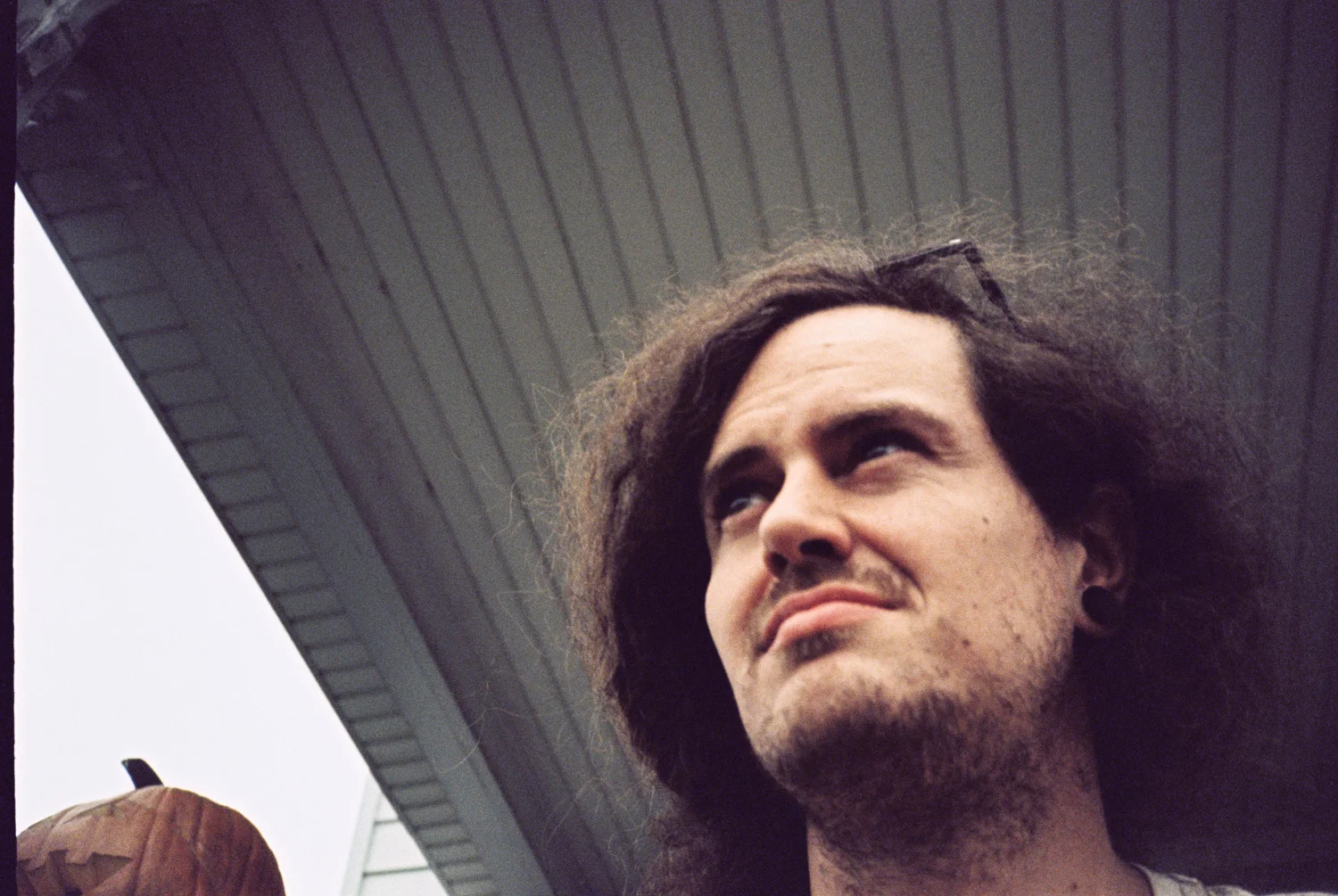
Poem: Unforgivable Deceit
Unforgivable Deceit
The sin of ultimate
destructive power
[oh how it seems and seams]
is disbelieving
one's own
ability to be
#loved.
(2016)

Poem: Woefully Human (Without Woe)
Woefully Human (Without Woe)
Woe is he who is not woe,
For all others shall bring
Their burden of disbelief and suspicion
To the sepulcher of his sorrow.
Woe is she who is not woe,
For her smile will alight
The angers of the sleeping
Sardonic armies of unknowing
Malcontents, encumbered
Like pincushions of daggers.
(2016)

On Being Your Authentic Self (guest post and film for The Listening)
Read my words on The Listening's blog
Short promo film I created to showcase the general experience of The Listening.
As my life has been in a fairly consistent state of flux since ... forever, the concept of "being authentic" (and no, in case you are worried, I never use the #liveauthentic hashtag).
For me, being authentic has less to do with searching and finding but more so with simply being still and realizing what and where you actually are.
Nick George, founder of The Listening, asked me to create a guest blog post in honor of tomorrow's session. If you attend, you'll likely see me doing a bit of photojournalism for Riverviews Artspace.
You may also see me perform a song and poem. No promises. But it's likely.
In the meantime, you can read my guest post on The Listening's website.

From negligent alcoholic to dedicated parent and doing yoga
You can change too.
Header image from a recent shoot with James River Yoga.
—————
I just realized that as I type these words, I am somewhere past the two year mark of practicing yoga, two years of engaging in a lifestyle and pattern far different than I would have ever conceived for myself — even up until the exact point where my switch finally flipped from progressively unhealthy to getting well.
I have been many things in my so-far short life. Thirty years is not a long life, but it sure feels like it sometimes, like my experience is a living cassette tape played (and worn) at 2x speed to fit in an extra 30.
I have been a college newspaper editor and columnist. An intern at a mom-and-pop newspaper. A high school literature teacher. An intern at a culture and arts magazine that highlighted the avant-garde leanings of Buenos Aires, Argentina. And let's not forget the years of my life spent in restaurants, serving soft drinks to kids, decaf to seniors and microbrews to coeds.
I have been a copywriter and a “reporter” for the propaganda wing of a well-known (for good or ill) institute of higher education. A newspaper designer and copy desk jockey. I left to try making more money as a car insurance salesman. It did not go so well.
I worked at a retail store for 18 months for less than the local poverty rate, while expected to operate as $50K/year marketing professional. Then I worked as a content manager for a counseling brand which, ironically, led me to depression, anxiety and extreme distractibility.
Throughout most of these experiences, I was married (we split at the end of 2015, but remain friends). I tied the knot two weeks and one day past my 21st birthday, with a year of undergraduate Christian college yet to go. Having grown up in the restrictive environment of WWJD bracelets, “go-against-the-flow” T-shirts, dogma-driven re-creations of pop culture references, and Vacation Bible School — where everything “outside" was considered unquestionably bad and everyone inside unquestionable — one is led to dip a toe into the pool of non-restricted life.
You quickly find the water is welcoming, warm ... and suddenly overhead.
I became an alcoholic, arguably in the few weeks preceding my marriage, which leads my therapist to suggest that I have a genetic makeup prone to addiction. It took me eight years and three children to emerge from no less than a slight buzz (if not a full-on blackout) on a nightly basis. That emergence came in August 2013, not long before I started yoga and right in the midst of when I stopped writing almost entirely, and instead spent my time taking pictures and shooting films at most every opportunity. I even squeezed small music video shoots in during my unpaid lunch breaks from my marketing gig at the retail store.
It took me going deep into the alcoholic pool, so to speak, to finally find my way out by means of the drain. I had lost all semblance of my childhood faith in 2010, a tumultuous summer that was less of a turning point in life and more of a completely destructive period of painful upheaval (the effects of which have yet to fully play out). The de-conversion pulled me even farther into alcoholism (age 25), into a three-year chain of late nights that I wasted on getting wasted. Those nights turned into mornings that sat heavy on my chest, like the 1,000 elephants in the bedroom that kept me from engaging with what was most important to me, what meant the most and for that which I labored so much to secure: a love for (and of) a beautiful spouse, otherworldly amazing daughters, a home I own(ed), a passion for lyricism and a desire to take up my post in the infinite tunnel of lamps and mirrors that stretches throughout time and place.
Simply stated: I was too depressed and full of toxins to roll off the couch to play in the sandbox or to crack an egg.
I was sick. Overweight physically and emotionally. Distant. Neglectful of myself, of those around me and allowed my so-called talents to dull. I subjected myself to the horror of clearly seeing the life I wanted to live while wondering why, over and over again, WHY I continued to act against it. An invisible figure, perfectly matched to my form, stood in my way down every pathway that could have proved infinitely more beneficial, lovely, profitable and enjoyable. I continued to wonder why I did and spoke such a way at such times.
I resisted the truth of it — too awful to comprehend in full and so instead of changing things, I persisted in foolishness.
That is, as I said, until August 2013 ... when a fully-grown doe jumped out onto a dark Virginian roadway to commit suicide beneath the front wheel of my vintage motorcycle.
Yet another venture that my then-wife suggested against with her sage-like clairvoyance. I slid 30 feet down the street, shredding my backpack. Remarkably, I hobbled away with minor scrapes and bruises. Two days later, I found myself on a plane to Los Angeles after accepting two invitations: to assist on a commercial shoot and to maybe give up drinking while I was out there in an effort to gain some physical and mental stamina.
(For the record, I was not intoxicated while riding the bike, but had been within the previous 24 hours and also immediately afterward).
Within 48 hours of no alcohol consumption and cleaner eating, I felt different. Sharper. More energetic. Present. I wound up in the apartment of famed rock-and-roll guitarist Warren Cuccurullo, whose many successes (world-renowned skill, multiple projects still ongoing, restaurants and a level of physique one cannot help but gawk at) he attributed to something he learned from his idol and former bandmate, Frank Zappa: He didn’t drink.
Aside from a sip at my friend's wedding a month later (wine made on location) I have not consumed a single drop of alcohol since, and doubt I will ever again. Everyone’s cognitive disposition and biology is different, but for me, I look back at that time (and the Instagram post) and give thanks to that doe who sacrificed her life — however unintentionally — so that I might regain my own.
It was in the following months that I began practicing yoga, and soon found myself at peace with myself and my surroundings while also growing more and more aware of how much of my life and love had been misspent. How much I had thrown away potential for just another night of IPAs and indie bands while my co-parent sat home wondering less and less:
When will he grow up? Where is he? When will he come home?
By the time I came out of this eight year hangover, many mistakes had already been made. No amount of yoga, meditation and gluten-free eating would unmake them. No deviation from my irrationally angry past would erase the trails that were left, would silence the vile, untruthful words I used to spill upon a person I love and respect above most others and, for reasons of puerile selfishness and addiction, I had forgotten how to cherish. The me that knew how had been drowned out and silenced (it’s all so painfully clear now) — but they're back.
All of this and more has pushed me from job to job, craft to craft, always seeking the peace and purpose that has been right in front of me all along. The peace I would never find in cigarette ashes, broken bottles and pot resin. The peace that is only found in loving well, loving often and loving incessantly.
Although, as said earlier, I feel decades older than 30, I also feel like a new human each and every day. On some mornings, I sense limitless possibilities for learning and capability, and on others I feel terror and vulnerability — like I am and adult who still doesn’t know quite how to stand better than a newborn giraffe sent out into the world with a disproportionate stature-to-experience stability ratio.
It’s hella frightening at times, but I’m beginning to wonder if that's the point.
I wonder if all of this living and learning, all of these life inversions that seem as inevitable as they are scary are pushing us onward into something real and beautiful and new. Perhaps instead of shying away from these heuristic flips, what I really need to do is dedicate myself to practicing them fully — like my crow poses, headstands, and shoulderstands.
The word yoga, in Sanskrit, means union. It is a union wrought from uncomfortable moments, often difficult to engage with and sometimes the last thing I want to do on any given afternoon. It’ll hurt. I’ll sweat. It will take and hour or so away from seeking another freelance client or from writing clickbait at a reckless speed to make the few dollars worth the time — all for the sake of creating noise, distraction and self-serving SEO rankings (which seems to be the one of the only marketable self-employed uses of a journalism degree, these days). But it always silences the internal voice, the voice that once called me away from my typewriter, down the street and into the bar. The voice that tells me nothing in this life makes sense.
It feels like our entire system is inverted right now. Few things feel substantive outside of spending time with the people I care about and practicing that which generates not money but inner and outer peace. We are faced with the reality of one bozo presidential option over another, while the only candidates who do seem to be authentically humanitarian are considered to not have an Icarus-the-pig in a hell-bound blizzard’s chance of getting elected (or much less, making a difference). We are faced with the quandary of doing what enriches our plotlines vs. what lines our pockets. We opt for the latter, and then wonder why the world is in bass-ackwards turmoil.
We seem to be choosing the same foolishness again and again, if for no other reason than we are used to it. History repeating itself. Dog to its vomit. Fool to folly. The Ego making sure we continue to confuse our limited thought patterns for our identity.
I predict either doom or transcendence. What other options are there? Because if there’s anything I’ve learned in the largely silly and ill-managed years I’ve spent on this planet, it’s that the status quo leads to nowhere but a cruse controlled careen on a windy mountain roadway. Things get better or they get worse. Stagnancy is a myth. As much of a myth that we need only bide our time and wait for some other person or entity to step in and save us from our own inactivity.
That's never going to happen. Change can be sparked by events outside of ourselves, but it can only be sustained through internal dedication. Through coming to terms with our very own foolish hearts and minds and deciding to walk another path.
For me to come so far in alcohol abuse as to now be counting the years of sobriety, for me to go so far away from angry as to now be idyllic in my pursues of unity and peace, for me to have once ignored the very things that are now the only pursuits I give any real lasting shits about, I know that you, dear reader — soul of my soul, consciousness buried in negative self-talk, fear, and disillusionment — are capable of doing the exact same: inverting your life.
There are two ways you can go about it:
Practice, so the labor and pain becomes your joy.
— or —Play roulette: Dive even further into the chaos of needless suffering — and, through the sheer agony of it, come out either reborn or dead.
The choice is yours.
(If you want to see the physical proof of what I am talking about, here's the before-and-after:)
That's me on the far left, Fallen Leaf Lake, California (September 2013).
Me in April 2018: 70 lbs., several addictions, and many emotions lighter.
How would you like your life to be different? What's standing in your way? What can you do about it today? Let's chat in the comments section.

Mystic Numbers, Mythic Voice: A photosession with Lloyd Harmon
“THEREFORE, WITHOUT BEING ATTACHED TO THE FRUITS OF ACTIVITIES, ONE SHOULD ACT AS A MATTER OF DUTY, FOR BY WORKING WITHOUT ATTACHMENT ONE ATTAINS THE SUPREME.”
— THE BHAGAVAD GITA
Jeremiah Lloyd Harmon contacted me in the fall of 2015 to obtain headshots for an upcoming voice recital.
The request came at a time when anxieties about some personal issues were mounting. Taking photos started to become a challenge. The excitement I once felt when preparing for a shoot was nowhere to be found. I would get worried about the end result being "cool" enough.
I used to get a similar sinking feeling when I worked various day jobs, but instead of being worried about the hip-factor, the sensation had more to do with work that required me to compromise my ethics in some way. Having since shed all such employment, the reappearance of those feelings was troubling.
It was a time when I learned to lean into a quote from The Bhagavad Gita, which Steven Pressfield paraphrases in The War of Art:
"We have the right to our labor, but not to the fruits of our labor."
The shoot took place on a foggy afternoon in downtown Lynchburg, Virginia. With rainwater dripping all around us in a leaky parking garage, we started off with some traditional headshots. After about an hour of snapping photos on my 5D Mark II and a Pentax MX 35mm, I started to feel a bit more comfortable (submitting to the process).
I clipped my UE Boom Mini bluetooth speaker to a belt loop on my jeans and let tUnE-YaRdS set the new rhythm.
Jeremiah transitioned from formalwear into street clothes, and then into something more representative of his true self: a Lebanese thwab, chalked-up Nikes he wore during high school basketball days, a baseball cap and a hooded green bubble parka. He could have just as easily looked like a cross-dressing hobo, but instead the ensemble felt cohesive and natural. He pulled some recent artwork out of his car, a Sharpie from his pocket and inscribed the number “3” on each palm.
The singer held the backs of his hands up to his eyes, recreating the scenes with El Hombre Pálido in Guillermo del Toro’s Pan’s Labyrinth.
I meant to ask him then the significance of the 3s, but I often get into a moment-to-moment flow while my shutter fires. The thoughts slide away. I’m simply breathing: present and responsive to the human on the other side of the lens.
NUMEROLOGY
When I sent him some digital samples later on that evening, I shot him a message on Facebook.
“Oh yeah. What’s behind the 3s?”
“33 is one of my favorite numbers,” he corrected. “It’s related to numerology.”
My only experience with something even related to numerology, the belief that numbers have a mystical connection to real life events, is the esoteric Jewish practice of assigning numeric value to Hebrew words from the Torah I read about in Chaim Potok novels.
I’ve never given it a second thought, but I’m a lot more spiritually open/curious these days. I looked into it, and immediately connected with a couple lines:
“A 33 used to its full potential means that there is no personal agenda, only focus on humanitarian issues. Someone with 33 strongly featured in their chart has the ability to throw themselves into a project that goes far beyond mere practicality.”
While I have yet to begin any investigation into my “chart,” this sentiment struck me because of the way I approach my life and work as a single practice.
After years of being employed at various functions — copywriting for evangelical higher education, editing advertising-heavy newspapers filled with syndicated content, receiving payment from companies that mistreat their staff and getting glimpses in the national advertising world that hocks harmful products for the sake of profit for a select few — I came to the conclusion that I cannot ethically accept a check in exchange for my complicity with what I believe is damaging to our lives and environment.
No, I don’t wish to help you sell your tobacco product. I will respectfully decline to create video content for a low-prices retailer with an inhumane work culture and bottom-dollar wages. Making any amount of money is not worth the weight of my soul, knowing that I am perpetuating “the problem.”
Instead, I’d like to take the route numerology ascribes to the Master number 33: Focus on humanitarian issues, no matter how “far beyond mere practicality” doing so might seem.
I would much rather film a low-budget sizzler for a local yoga studio than create another wine commercial. Or, like in this instance with Jeremiah, help a fellow artist bring more beauty into the world.
TURNING PRO
Up until the day of this shoot, I had only known him as the fiery-haired singer-songwriter who kept popping into my periphery through the landscape of the local music scene.
About a year before, my brother sent me mobile footage from a coffee shop performance where Jeremiah played an original tune, “January Eyes,” on a harmonium, and also a cover of Gnarles Barkley’s “Crazy” — both of which challenged the capacity of my iPhone speakers despite the simple live setup of one voice and one instrument per song. I was shocked by his level of vocal ability, a cross between Jónsi, Jeff Buckley and a soulfulness uncommon to his complexion.
I texted back to my brother: “Holy shit.”
He’s an anomaly: a ginger who sings in a gospel choir, performing solos simultaneously transcendent and reserved that break through already-powerful backing harmonies. And his personal work draws heavily from electronic experimentation, otherworldly folk music, jazz, eastern philosophy and esoteric knowledge.
For a transient town such as ours where bigger talents pass through from time to time — but only to get a degree and shove on to bigger cities to find room for self-actualization —discovering an artist’s artist such as Jeremiah is a rarity. He isn’t waiting for greener pastures to flex the fullness of his creative muscle. Instead, he’s actively engaged with the process of fertilizing his work in the “here and now” of a strange (yet lovely) Bible belt city.
Pressfield, in Turning Pro (his follow-up to The War of Art), lists this attribute in his twenty Qualities of the Professional:
“10. The professional plays it as it lays.”
Even pro golfers foul up a stroke from time to time and send the ball into the cut. There’s no option but to submit to the reality of a bad shot (“play it as it lays”) and get back into the game. The lesson is that any amateur wanting to turn pro must learn to not approach these moments with discouragement, but to perceive shortcomings as opportunities to embrace her or his current skill level and to attempt a course-correct.
Accept and work with reality. There’s no other way to progress.
No, Lynchburg isn’t the most opportunity-laden town for artists of any medium (at the moment), but a true artist like Jeremiah practices regardless of externalities. I pass by his room now late at night (I now rent a makeshift “studio” — a spare room in the midtown duplex where he lives with two other singer-songwriters) and hear him live broadcasting his painting and songwriting process on Periscope. Or I come by in the middle of the day and hear him experimenting with outlandishly beautiful sound samplings and beat makings on an Akai keyboard. I hear him pumping away on his harmonium while he allows his voice to effortlessly float with the powerful, always-on-pitch control that a show tune singer would envy.
And while the experience of his art (like I said earlier) is one of transcendence, a near mythical vocal quality infused with the musings of a mystic, there’s also an undeniable practicality to its practice — an application of ass-to-chair (to paraphrase Norman Mailer), an application of Self to simply do the work we feel compelled to do while letting the unknown results of that labor come about of their own accord.
Perhaps this “mere practicality,” attributed to the number 33, the number Jeremiah wrote on his outstretched palms doesn’t mean impracticality, but rather a far greater practicality. Perhaps if instead of doing things merely for an anticipated and assured outcome or gain we did them simply for the sake of doing — for self and for humanity — we would find a far greater reward than we could have ever conceived.

Poem: The Anatomy of Daughters
The Anatomy of Daughters
Breath too human to the smell.
Complaints too momentary to consider.
Alternating cereal scoops: hand and spoon.
Inconsistent dress; ill-suited for all weather;
Bright, happy, and free.
Roundness in the face brings pause ...
The mystery and masque of living.
Golden starshine through a hundred thousand strands
Growing longer from the source,
Prone to the tangle, the break, the fall.
Strength in each vulnerability.
Being in every new death.
Hope in all disaster.
###

The Prophetic Leanings of Matthew Paul Butler
Matthew Paul Butler (MPB) wants you to feel what he feels.
What he feels when he’s listening to Jeff Buckley, Bob Dylan and Songs: Ohia’s Jason Molina. What he feels when he’s writing or performing — perhaps putting down the microphone, unplugging the guitar and inviting you to hear the sound of your own voice and all the voices of those around you, together in the ever-present moment.
He wants you to feel connected, finding the way between you and yourself or you and something greater — even if that “something greater” is just the combination of yourself and anyone sharing in the experience.
MPB’s music is equal parts delicacy and anarchy — indie neo-folk soul rock — emotional and musical nuance and egress. His post-church, visceral spirituals are often raucous and attention grabbing, but with enough subtlety to incline you to turn up the volume (or stand closer) and let your eyelids fall in sweet meditation. You’ll experience a range of emotions set to lingering, distorted chords to sparse yet deft acoustic fingerings that provide reason to reflect or to throw down and dance.
Growing up between the Democratic Republic of Congo and the U.S. as the son of a charismatic preacher in a time when western Christianity drew a line through the music industry and proclaimed anything not overtly evangelistic to be unfit to be heard meant listening to the music he wanted to listen to was a conscious act of rebellion, carried out until early hours in the morning with a tape deck radio and foamy headphones.
MPB has in some ways strayed from his youth of leading music in churches, but there’s an obvious similarity between his father’s work as a minister and his as a minstrel. Both get to travel to meet new communities and reconnect with old friends, swapping stories about what it means to be alive, what it means to feel, to get bent, to disown old ways of doing things and to seek a new path.
Far from faithless, MPB’s beliefs are found in the expression of his day-to-day living, in composing melodic poems directed to strike you at your center and move you to do more than fold your arms and bob your head because you’re, as one lyric intones, “too cool to dance.”
Maybe, just maybe, you’ll heed his invitation to join in on the experience with him — to feel what he feels. You’ll listen to the words written for the exact moment you’re hearing them, for the exact ears that are hearing them, written for you to sing as your own words with your own voice, at once feel your feet grounded to the floor and your heart beating as if to remind you that you’re here, that you’re alive in the happiness and groaning of life’s chaotic orderliness.

Unstuck in space and time
It has become obvious that I'm unstuck. I'm in a perpetual state of leaving and going to all at the same time. Even while I'm sitting here writing this, I'm thinking about where these words could possibly go, and how I have to leave this job and go to another within a matter of hours.
I'm always going and leaving, which leads me to wonder which places am I leaving from and which am I coming back to. In short, there is no place that I go to where I finally "am" and that when I leave it I will eventually come back to it. I'm going off to somewhere else where I will eventually leave and then return to. All of it.
I'm realizing that the idea of coming and going is nearly irrelevant. I simply "am" wherever I am -- in one constant and permanent stream of nowness, and it's infinite, because when I inevitably die and decompose, the matter that formerly made up my skin, teeth, blood, flesh and these days mostly hair, will dissipate through the earth and the atmosphere, only to be recollected somewhere and become something else.
The point becomes to make sure that wherever I am in this moment, that I am making the best of it and not giving too much thought to what I have done or could be doing in the future. It's irrelevant, because neither of those timescapes exists. It's only what I'm doing in the moment that has any actual meaning, what I'm doing to build upon and enrich my forever current state of being.
It's always now. It always has been and it always will be.
It's infinite. Like an abyss staring into another abyss trying to make sense of it. Or, better yet, mirrors standing face to face. We're all doing this at all times, simply reflecting other people and everything, which is also reflecting itself. Infinity.
This is significant for creativity. At least it is to me in this moment. Knowing that whatever I do is a reflection of my environment and how I interact with it, and how that "image" is reflected again and again without end. The simple way to say it is that "everything is connected," which I believe to be true, but I believe that phrase is a misdirected oversimplification.
I believe that in the same way holy texts use the phrase "I am," that "We are." And it doesn't matter what happens tomorrow or in the future or after we die. Because it all will just be whatever it is, so it's ridiculous for anyone to do anything other than to just "be" and "do," since that's all there really is. Outside of that, it's all just distractions keeping us from being fully present and actually living.
My mind is so caught up in it's own constructs and endless loops that I fail to "do" more than I actually do. Even 90/10 would be an overly-generous ratio.
But enough of that. I'm approaching the precipice where my continuing to write this could begin to infringe upon "doing" and become more of a now waste. The only way, then, to be there, it to just jump into stream. And instead of letting it carry me along for a ride or, worse yet, sinking or trying to swim the other way, I'm charged with more than simply swimming with the tide: My task (or my life's purpose) is to create currents of my own.
Now and forever.

New articles, new insights, but more to come {in brief}
For my second piece in Lynchburg Business magazine, I was assigned to speak with local building juggernaut, English Construction (PDF). It's becoming a trend, it seems, that I'm on the construction beat. My third (PDF) was about an mammoth renovation going on in what was formerly the most advanced textile research facility in the country.
I'm a couple months in on my adventure of non-traditional employment. I do supplement my workload with shifts at my favorite bar/pizzeria and by doing some page design for newspapers in the region, but I have yet to regret my decision to leave my full-time job this past July.
There is definite struggle, though — it's what I signed up for. As compared to months (years, even) past, living feels much more full over these past few months. I'm doing more of what I enjoy. I'm more active (read: losing cubicle fat) and spend more time with my kids. And opportunities are opening up like never before.
So I might be tightening my belt from the combined effect of being more active and not being able to afford as much food, but I'm living for myself and my loved ones, and not under the thumb of any employer that maintains that they have any right to dictate the way I look, speak, dress and think.