
At the Crossroads of Fundamentalism and Humanism:
Recalling Bernie Sanders's Visit to Liberty University
Recalling Bernie Sanders's Visit to Liberty University

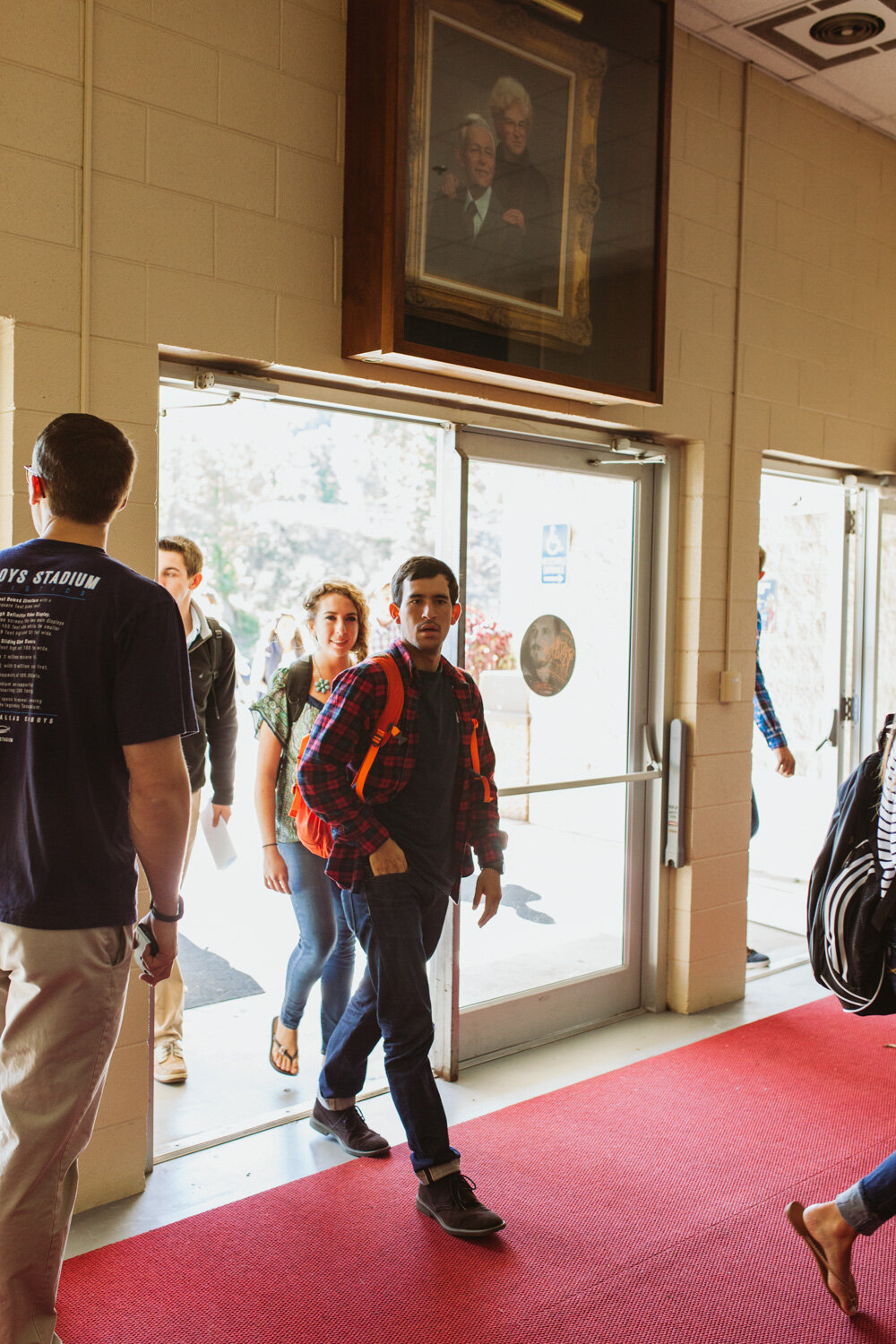
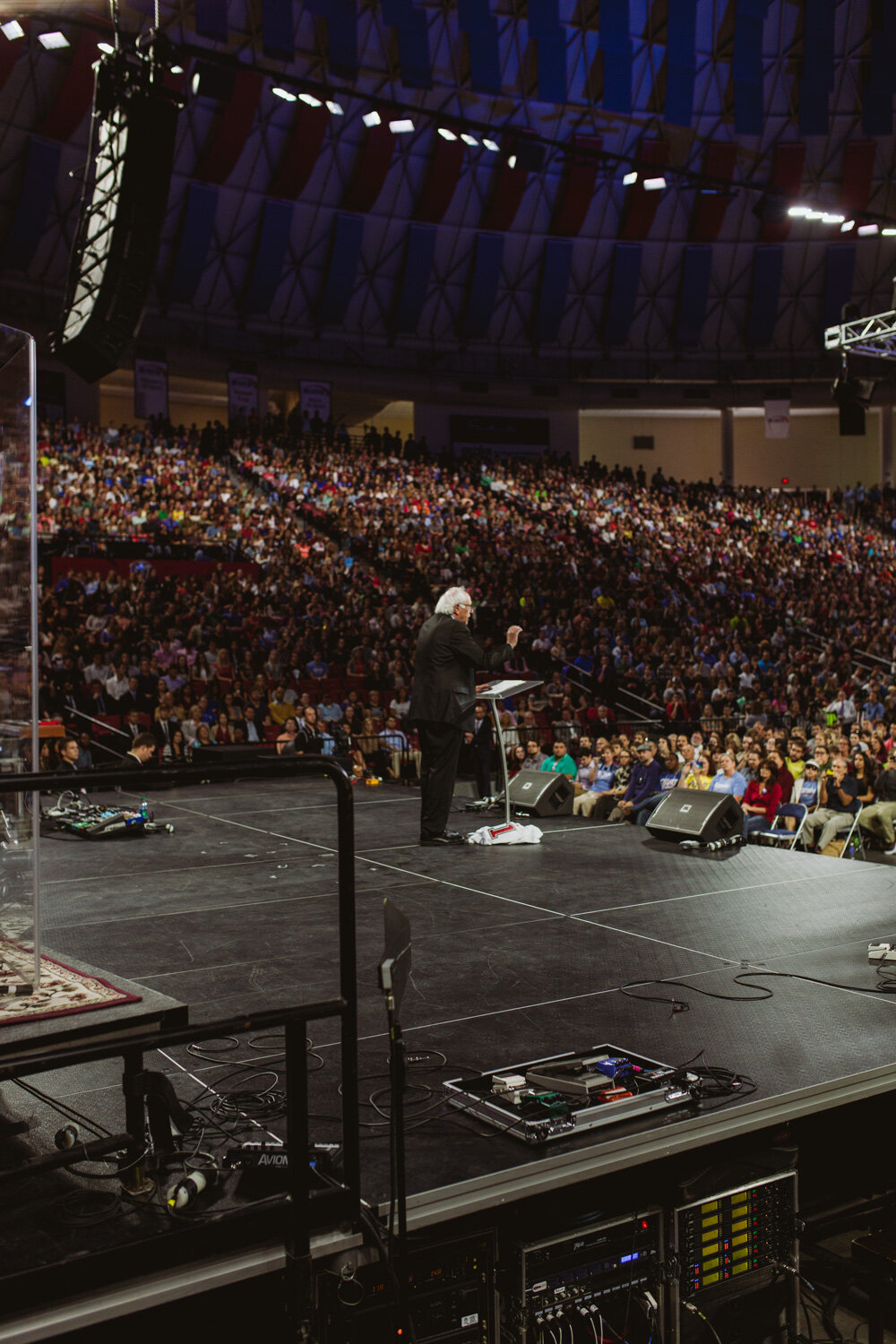
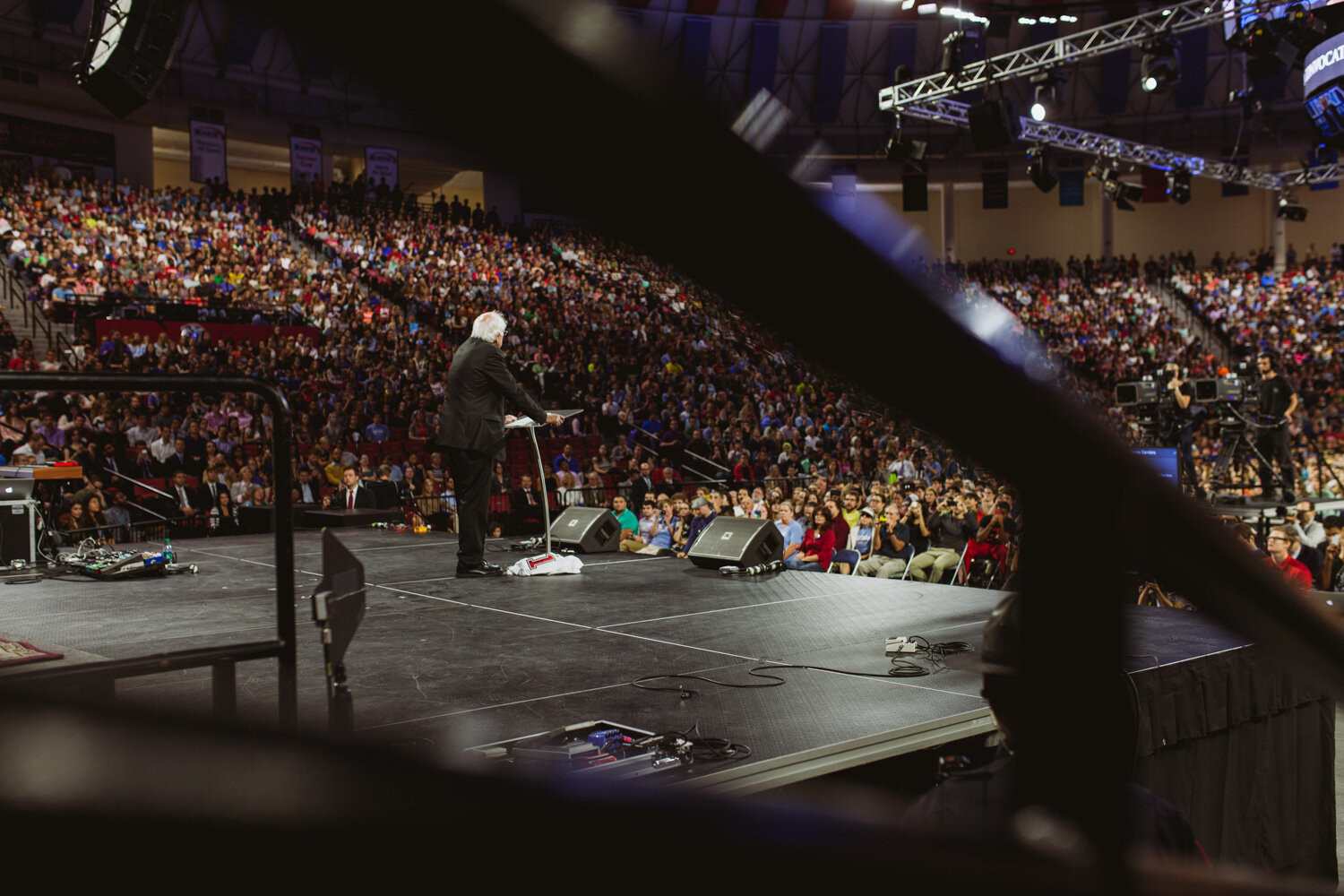
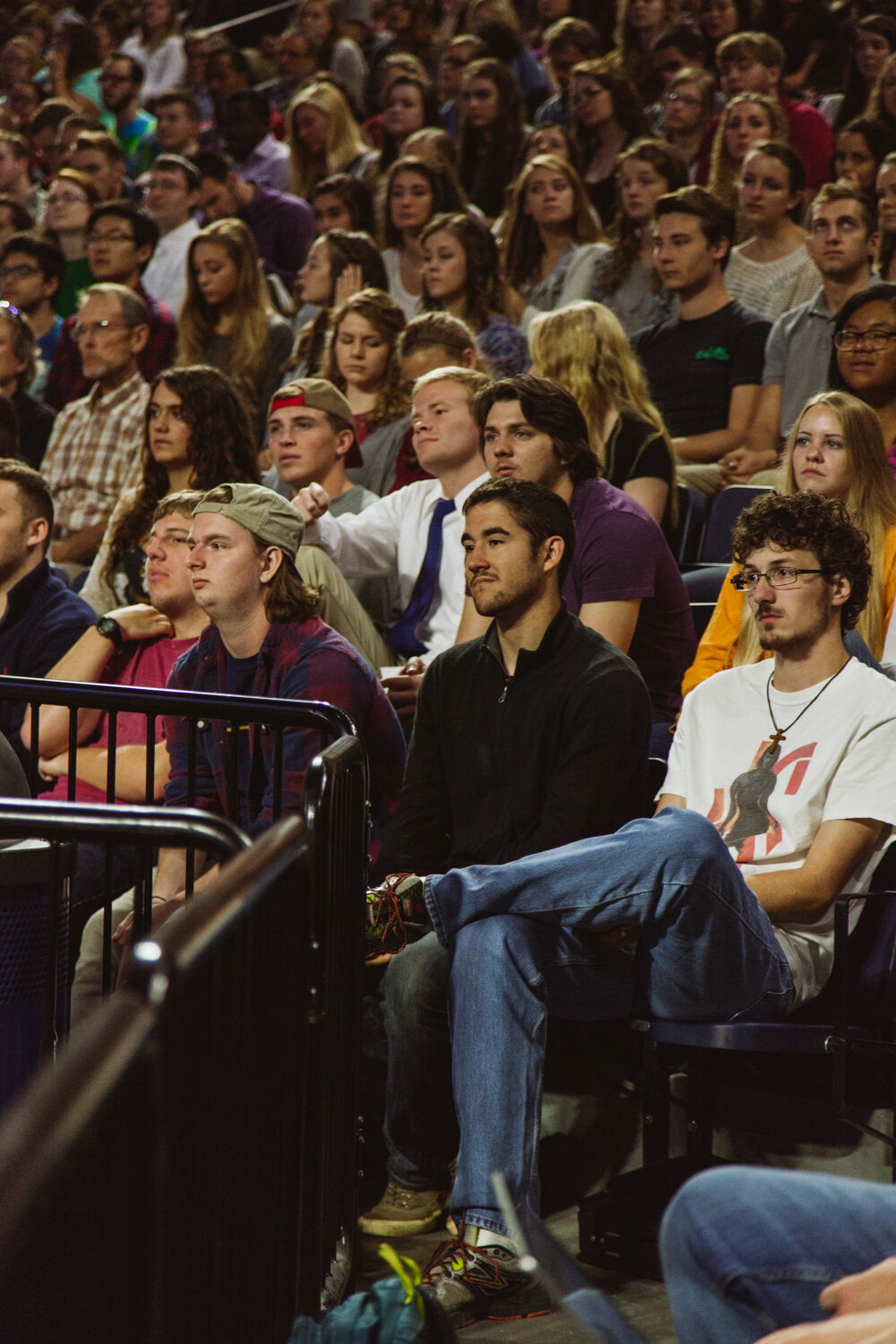
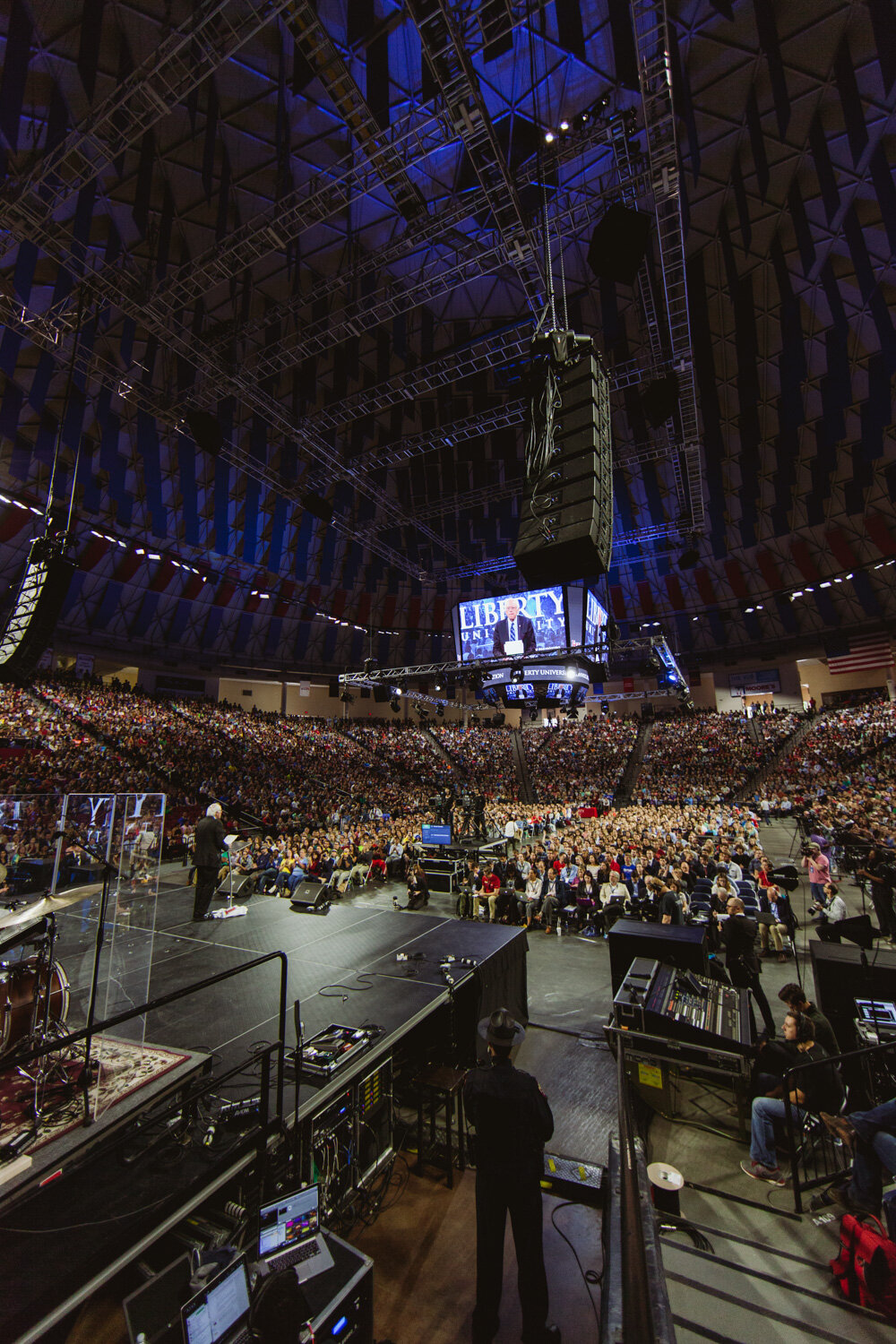
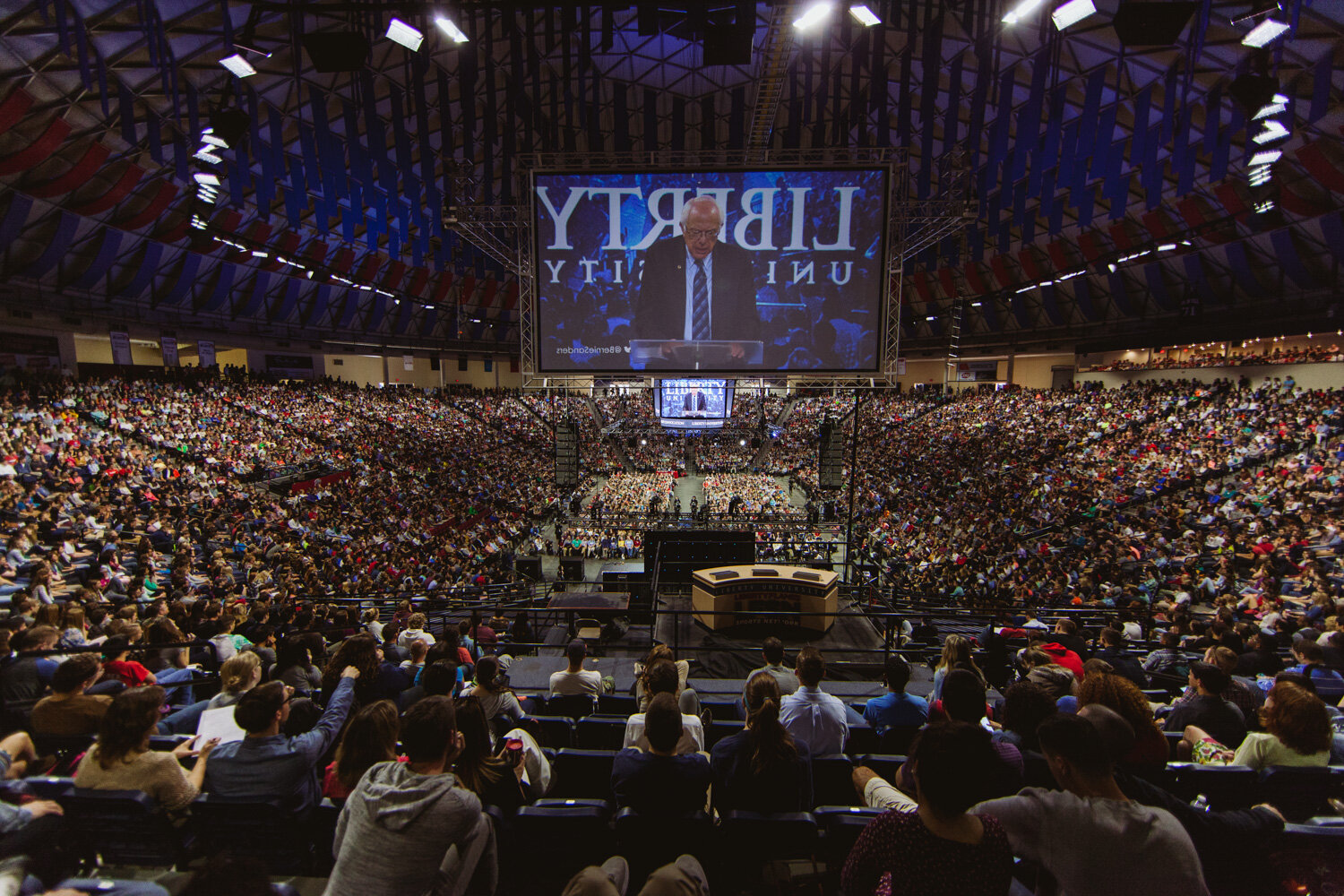
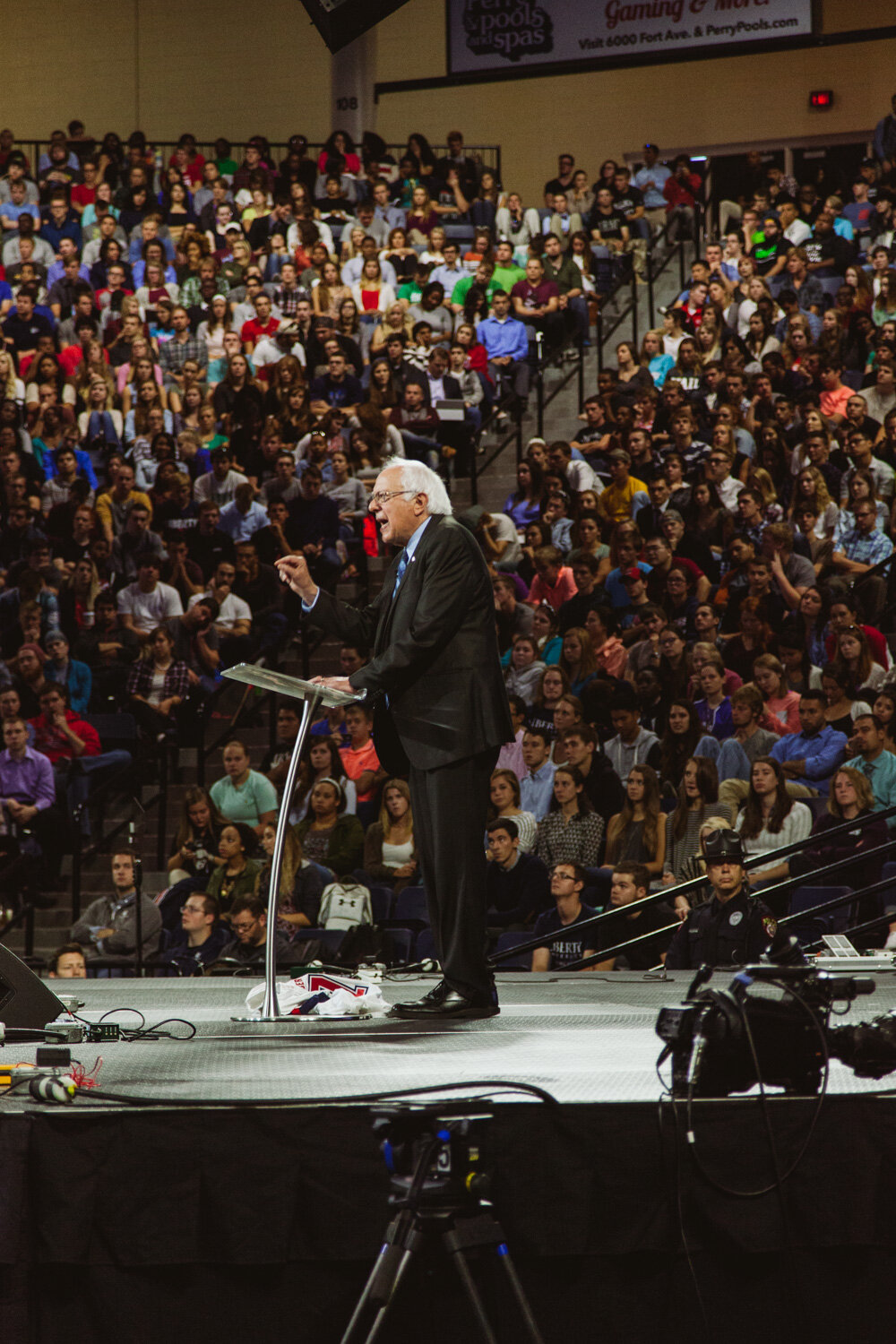
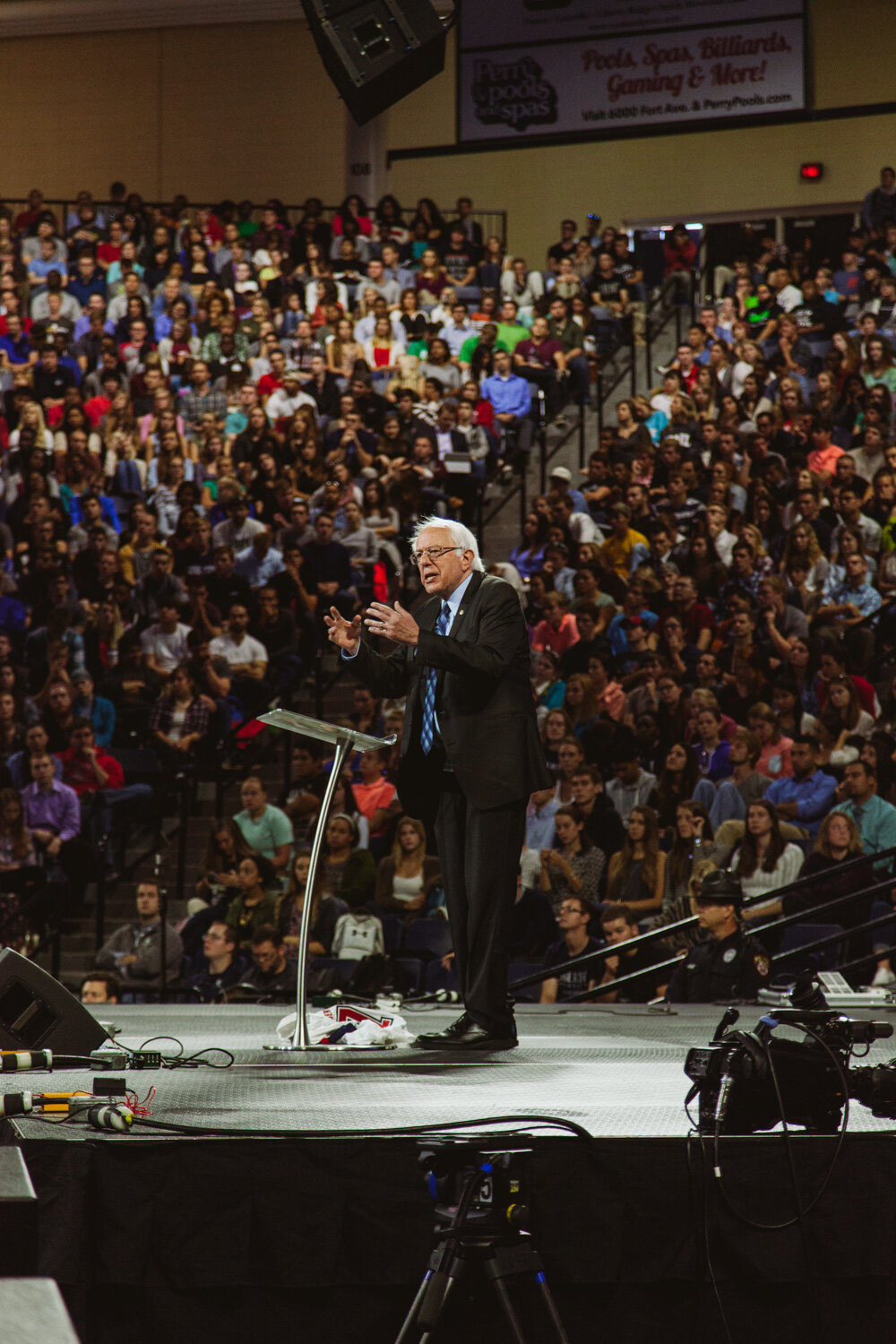
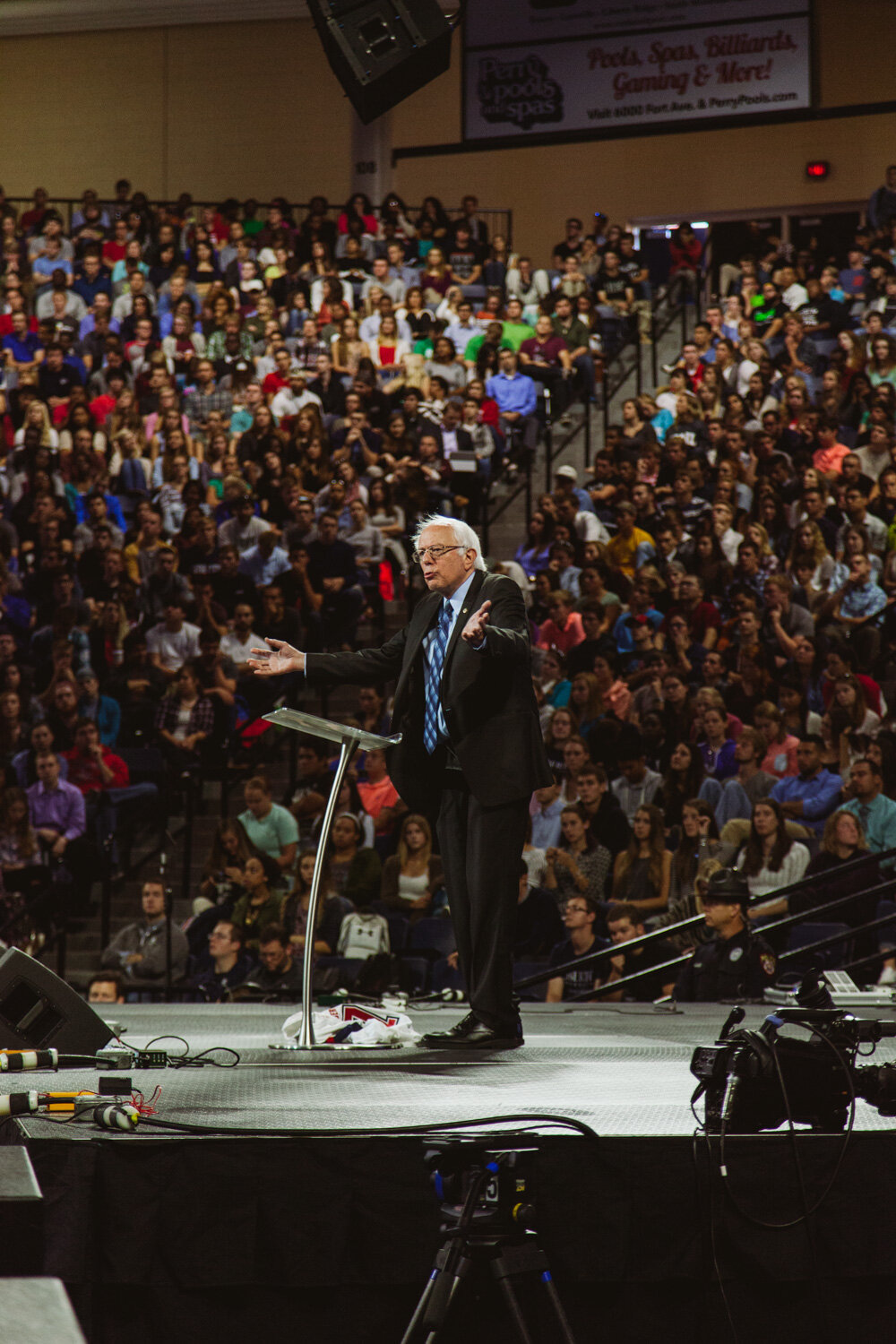
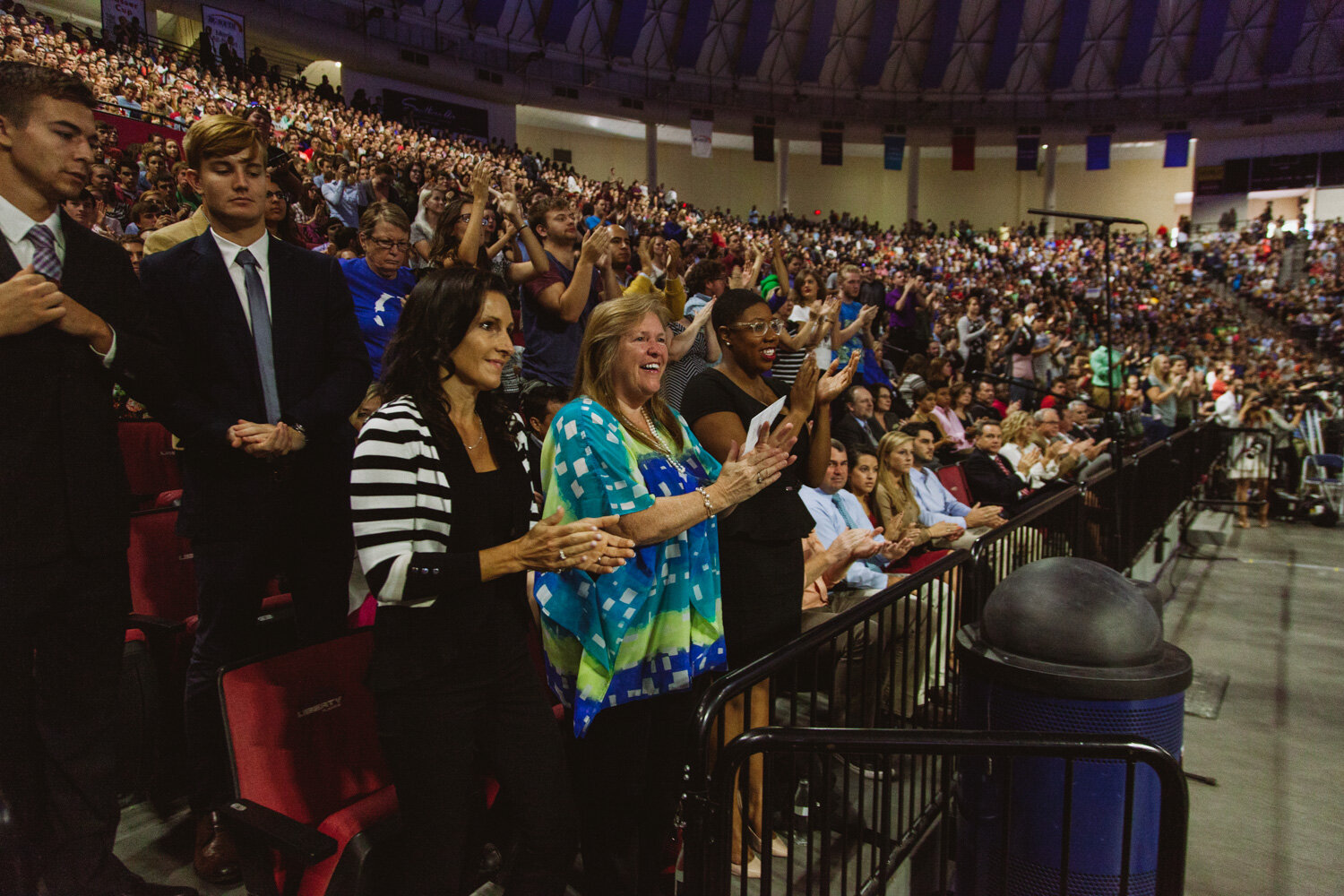
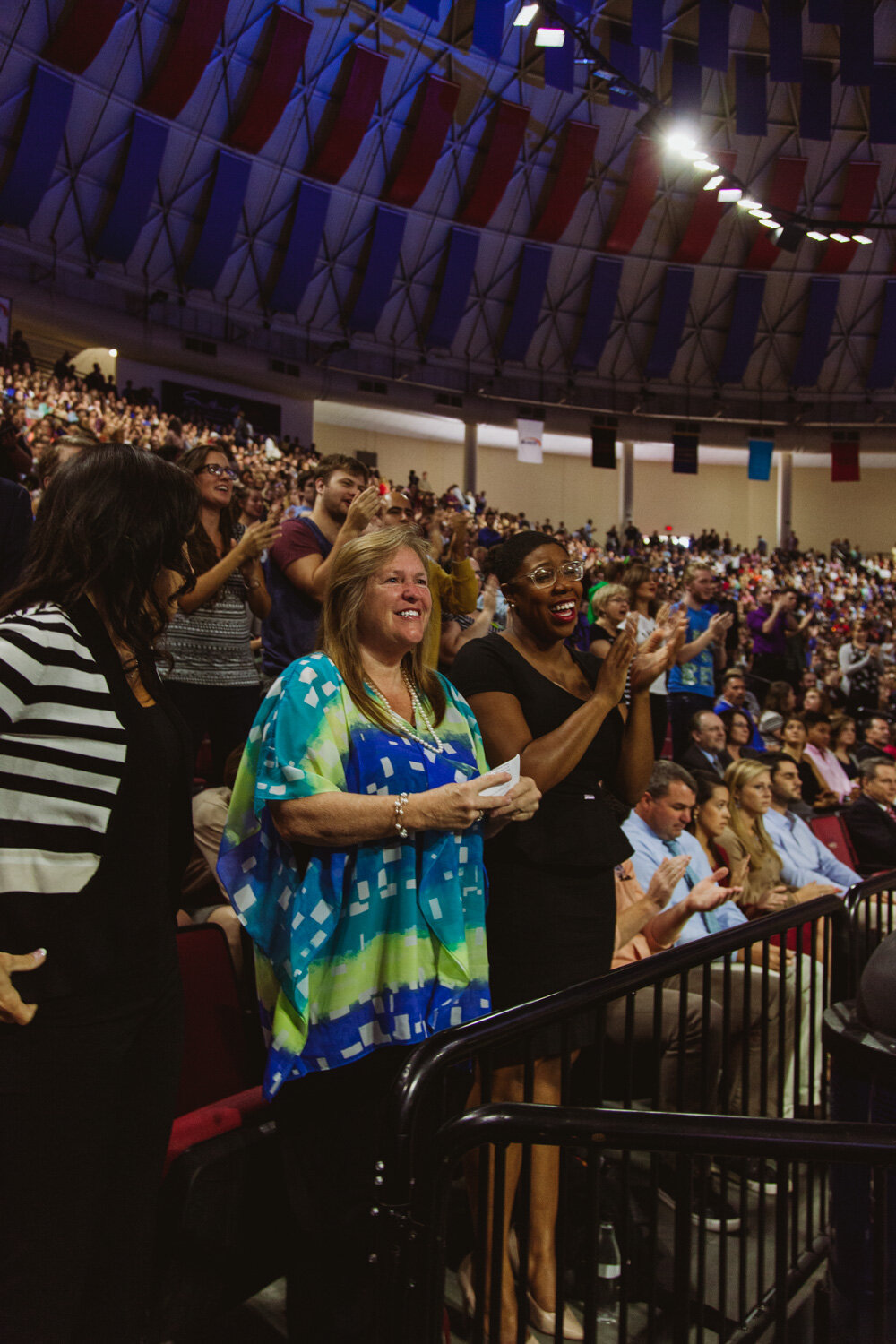
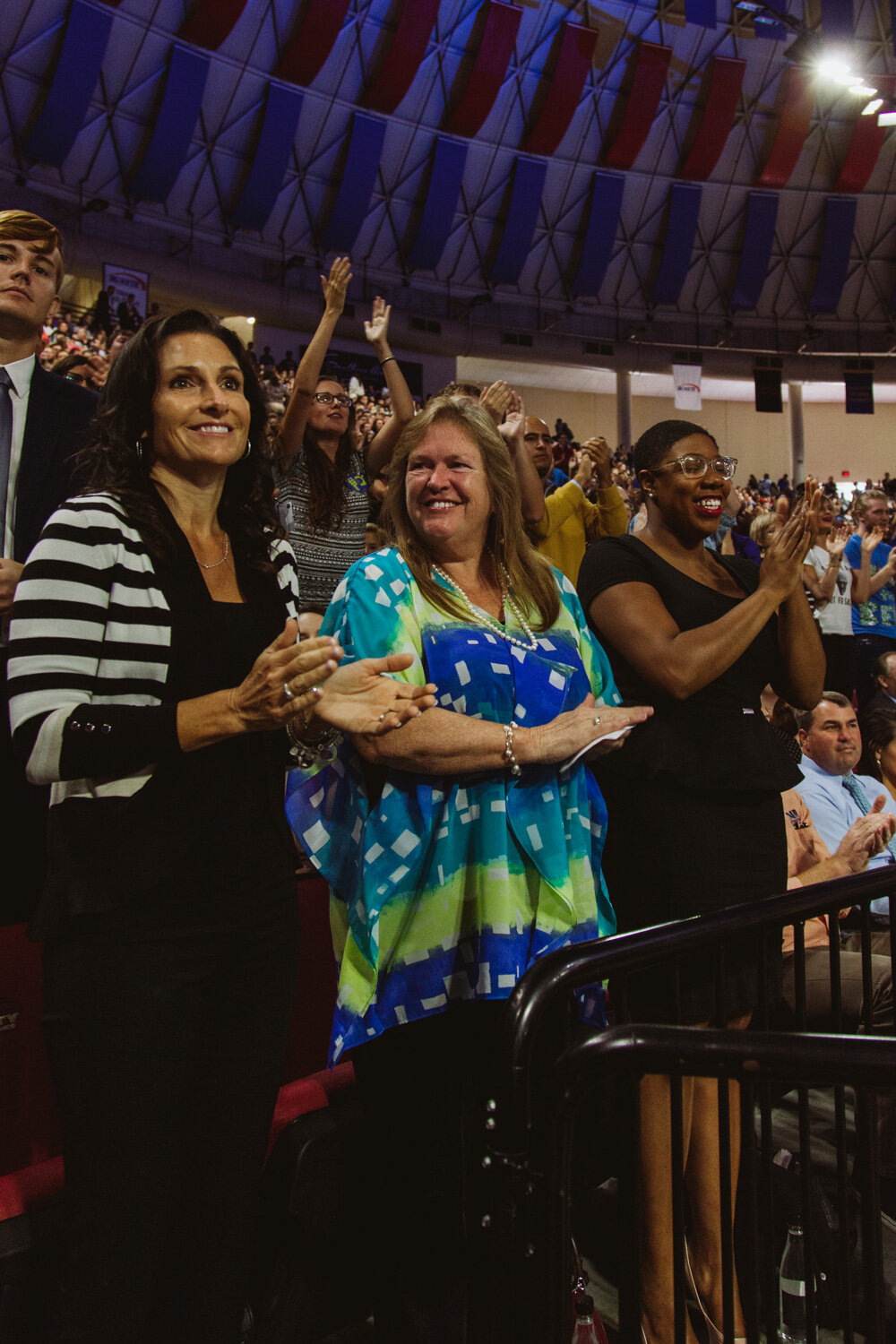
Liberty University students, among others, enter The Vines Center in Lynchburg, Virginia, on September 14, 2015 to hear US Senator Bernie Sanders speak.
“It may be that the human race is not ready for freedom.
The air of Liberty may be too rarefied for us to breathe.”Steven Pressfield, The War of Art

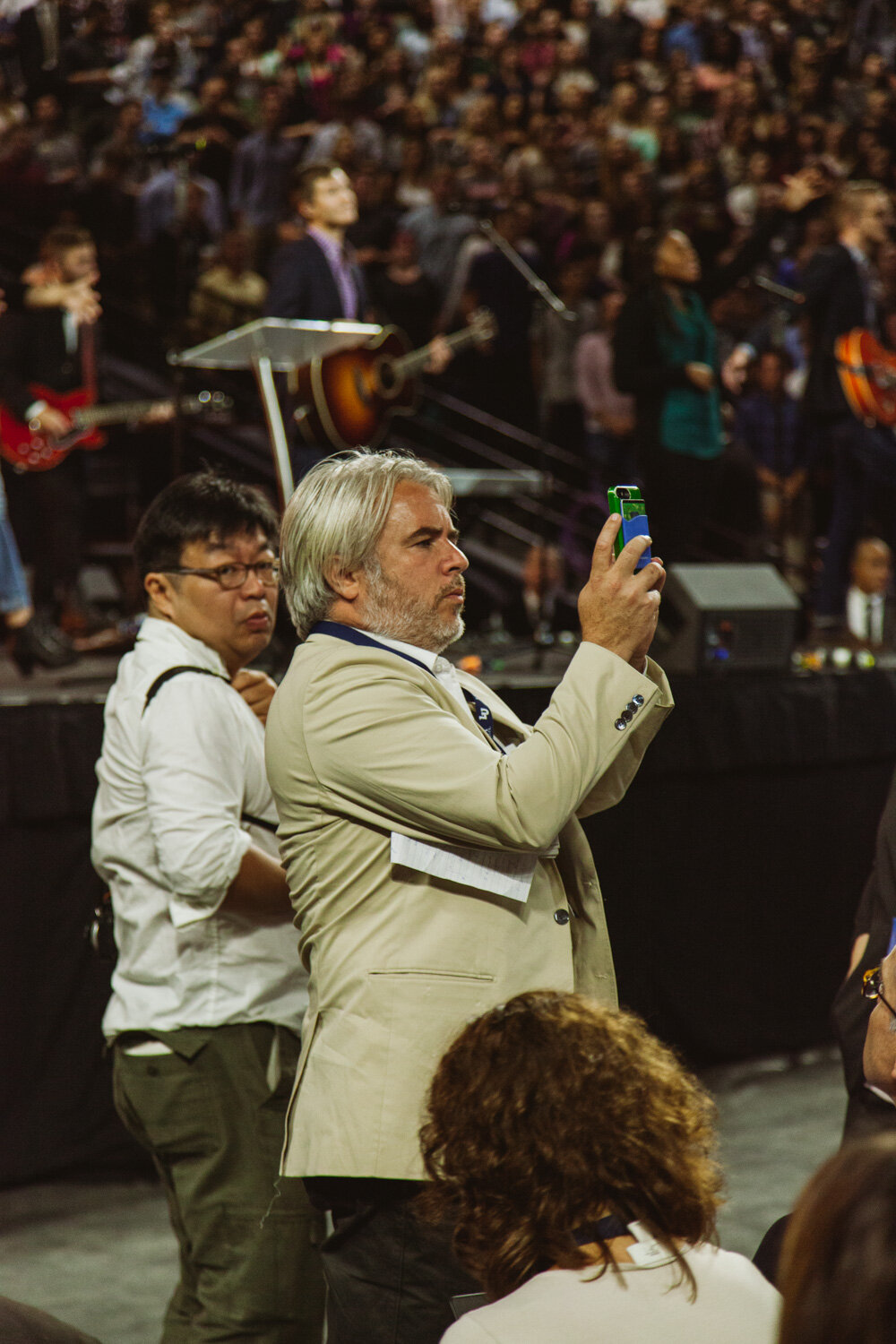
A news reporter gets ready to speak into the camera with the swelling in the background.

The scene at Liberty University on September 14, 2015, was a familiar one, as was the creeping feeling of overwhelming inauthenticity, likely stemming from the fact that 10 years ago I sat in those same seats three times per week attending what the university ardently claims is not a worship service, listening to people preach and sing about God. Every so often a political speaker would come through, but one could (so to speak) lower the volume on what was being said and not miss a thing. It was always the same.
That same feeling persisted while I worked as a copywriter and editor for the school’s propaganda department in 2010. It only alleviated itself once I finally left the position (and my seat in my graduate English classes 18 months later), and stepped away from 25 years of living within the Evangelical Christian community.




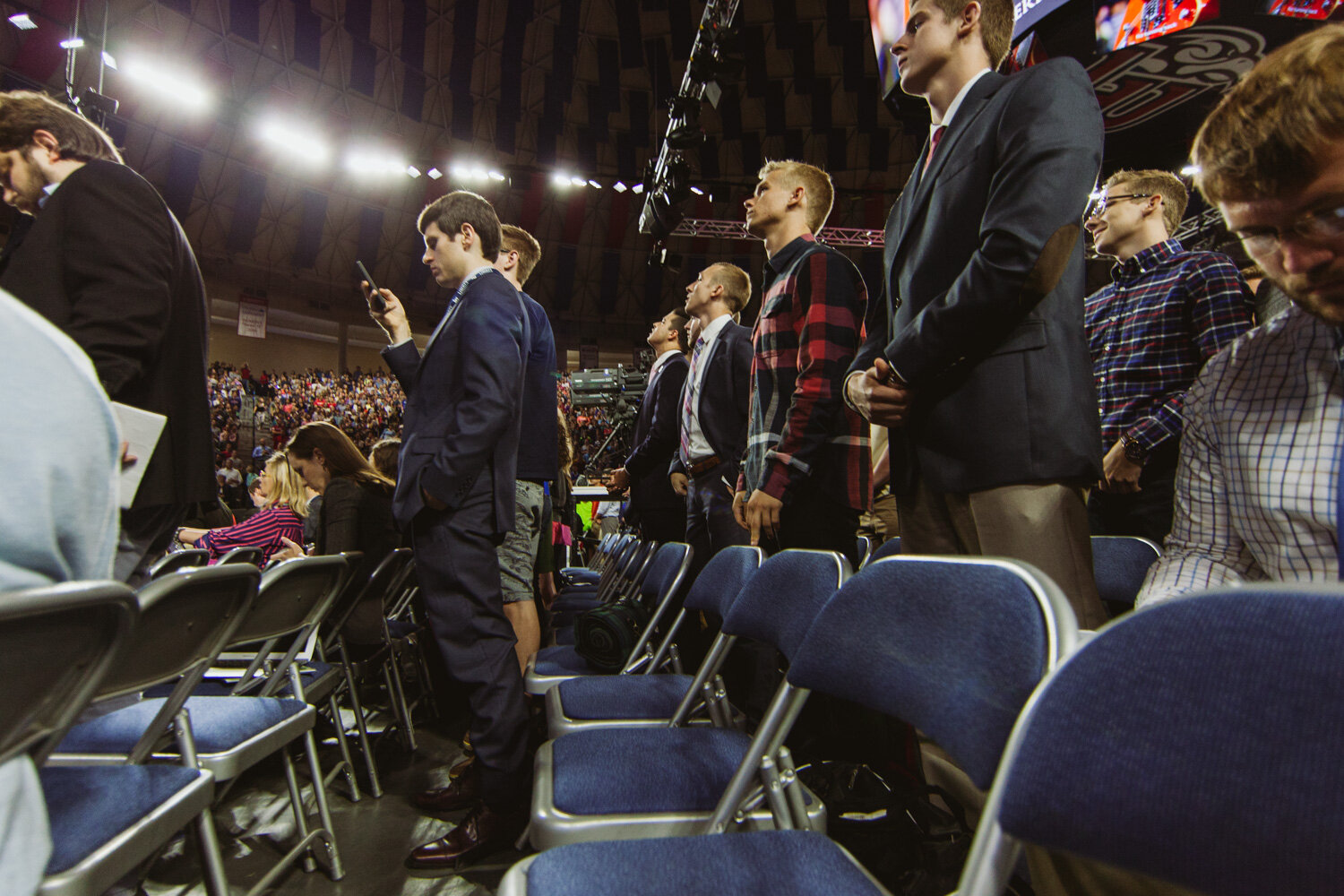
On this particular morning, I let the feeling pass over me while Liberty University Senior Vice President for Spiritual Development David Nasser prayed into the microphone, to be heard by millions:
“I pray that today, Father, that you would teach us, God, that you would use our guest today to help us know not just what to think but how to think.”
Before the guest, Vermont Senator Bernie Sanders, could rise to the podium, Nasser delivered an enthusiastic update on how a student in financial need was given $7,000 in excess of what was required for her to stay in school. She in turn decided to give the surplus to other students in need.
Another report: Students, thousands more than were expected, showed interest in a new outreach campaign to the point that the website kept crashing.
“It is by far the largest single response we’ve had like that as a student body,” Nasser said, “and I think it just goes to show that nobody is a greater servant than a Liberty University student.” It was the first of two wildly hyperbolic sentiments Nasser would utter — well aligned with my overall LU experience.

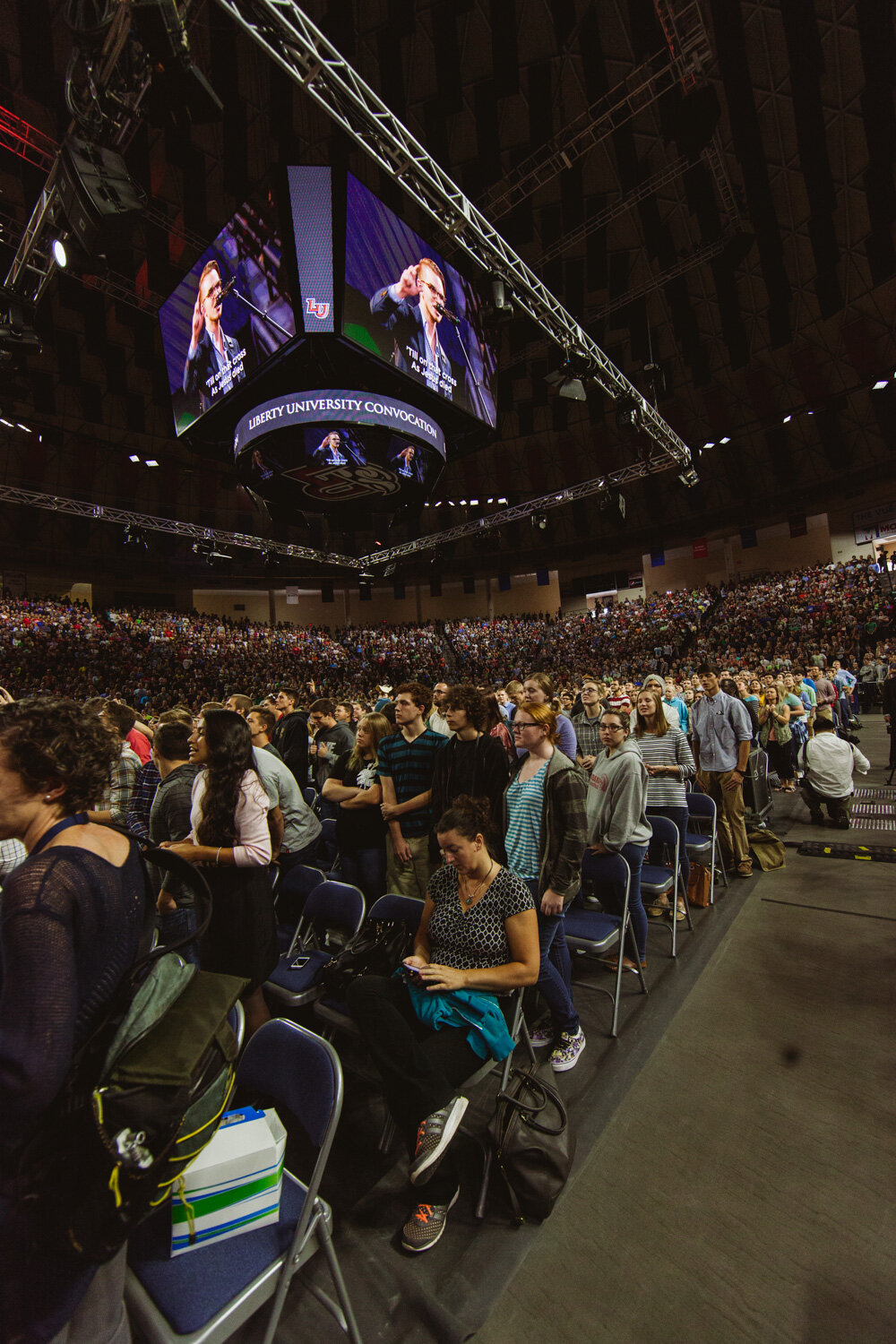
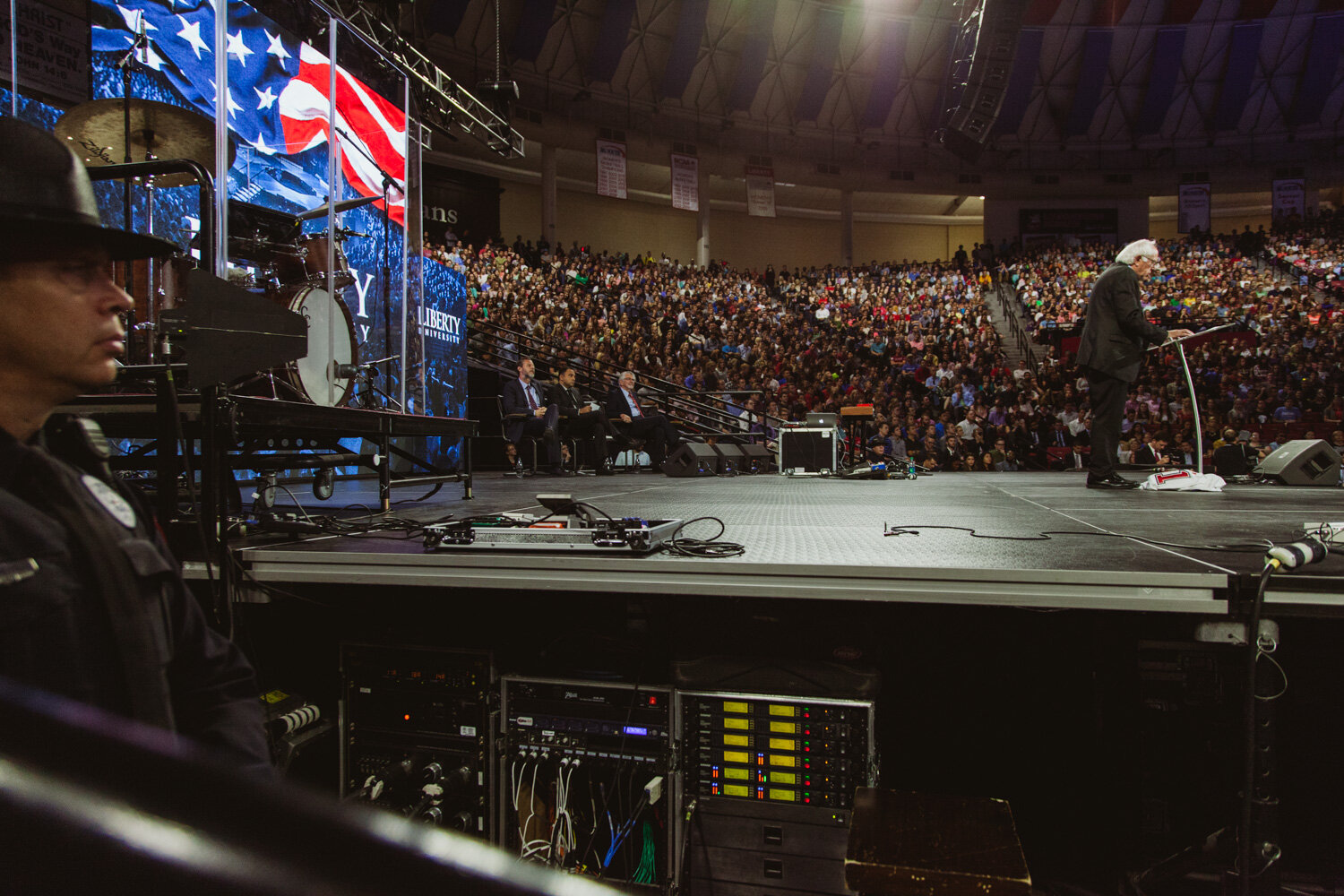
As if to serve as a reminder to those in attendance and viewing around the world of the particular socio-intellectual climate they were entering into, the praise band performed “This I Believe (The Creed).” Rather than an artful expression of worship of an all-powerful, all-encompassing deity, the song is a listing of the basic tenets of Christianity set to the emotionally saccharine soundscapes usually found during the tender moments of a summer romance flick — built by major and minor chords carefully tied to the heartstrings they're intend to pull.

Liberty University praise band performs “This I Believe (The Creed).”
Following the incantation, Nasser returned to the microphone to introduce Liberty University President Jerry Falwell, son of Liberty’s founder, the late Jerry Falwell Sr. — a man infamous for blending political consciousness with evangelical conservatism (among other controversies).
“Nobody loves you more, Liberty students, than our president,” Nasser said of the extant Falwell. “No one cares about you, wants the best for you and wants to see you be world-class leaders more than our president.”
Nasser said that students reciprocate that love, and as an illustration explained that the guttural bellow of “JE-RRYYYY” the students would initiate upon his approach to the podium, was a sign of a support, rather than a cacophonous jeer.
This cheerleading rigamarole, the endless qualifying and over-stressing of statements is identical to the form and feel that I experienced as a student and employee. It always seemed intended to ensure that the perception of Liberty, its students, and its administrators is not left up to chance.
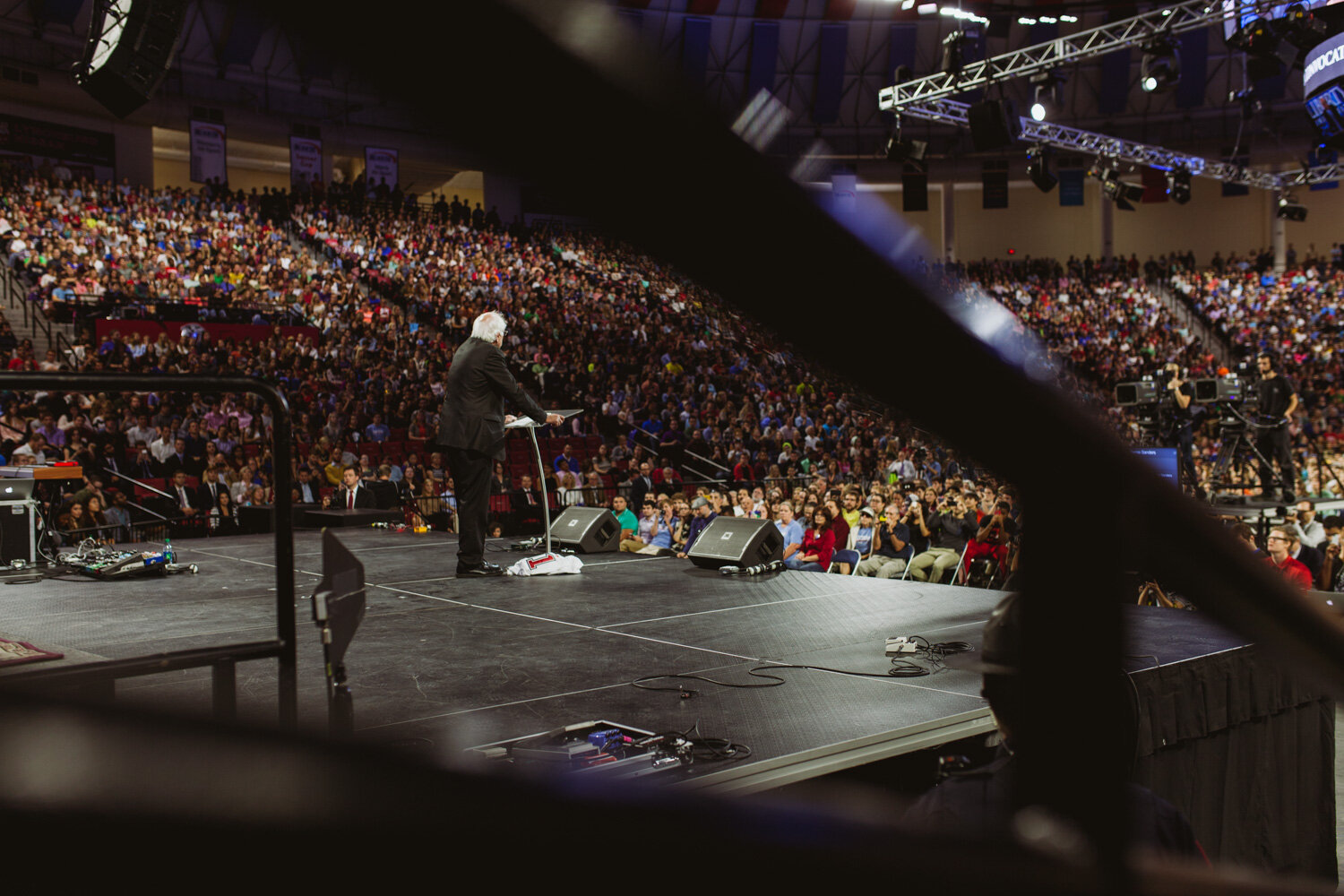
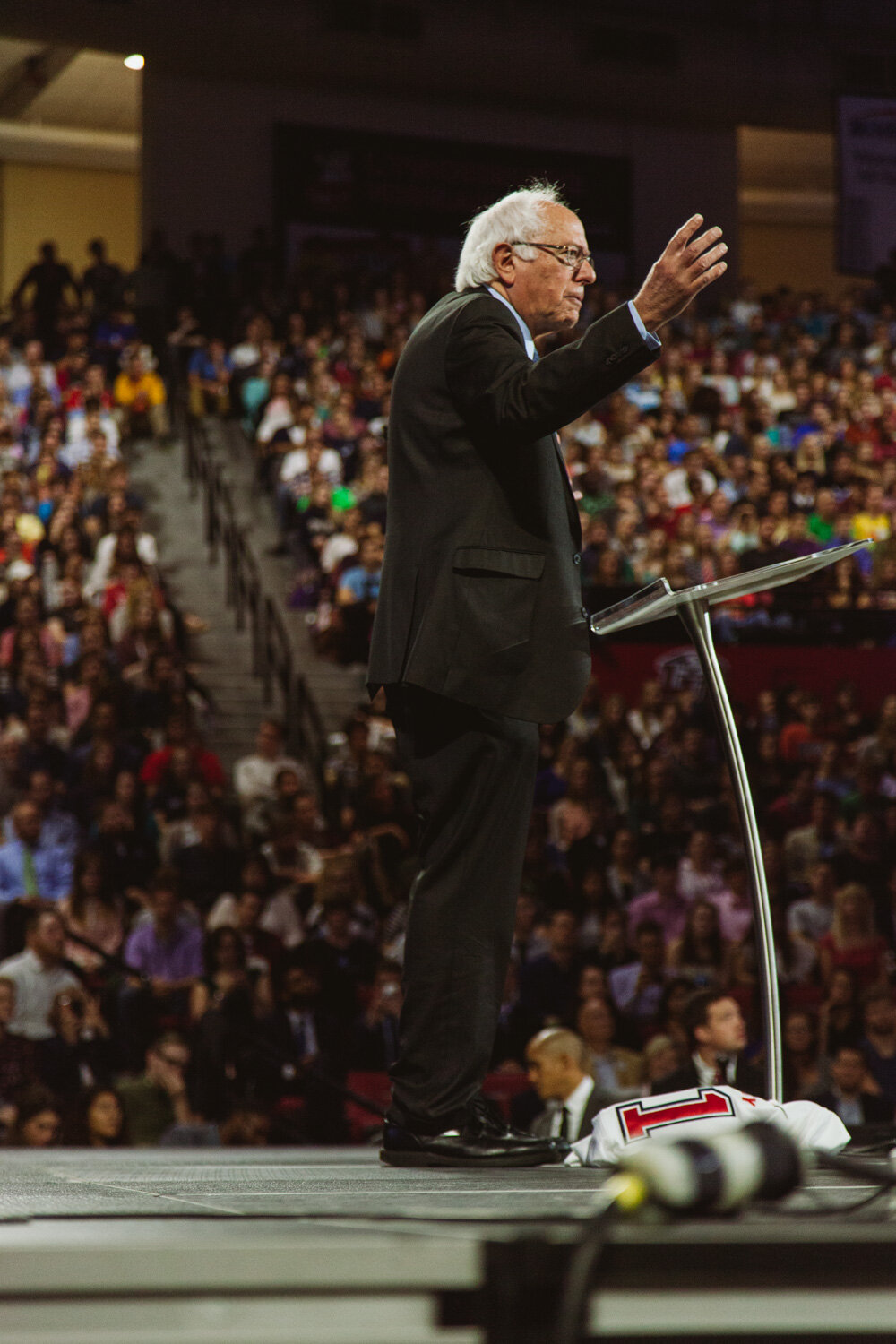
Even Falwell’s gifting of a personalized football jersey to Sanders felt nearly ritualistic; I have witnessed many guest speakers receive memorabilia or honorary degrees over the years and it carried the feeling for me of Liberty trying to “mark” someone for the university’s own edification.
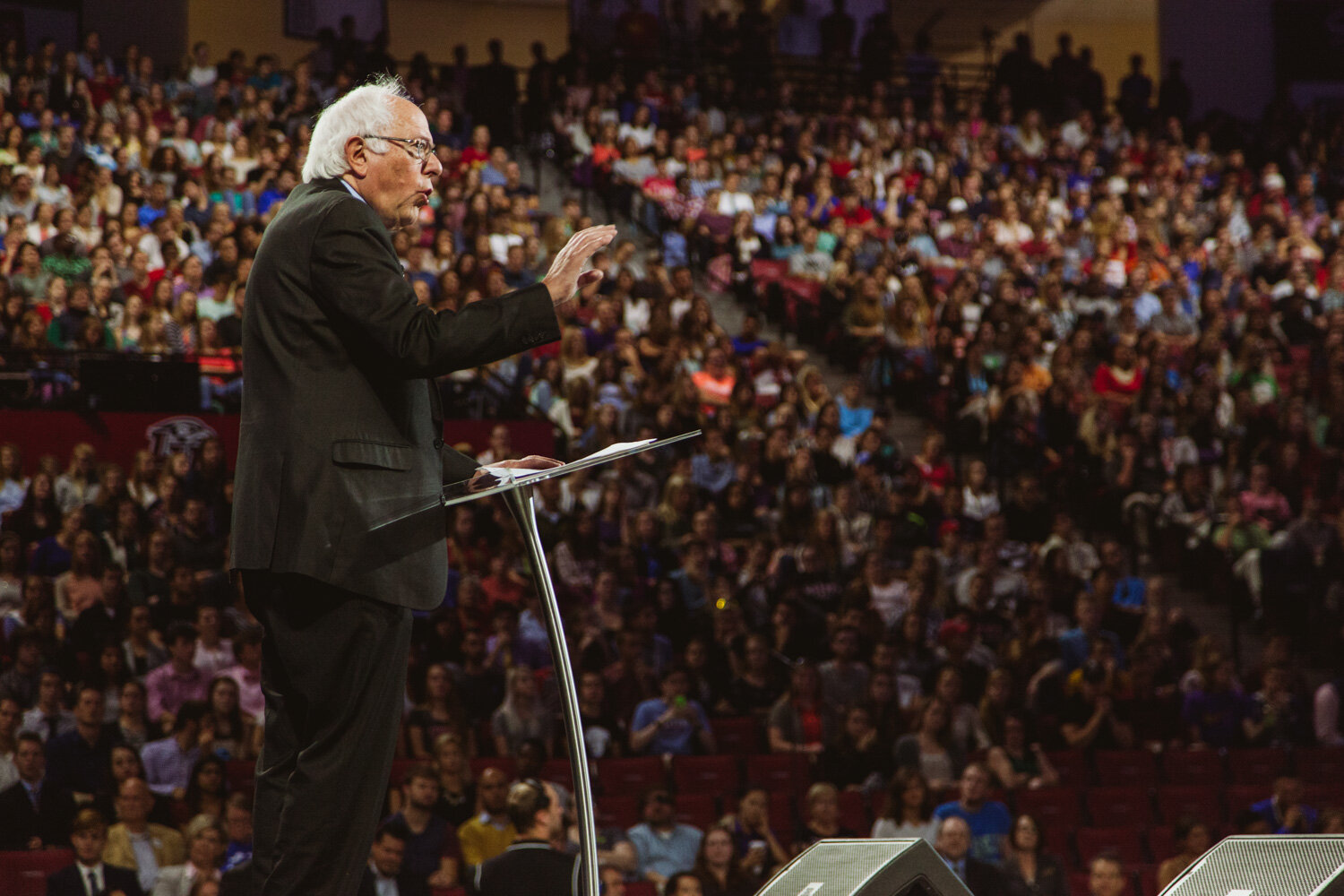
After Liberty had sufficient opportunity to position their cultural niceties and carefully construct their whitewashed house of cards, Sanders began his speech by cutting straight to the quick
“Nobody loves you more, Liberty students, than our president. No one cares about you, wants the best for you and wants to see you be world-class leaders more than our president.”
“[L]et me start off by acknowledging what I think all of you already know. And that is the views that many here at Liberty University have and I [have], on a number of important issues, are very, very different.”
A fair amount cheered in support of those beliefs: gender equality, the right for a woman to control her own body, LGBTQIA+ rights, and gay marriage. Some of the voices belonged to students. As it was during my time as a student, many on campus are not as conservative as the administration’s statements to the press imply.

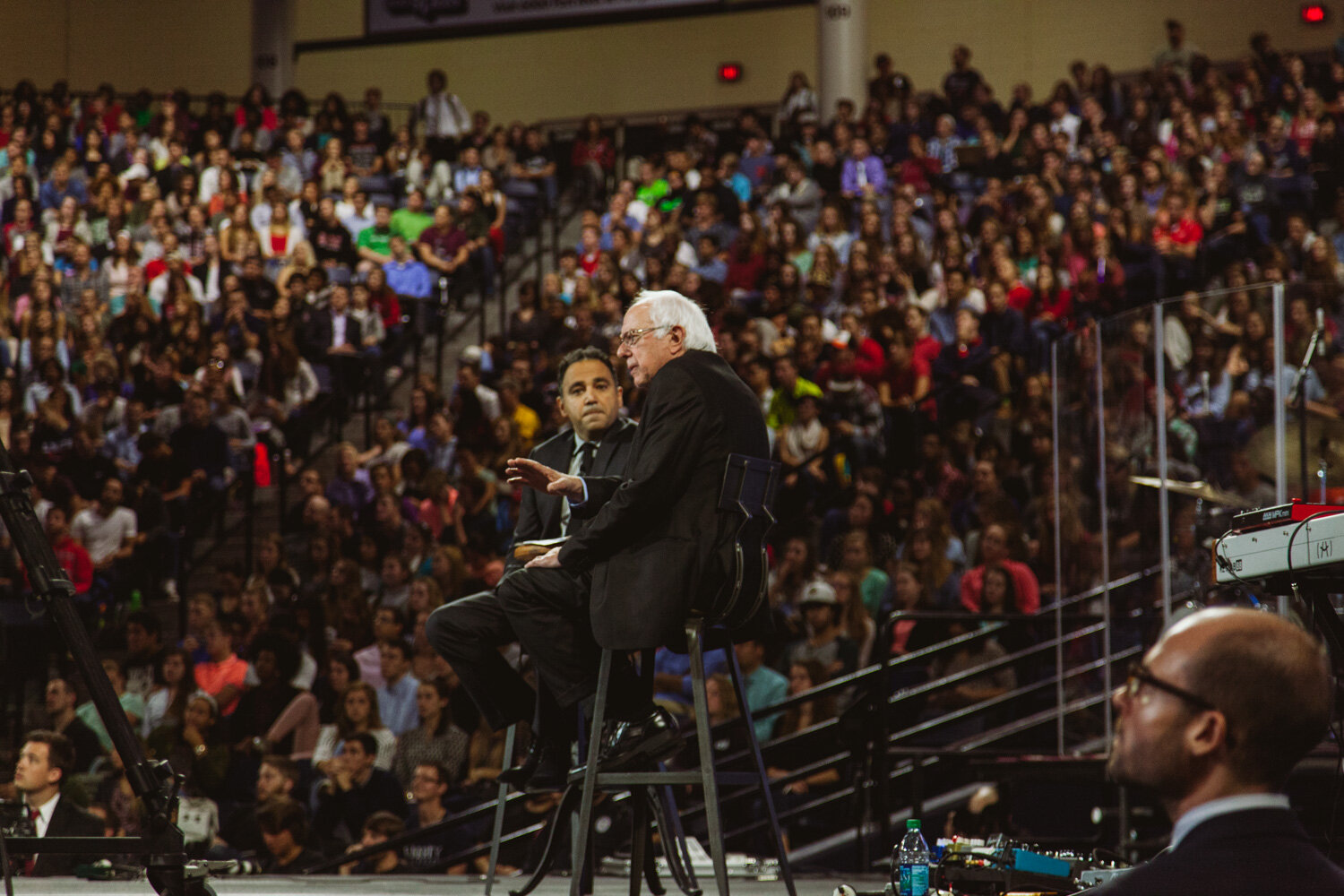
Liberty University Senior Vice President for Spiritual Development David Nasser addresses the audience. Liberty University President Jerry Falwell Jr. and US Senator Bernie Sanders sit in the background.
“But I came here today,” Sanders said, “because I believe from the bottom of my heart that it is vitally important for those of us who hold different views to be able to engage in a civil discourse.”
In case you missed it, you can watch and read that discourse in entirety here. I won’t analyze or recount much of what he said in this piece, as that has been done in dozens of other places in the days since he came to speak.
What’s most interesting to me about this event is the interaction between these two forces: Evangelical conservatism and self-spun socialism. A clean Protestant comb-over and the wily white wisps of an irreligious Jew. My past haunts and my present leanings. The fundamentalist and the humanist.
In the evening after the engagement, my co-parent was at a local bookstore preparing for the next day of her teaching job, and I asked her pick me up a copy of Steven Pressfield’s creative manifesto, The War of Art. One section of the book, called “Resistance and Fundamentalism” does an excellent job comparing these forces.
“The artist and the fundamentalist both confront the same issue,” Pressfield writes, “the mystery of their existence as individuals. Each asks the same questions: Who am I? Why am I here? What is the meaning of life?”
So, there is common ground here. Sanders positions that commonality with a different, yet related, question: “What does it mean to live a moral life?” How does one govern morally?
“The difference is that while one looks forward, hoping to create a better world, the other looks backward, seeking to return to a purer world from which he and all have fallen.”
Steven Pressfield
The War of Art
That common ground falls away, however, at the precise moment each party seeks their reply. The fundamentalist, says Pressfield (an authority on ancient Greek civilization, the author of The Legend of Bagger Vance, and a self-described Christian), attempts to find an answer in sacred texts written thousands of years ago, in the context of a society far removed from our own, and attempts to apply those old responses to today’s complex cultural landscape.
“The difference is that while one looks forward, hoping to create a better world, the other looks backward, seeking to return to a purer world from which he and all have fallen,” Pressfield says.
The artist (or humanist — the author uses the two terms interchangeably in this section) seeks to find that answer in the here and now:
“The humanist believes that humankind, as individuals, is called upon to co-create the world with God. This is why he values human life so highly. In his view, things do progress, life does evolve; each individual has value, at least potentially, in advancing the cause.”
The latter approach, is a far greater challenge, but is more in line with the demands of a global society that faces ever-the-more complicated trials and questions.
Reducing the presidential election to two issues (gay marriage and abortion), then, as Christian fundamentalists have stereotypically done, is far more understandable given Pressfield’s distinctions. It’s just so much easier. It requires less thinking and deliberating. There's effort and uncertainty involved.
The fundamentalist doesn’t have to weigh the pros and cons of carrying a fetus to full term when it’s diagnosed with skeletal dysplasia. The fundamentalist doesn’t have to dive into the alleged moral ambiguity of a person who has felt like a stranger in their own body, only to feel whole through modern science’s ability to allow her to affirm the gender she (or he or they) has identified with all along. To the fundamentalist, the answer is clear. The baby will be born (and, in some cases, summarily die). A man is a man and a woman is a woman. Thinking anything outside of that makes you wrong: a murderer, a freak, a pervert, a sinner — lost.
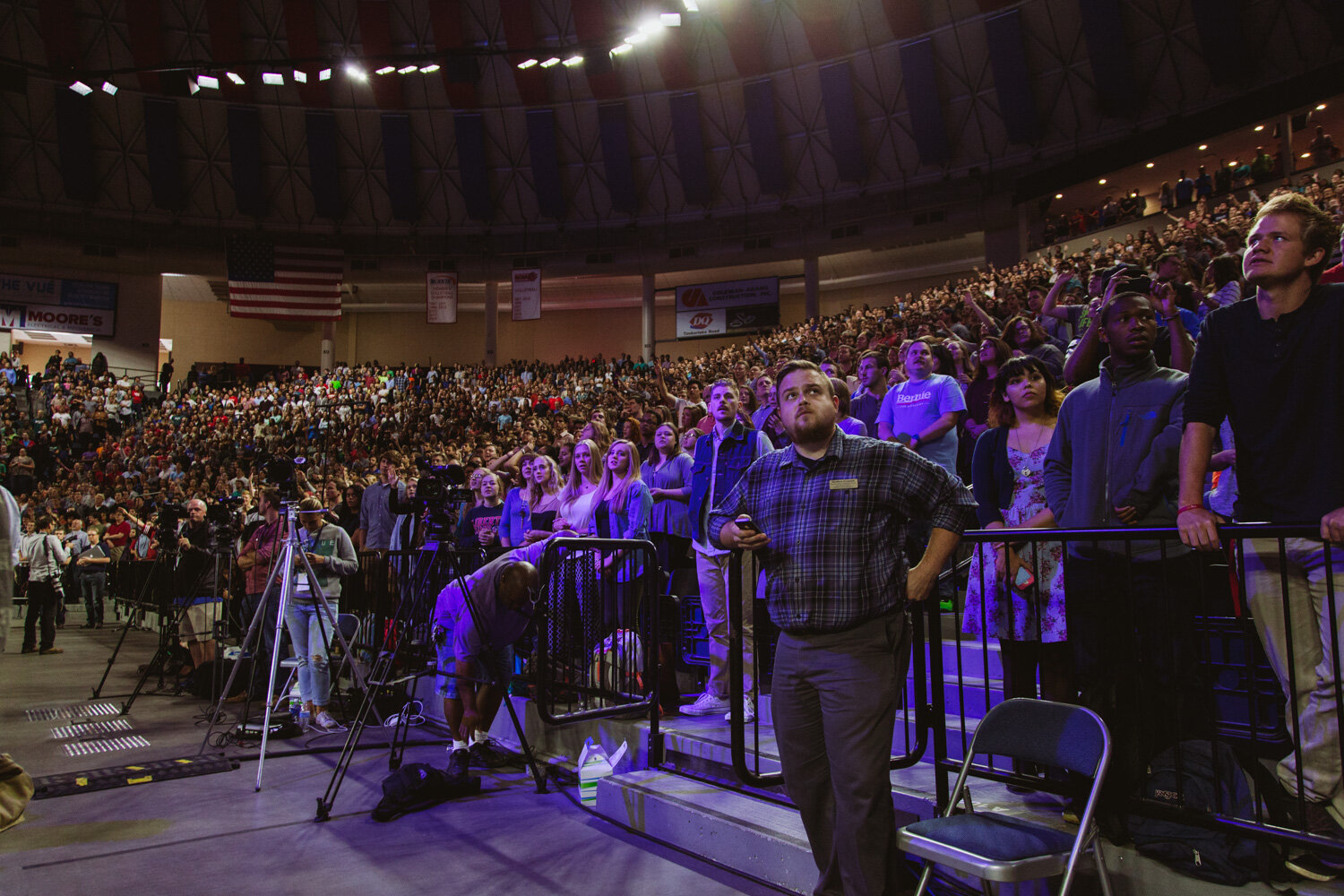
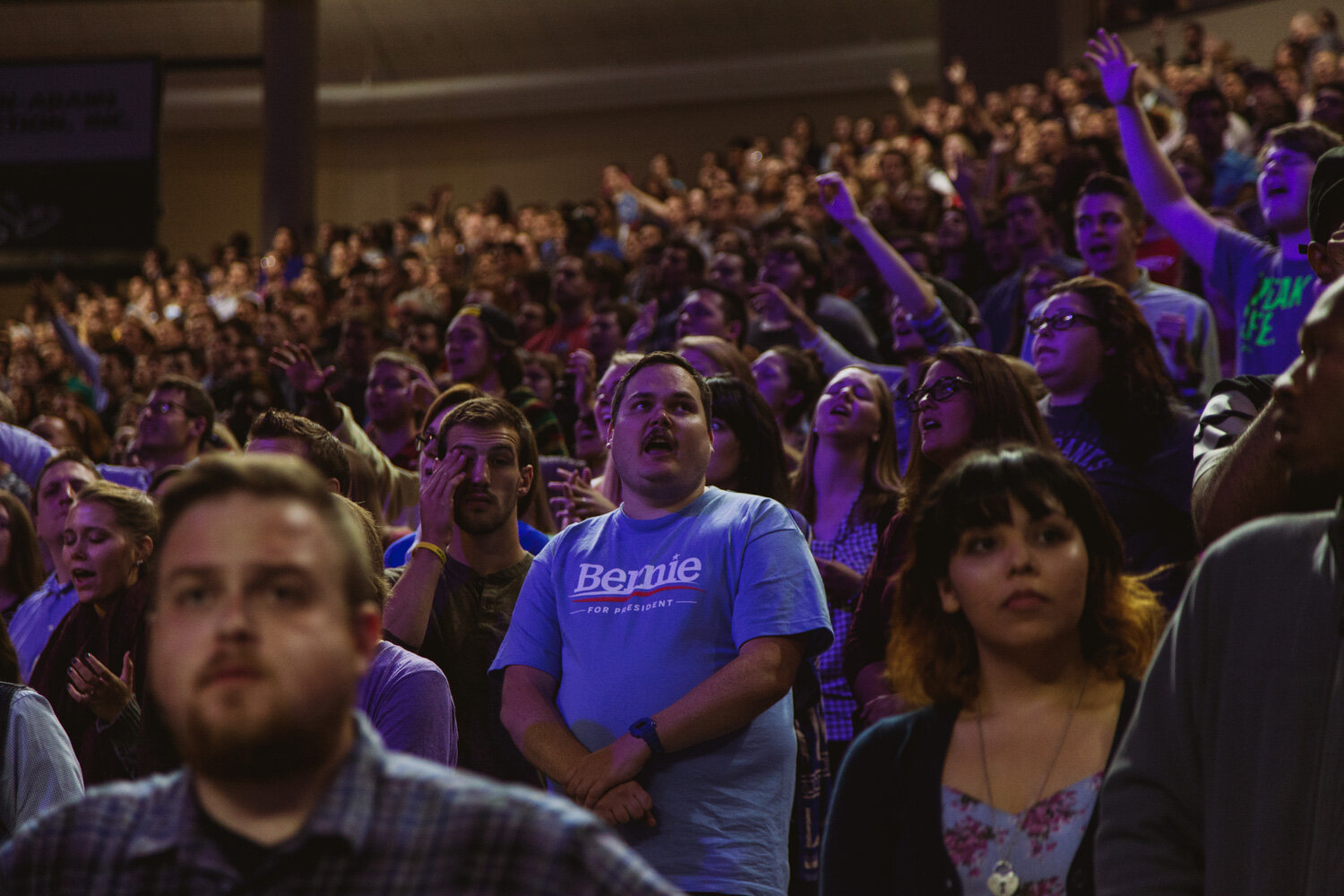


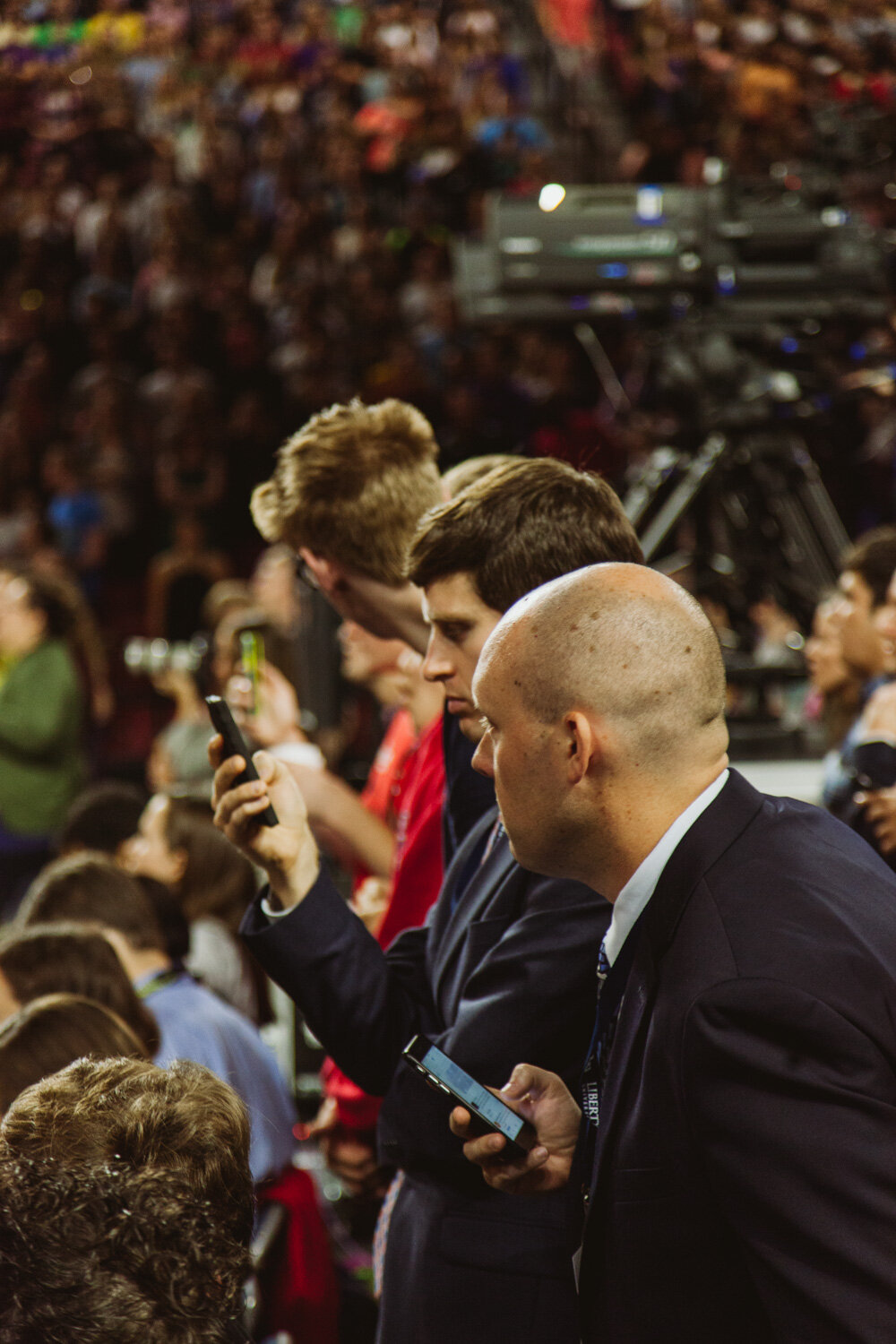
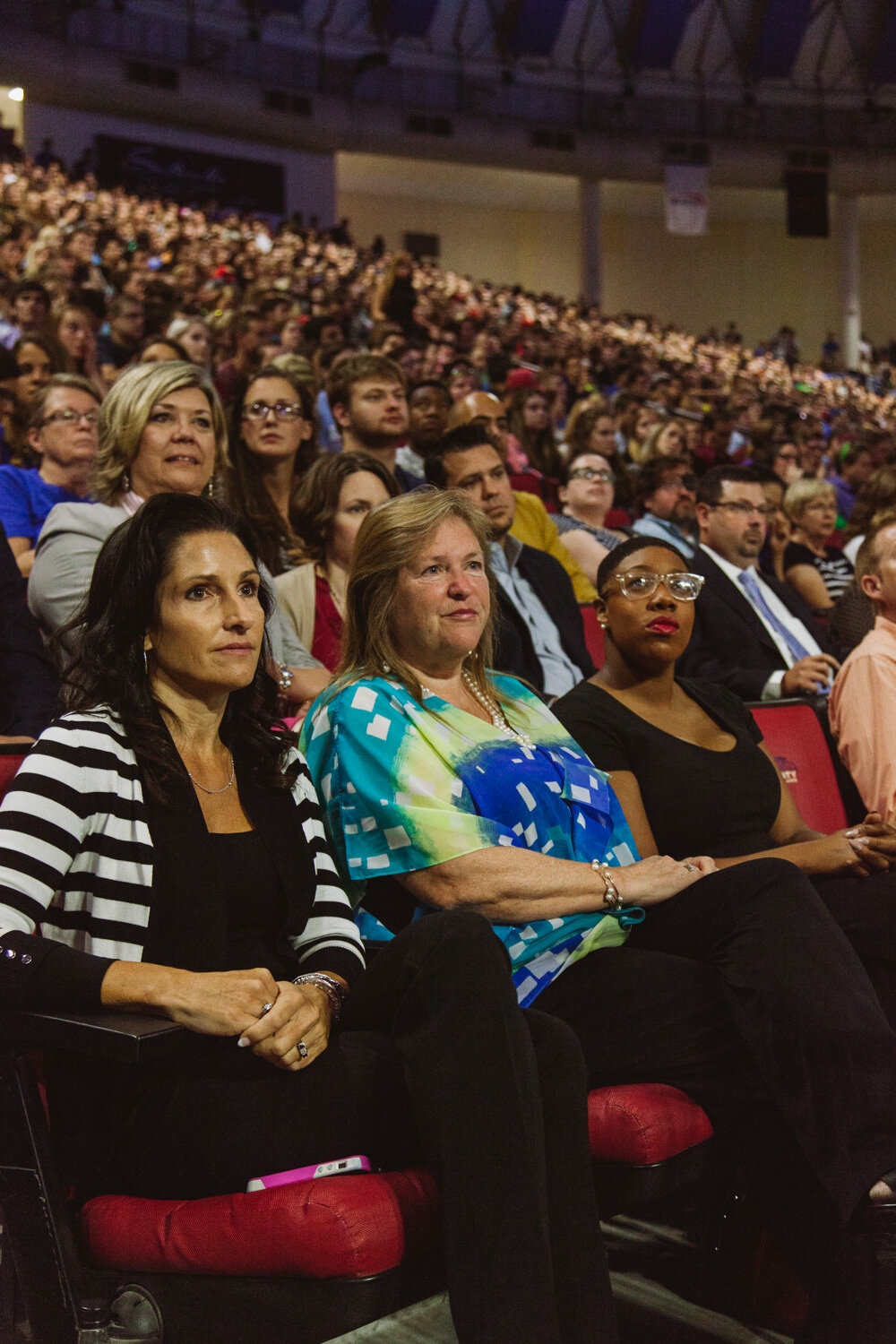
The fundamentalists can sit quietly in their seats, letting their thoughts drift to a homework assignment or their eyes to smartphone screens during the speech and Q&A, while Sanders postures that the United States is not a just nation. But those same individuals can jump into raucous applause when the campus spiritual leader offers a cute rebuttal about inequality: “It’s not a skin issue, but a sin issue.” (Note: A clever turn-of-phrase does not an absolute truth make.)
But there is hope. I spoke with a Liberty University resident assistant who said she cheered for the right for a woman to have control over her own body (although a guy from behind offered her a consequential “fuck you”).
I spoke with a few others who said that you no longer get reprimanded, fined and expelled for being gay at LU, as you would have in the past. And for further sense being made, I encourage you to hear the words of an evangelical pastor (and fellow alumnus) who equated Sander’s plea at Liberty to John the Baptist decrying the Pharisees.







What I’m getting at is that hope is out there, however rarefied. And I think it’s the duty of those who see it to keep that candle burning, if not tip it to the person sitting next to you to light another, and another, letting the wax spill over your hands and Levi’s.
Even though I may seem somewhat positioned against Liberty and its administrative body (arguably with good reason), my frustration really comes from a place where I know people can be better or, rather, must be better if we are going to keep this beautiful thing called human life spinning for another few thousand years or so.
My preference is to not be ashamed of the fact that my undergraduate degree is from Liberty University, a place not exactly synonymous with intellectual integrity and compassion for those who are different.
My preference, as it was on that day, is for positive change to take me by surprise.
At Liberty, the cultural climate seems to have improved from the time my supervisors tasked me with editing less-than-favorable information from the school’s Wikipedia page (I declined), but there’s a long way yet to go. I hope to be able, as I was on that day, to take an electric blue and pink polka dot bicycle ride across town (like a one-person queer pride parade) to witness it happening.
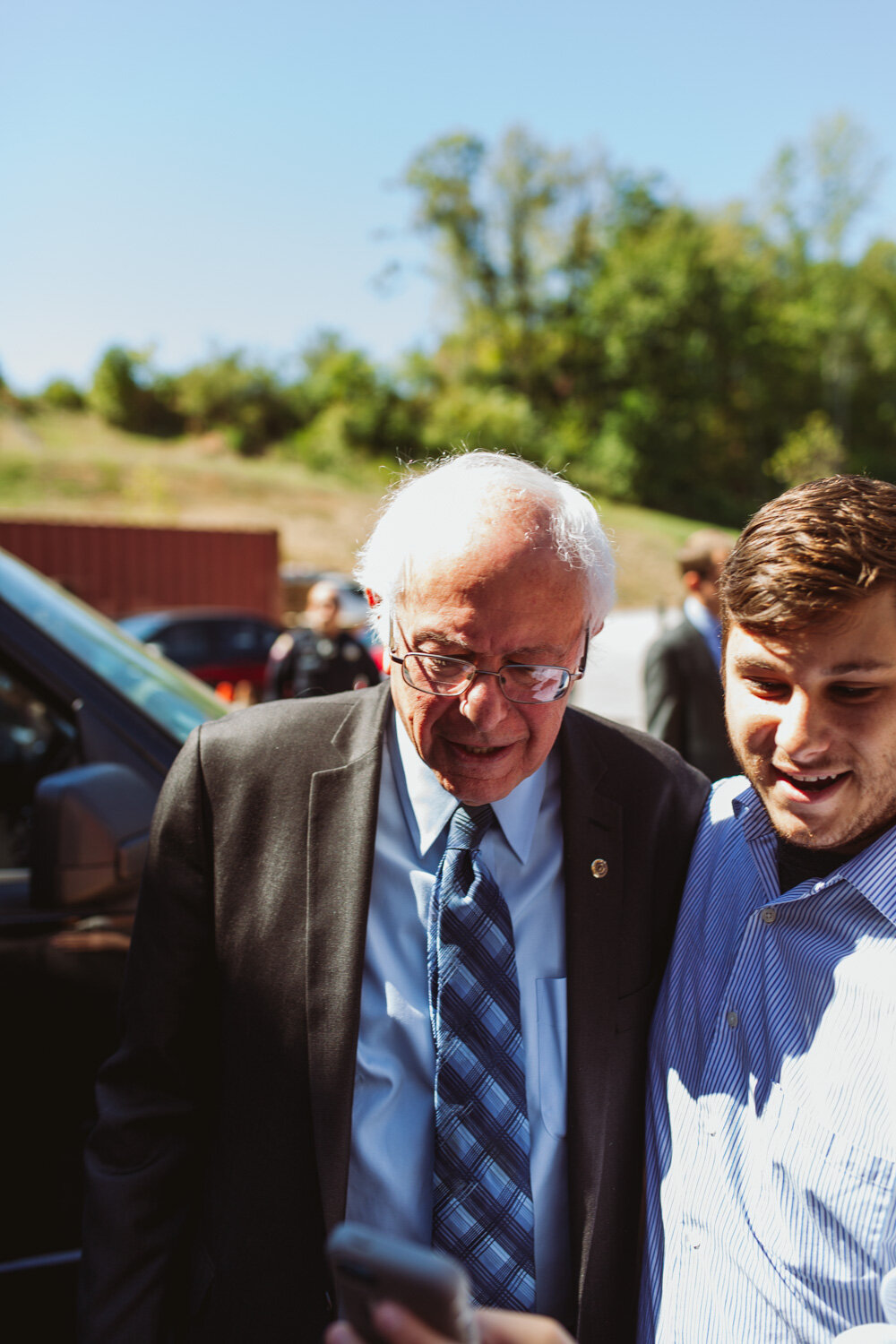
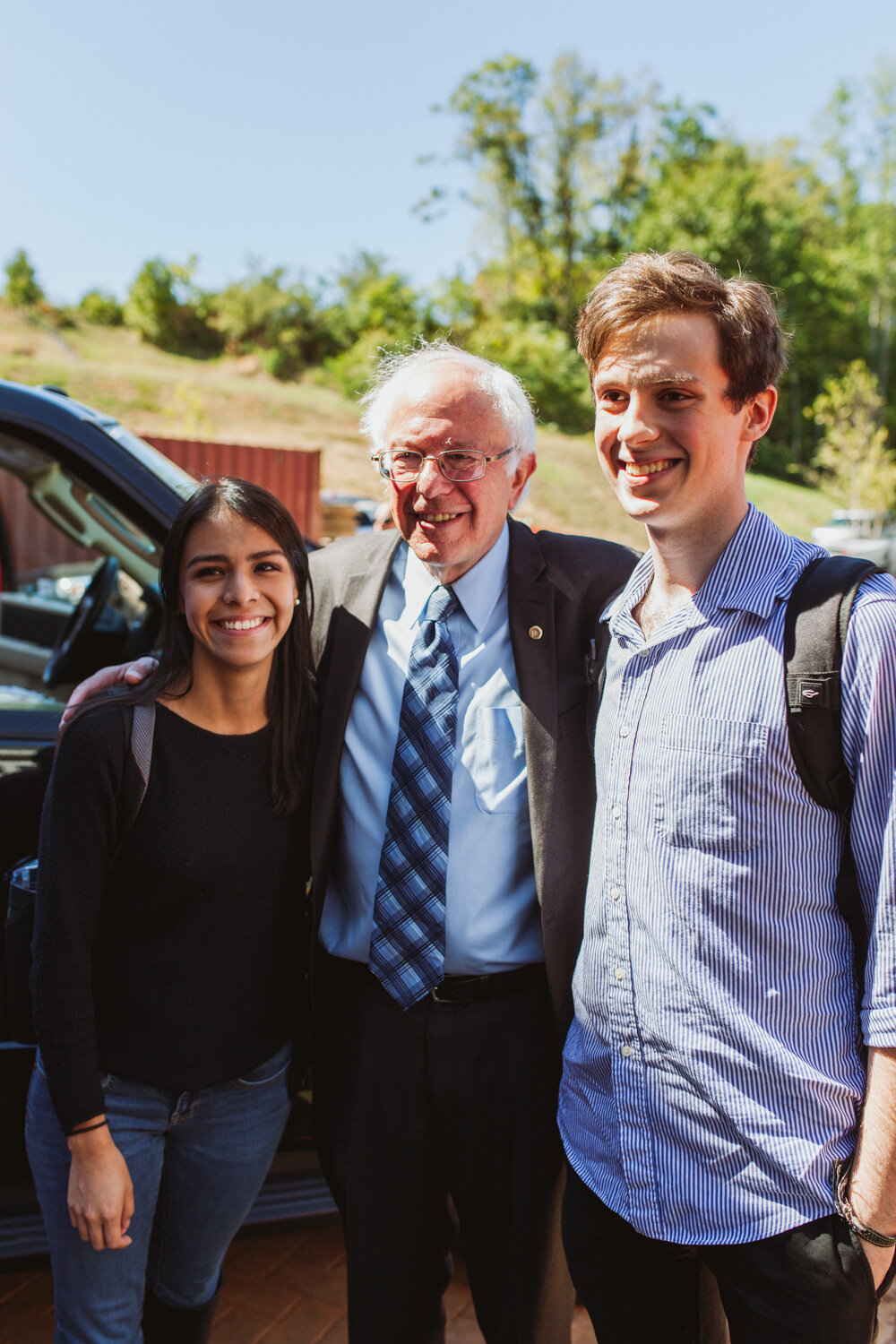
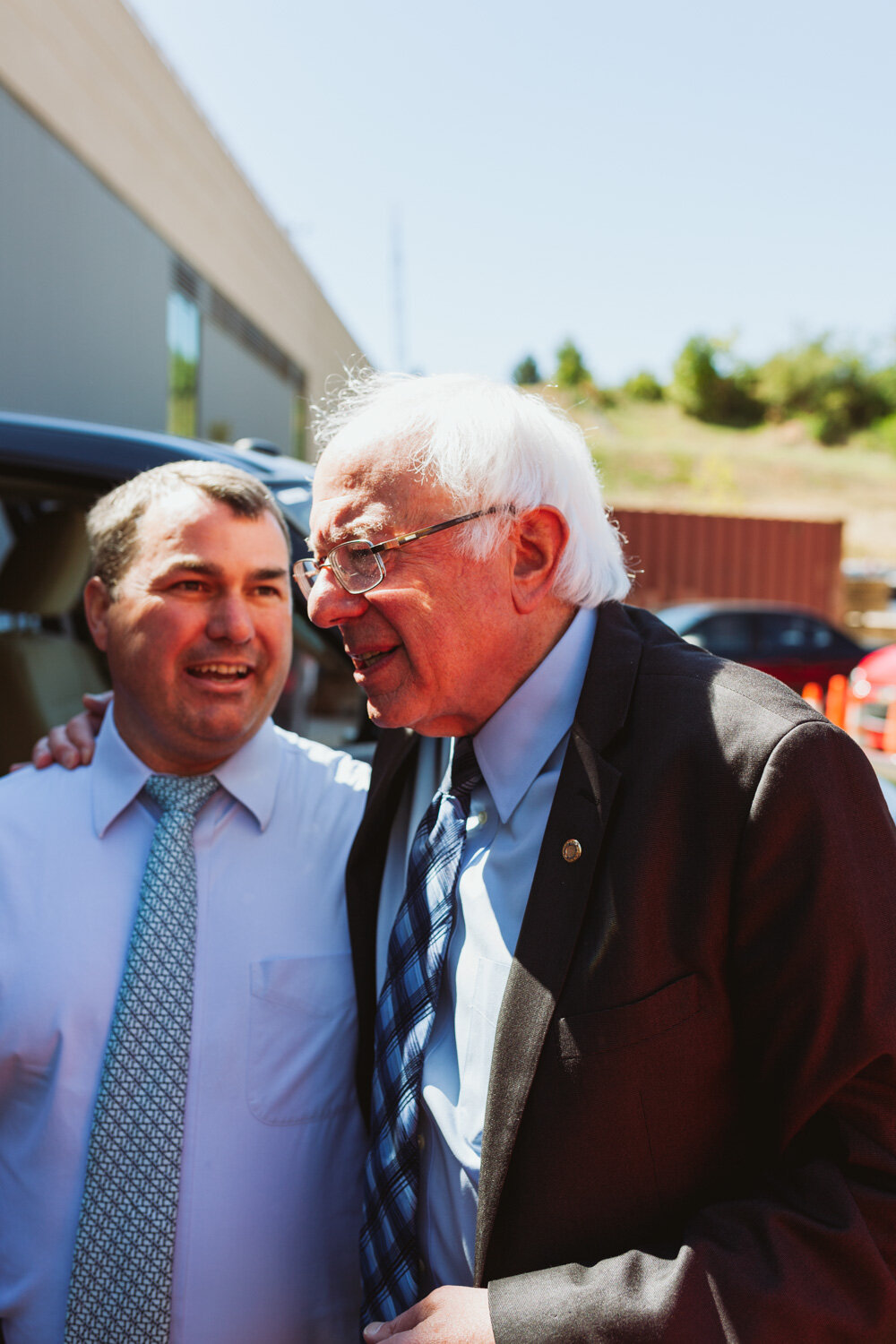
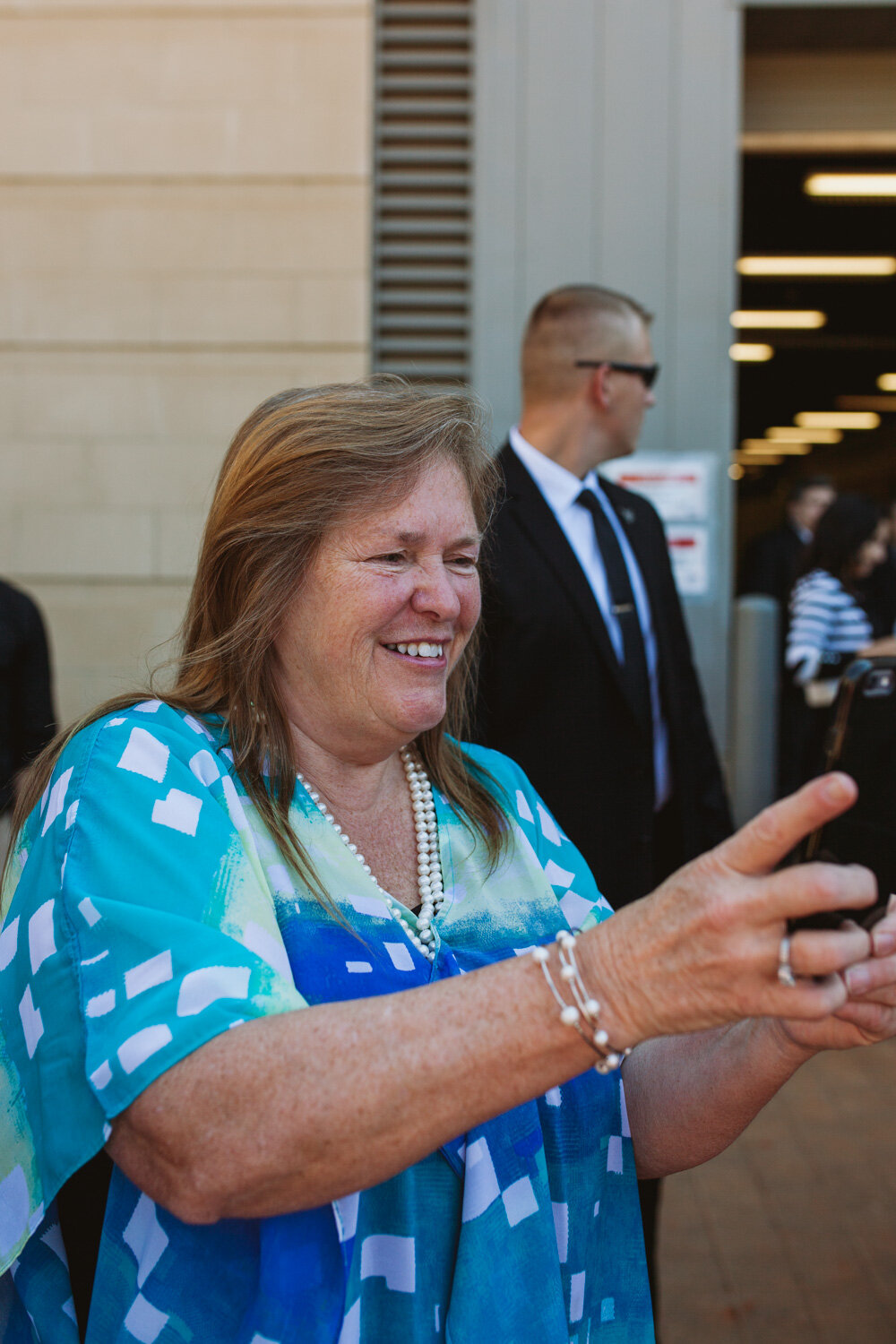
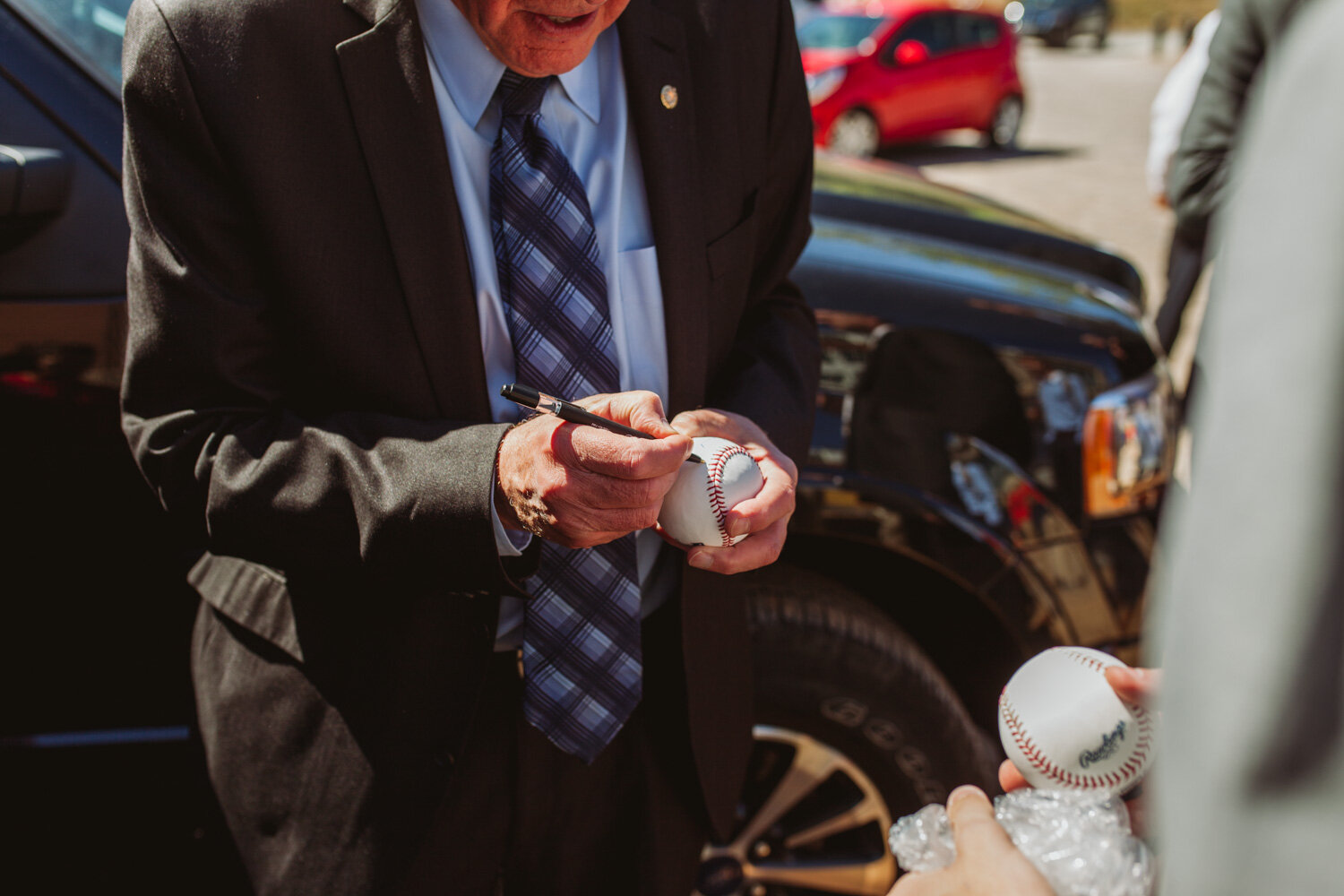
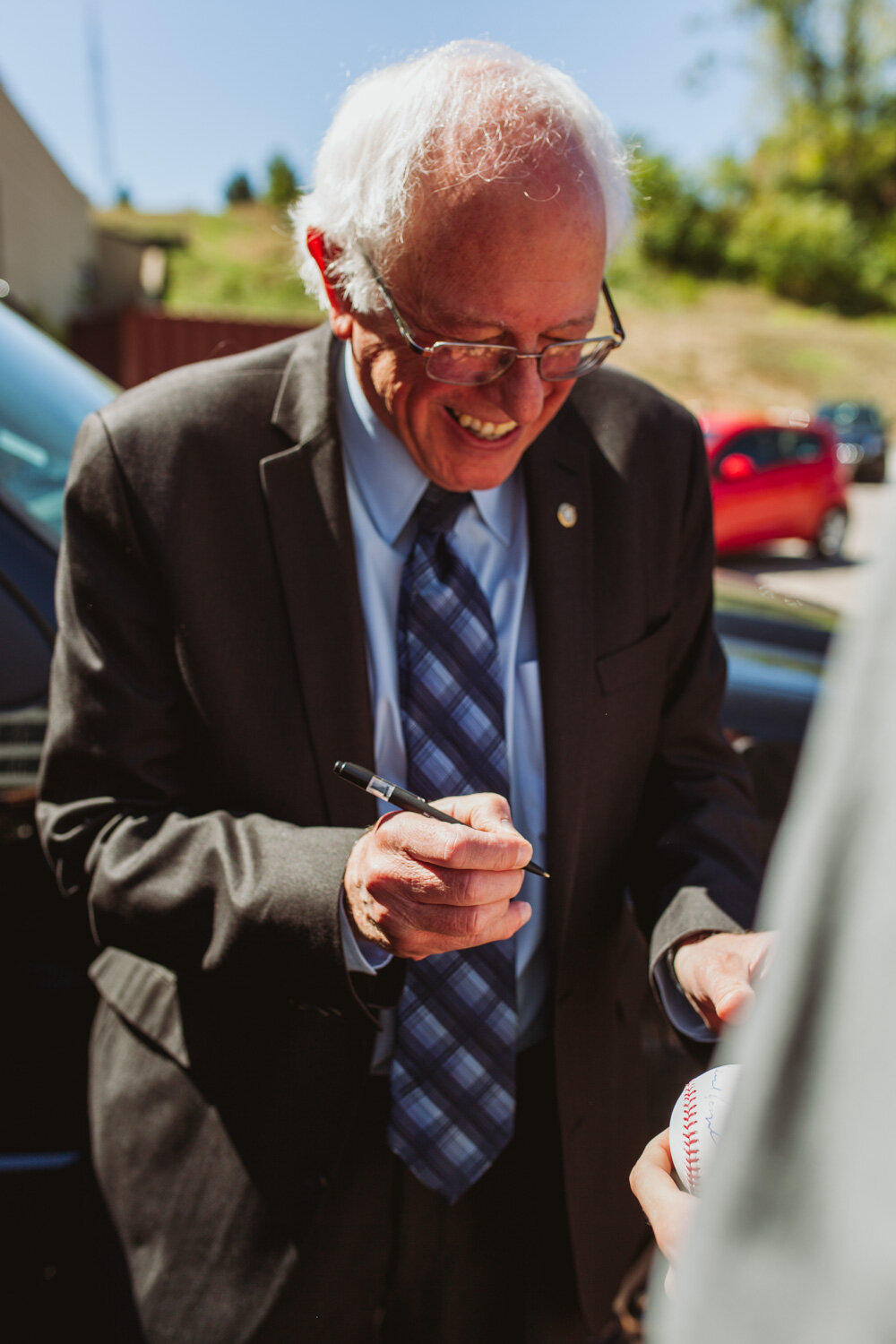



Once the service was over, I ran into a couple of friends who are currently enrolled. Their energy at hearing Sanders speak was electric, encouraged and invigorated. They told me to follow them around back of the building so we could possibly meet him.
And so I did.
He graciously exited the SUV when he saw us, and said he had enough time to take a few photos. When it came my turn to say hi, I handed my DSLR to a friend and told him how to shoot (but neglected to give instructions on the focus, as you can see below).
I had never met a U.S. senator before, much less a presidential hopeful, and so I was grateful for the opportunity and wanted to say something meaningful. What I wanted to tell him was that in my 12 years of voter eligibility, I’d always cast my ballot in favor for who seemed like the lesser of the two evils. This election could be different. There’s a candidate who I believe actually represents me and the America I was raised to believe could be possible.

OOPS: Forgot to tell my friend how to focus my DSLR for this shot of US Senator Bernie Sanders and myself.
But I couldn’t get any of that out. Instead, I shook his hand, smiled for the camera and said, “Thanks for not being full of shit.”
He laughed, and looked into the camera. I’m pretty sure he knew what I meant.
Thoughts? Questions? Frustrations? Let’s talk about it (below).

You can Help Connect the World (with art)
From the desk (and heart) of @marceloasherQ
Although I’d love to go through the joyful process of focusing on an individually-crafted message for each of the people in my life, both the feasibility of such an effort and the time sensitive nature of what I have to say require that I reach out with the quickness.
Given the breadth of life I have lived so far, you might know me as a student, musician, parent of three daughters, high school literature teacher (in Argentina and in Virginia), writer, yoga practitioner, newspaper designer, web developer, content marketer, editor, journalist, outdoors enthusiast, traveler, photographer, filmmaker, insurance sales person, poet, pizza slinger … or one of many other roles I have stepped into over the years.
But I’m coming to you now fulfilling a task that’s at once something I’ve never quite tried before and a culmination of everything I’ve ever been: a director, cinematographer, and producer of an ongoing cultural exchange documentary series that seeks to uncover global connections through music and film.
As an introvert, reaching out in such a public way is not my norm (I’m growing). Being super vocal about my own projects can sometimes feel too narcissistic for me to do, but I feel that this project is so far beyond “me” that I’m unusually inspired to share it with you, hoping that perhaps you’ll seize the opportunity to be a part of it as well.
Someone I deeply respect recently told me that “art” projects (like this) are much more difficult to crowdfund than goods or causes. I insist, however, that Street Muse is all three — a film you can purchase, a humanitarian effort you can support, and an artistic project you can experience and enjoy.
This series began in 2012, when my dear friend and incredible musician (and excellent human) Nate “Gull” Rappole traveled with a small film crew to Kenya to perform his unique music and to interact with the local culture. After more than a month in Africa and many hours of editing, the hour-long Street Muse Kenya documentary came to be.
Film still: Meryl O’Connor
Over the past year, Nate, myself, and a few others have put in countless hours trying to ensure that the message of Street Muse does neither goes unnoticed nor ends with Kenya. We want to bring this project to as many nations as we can — not to impose any western (or personal) ideals on other people, but rather to connect with and showcase human culture as it is. You can help make this happen.
Ultimately, the underlying message of this series is for everyone — not just music music and travel enthusiasts. Street Muse is here to show that as humans, we are one people, and that cultural exchange is one way that we can choose to wage peace.
Yes, differences between us do exist, but my experience and belief is that through investigating and unpacking those differences, we inevitably find significant points of connection that far overshadow perceived details that make us believe we are “separate” from one another.
And in a socio-polticidal climate that is plagued by countless lines of division, this is my way of helping to foster peaceful, collaborative unity among all peoples.
While you can learn additional details from the Kickstarter campaign, I’ll leave some key points here:
We plan to explore Laos, Thailand, and Vietnam to learn how ecology influences the types of instruments and sounds humans make
The Street Muse Kenya team raised $10K in Kickstarter in 2012, but wound up spending more than twice that on overall production costs
We need to raise $25,000 by February 19 in order to reach our mark and receive any funding — it’s all or nothing
As of this writing, we’ve only recently broken the $6,640 mark
There’s less than one week left of the campaign
We have a long way to go, but you can help shorten that distance by getting involved. Whether it’s with $1, $1,000 (our largest pledge to date), or sharing to your social networks — every bit counts and is greatly appreciated.
Street Muse allows us (all of us) to bridge cultural gaps through music, and is a unique way to gain insight from personal connections and exchange.
We are currently screening Street Muse Kenya in Virginia, but would love to bring it to other cities over the next few days and weeks. Reach out to me if you like what you see and can help facilitate (in whatever way) a screening/Q&A/music performance night near you.
~Let’s continue this conversation together ~
Peace and love,
Marcelo Asher Quarantotto


New articles, new insights, but more to come {in brief}
For my second piece in Lynchburg Business magazine, I was assigned to speak with local building juggernaut, English Construction (PDF). It's becoming a trend, it seems, that I'm on the construction beat. My third (PDF) was about an mammoth renovation going on in what was formerly the most advanced textile research facility in the country.
I'm a couple months in on my adventure of non-traditional employment. I do supplement my workload with shifts at my favorite bar/pizzeria and by doing some page design for newspapers in the region, but I have yet to regret my decision to leave my full-time job this past July.
There is definite struggle, though — it's what I signed up for. As compared to months (years, even) past, living feels much more full over these past few months. I'm doing more of what I enjoy. I'm more active (read: losing cubicle fat) and spend more time with my kids. And opportunities are opening up like never before.
So I might be tightening my belt from the combined effect of being more active and not being able to afford as much food, but I'm living for myself and my loved ones, and not under the thumb of any employer that maintains that they have any right to dictate the way I look, speak, dress and think.
—@MARCELOASHERQ

Once upon a time, I interviewed (The) Facebook cofounder Chris Hugues
When I started pursuing writing back in 2005, I knew almost nothing about journalism, and what was then called The Facebook was brand new (and available exclusively) to college students. We had no idea how the social media platform would come to define our generation.
I thought it was pretty cool and I wanted to write about it for my practicum writing for Liberty University's student newspaper, the Liberty Champion, so I sent an email to The Facebook, which eventuated in some back-and-forth with cofounder Chris Hughes. I'm still trying to locate the PDF of that issue of the paper (it seems I've found every single one I either appeared in or designed except this one), but want to share with you what I wrote then, despite how it reveals how much of a novice I was.
Below is the unedited draft of what was published in the 2005 spring semester.
~~~~~~~~~~~~~~~~~~~~~~~~~~~~~~
Get Poked
by,
Marcelo A. Quarantotto Jr.
LIFE! Reporter
Liberty Champion
As of April 2005, LibertyUniversity has been overtaken by one word: Facebook. The Facebook is an internet-based networking phenomenon that has become somewhat of a craze among Liberty’s student body, as well as being utilized by various faculty members.
Back in winter of 2004, the gears in the head of Harvard Student Mark Zuckerberg began to turn as ideas formulated to what The Facebook is today. Zuckerberg, the founder, eventually joined forces with Dustin Moskovitz, officially known as “Destroyer;” Andrew McCollum, called “Lockbox;” and “Pressguy,” Chris Hughes.
Hughes states in an email that the original vision “was a pretty simple concept: to create a universal online database for college students with social-networking functionality.” He explains how Zuckerberg wanted to create an alternative to the standard college yearbook that often leaves students disappointed and/or embarrassed, and instead give students something that they can customize to their own personal predilection.
During The Facebook’s initial release on Wednesday, February 4th, 2004, “it was a project by and for Harvard students,” claims Chris Hughes, “but because over 6,000 Harvard kids signed up within the first three weeks, it seemed ridiculous not to open it up to a few other schools.”
As it stands today, The Facebook has about 832 colleges and universities registered, which includes about 3.6 million students, teachers, alumni and the like. On the website’s “About” page, it describes it as “an online directory that connects people through social networks at colleges.”
What is the future for The Facebook? Chris Hughes claims within the next few months there will be right of use for every college and university in the nation, and that the staff of The Facebook will continue to add “new functionalities and features…improving our users’ overall experience on the site.
The Facebook gives its users the capability to search people in their schools by name, gender, graduating year, interests and many other classifications. There is a multitude of other functions offered such as looking into how certain people are connected to each other and seeing who is enrolled in the same classes.
Junior Christopher Bowman, a Broadcast Video major, expresses his satisfaction with The Facebook. Although he doesn’t spend as much time on the site as he did when he first registered, he still says, “The Facebook is great for keeping in touch with friends over the summer break.”
Another Liberty student, Pastoral Ministries major Jason Drinnen, uses his account for more than just keeping touch with friends. “The Facebook is a bridge for ministry,” he states, “It is good in evangelism for reaching our peers for Christ.”
One comical and good-natured activity found on The Facebook is poking. Poking is a feature added to the website that has no real purpose other than sheer amusement. One student can “poke” another by pressing the link that says “Poke Him!” or, “Poke Her!” under another student’s profile picture. The other user will receive a message later with a picture of a finger that says “You have been Poked,” and will be given the option to “poke back.”
“It’s kinda cool when you get poked and you see the picture of the finger,” says Senior Tim Hawks who is double-majoring in Business and Psychology. “It’s a fun way of interacting with your friends when you don’t see them much….especially when you get in a poking war.”
The Facebook will also give users reminders of when another person’s birthday is. Isabel SoriaGalvarro, a Sophomore Family and Child Development major, told The Champion that mass amounts of people were giving here birthday congratulations, even people that she didn’t know!
The capability to find people with common interests is a very prominent theme of The Facebook. For each college, there is the ability to create groups of any kind, and students can join most groups of their choosing. Communications Faculty member Mr. James Pickering is one of LibertyUniversity’s teachers that frequently uses The Facebook. Mr. Pickering confirms the usefulness of it when he says that it “allows students to communicate who have like interests.”
While Mr. Pickering, and other faculty members, enjoys The Facebook as a worthwhile tool for communication, he shares some concerns for misuse. “Let’s not promote or be proud of the negative parts of our university.” Apparently, there are some groups of questionable ethical content.
So, as a message to the incoming freshman, log-on to www.TheFacebook.com, get connected, start poking and mind your manners.
—
Photo source (altered for visibility).

Article: Function is Beauty — Falling Acorn Timber Framing Company
I first met Kyle Murphy not long before I moved to Buenos Aires. He was a recent transplant to Lynchburg, Va., from Raleigh, N.C. Another editor at my college paper had grown up with his wife, Carolyn, in Maine. I guess Carolyn came to Lynchburg on occasion, but they essentially moved to Lynchburg without knowing a soul.
When I finally moved back to Lynchburg, nearly three years later, I'd run into Kyle and Carolyn on occasion. We'd share anecdotes about our kids or news about our mutual friend.
Last month, I had the opportunity to sit down with Kyle for a freelance article I was to writing for Lynchburg Business Magazine. My preparation for such encounters includes as little preparation as possible. I may have a list of questions to ask, but it isn't often that I find it appropriate to ask all if even half of them. My preference is conversation to interview; the responses I get from the few questions I do ask end up being much more meaningful in these situations.
I approached our encounter not without a hint of butterflies. Kyle and I have known each other for nearly five years, but this was the first actual conversation we would have. The interview opened with my telling him that I would be asking a bunch of questions that might seem redundant or obvious, but for the sake of the interview I was going to pretend that I knew nothing about him. I didn't really have to pretend though. At most social gathering's, we'd tip-toe around one another without a damn thing to say. A lot of whatsups and nodding.
Our interview stretched on for three hours, challenging the batteries in my digital voice recorder. Friends dropped in throughout the conversation, and my playing back the recording revealed more than a few instances where I asked myself: "Why the hell did you say that."
That's to be expected.
Kyle went into great detail about his passion for timber framing, a minimalistic style of carpentry where the builder uses large beams and few tools (almost no power tools). And with everything that was said, there was one mantra that rang out: Do things well so others will do things well too. It sounds almost sacred, and it speaks volumes of what should be at the forefront of the mind during the artistic process. The ultimate goal of the artist, then, should not be one of glory or riches -- the goal of the artist should simply be to create the best art he or she can possibly can, that way others are prompted to do the same. Spending time in Brooklyn last week made me think of this concept again. I was surrounded by millions of people, and for any one of them there is probably another 10,000 trying to achieve the exact same thing. The perpetual result is a massive ball of flesh, stone, glass and steel that's in a constant wrestling match to produce better and better things.
But I digress.
The folks at Prototype Advertising were kind enough to publish the resulting article in the July issue of Lynchburg Business Magazine, and even gave me another assignment for another construction company. Is there such a thing as a "construction beat" in journalism?
The article in its entirety can be read here.
View Kyle's work at www.fallingacorn.com (slated for a rebuild in the near future).
Header imagery from www.fallingacorn.com.